Prediction markets were historically niche but are now gaining mainstream attention and institutional interest. In 2025, global prediction market volume surpassed $44 billion. User participation has also expanded rapidly, with leading platforms reporting exponential growth during major global events such as elections and economic policy shifts. This outlook is supported by Coalition Greenwich, a leading financial services research firm. In their Jan 2026 report, “Prediction Markets: It’s All About the Data,” they found that nearly three-quarters of surveyed market-structure professionals believe prediction-market data will hold significant value for institutional investors.
This growing institutional interest signals a large opportunity for investors looking to build something new in this space. Also, the rapid rise of platforms like Polymarket and Kalshi highlights the real demand for such markets.
For entrepreneurs, this simply means investing in prediction market platform development is no longer a speculative bet but a strategic move into an emerging market category. As adoption rates grow, there will be a perfect opportunity to capture user attention and establish trust before the space becomes saturated.
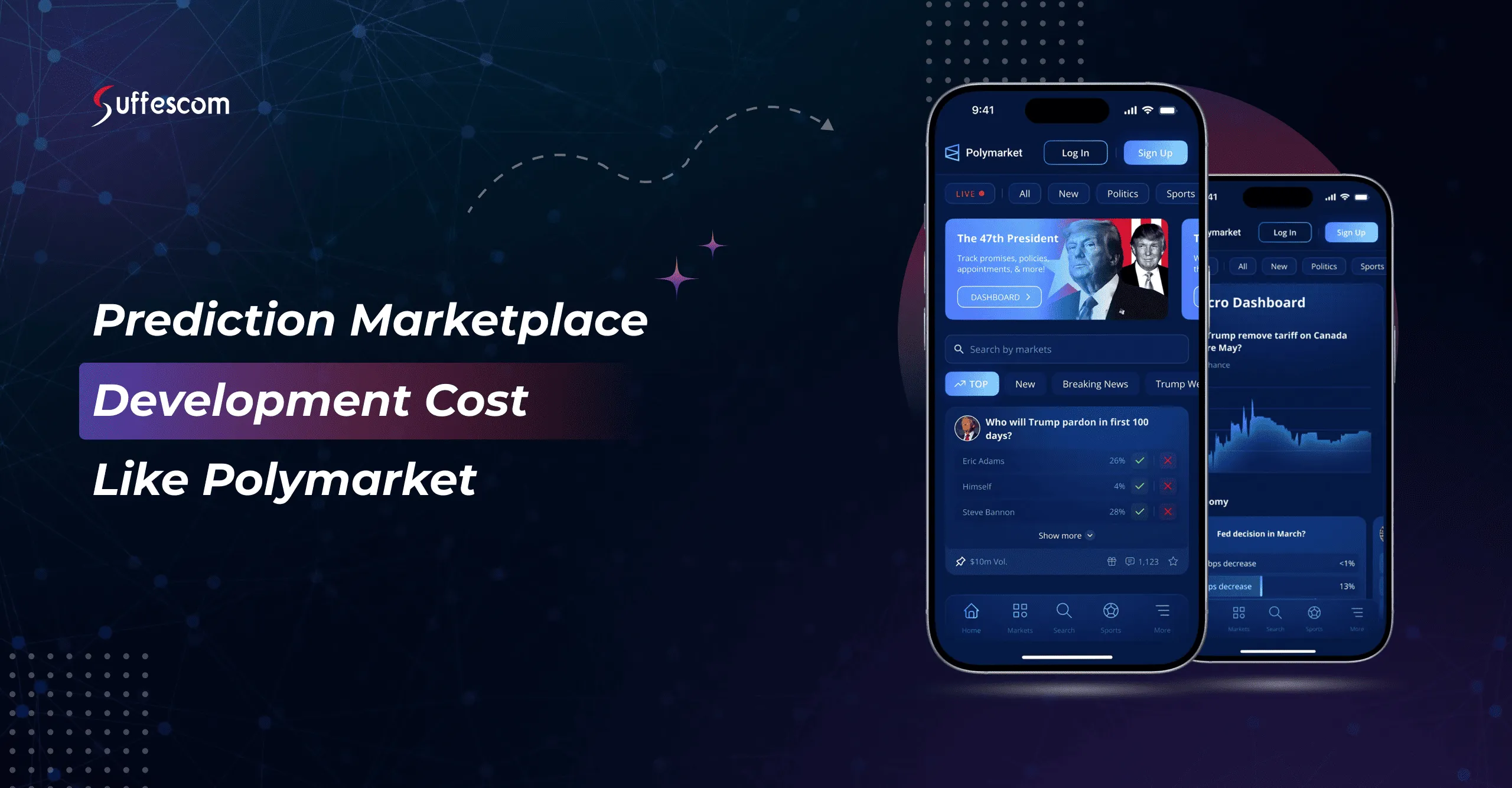
If you are also inspired by Polymarket’s model and want to build a similar platform, this guide will help you understand how to enter the market with a foolproof strategy. This guide will also cover everything from development aspects and build time to investment costs and anything else related to building such platforms. So, read on!
If you’re thinking about building a similar market, the first step is defining your product structure correctly.
Plan Your Prediction Market Idea.
What is a Prediction Marketplace Platform?
A Prediction Marketplace Platform is a system where people buy and sell shares in the outcome of future events. For example, in this type of platform, users can trade contracts based on questions like “Will inflation fall below 5% this year?” or “Will a specific team win a championship?”, with prices reflecting what the collective belief of the crowd is about the likelihood of each outcome.
| Basis of Comparison | Prediction Market Platform | Traditional Forecasting |
| Participants | A large group of users trading | Experts or selected respondents |
| Method | Buying/selling contracts | Surveys, models, or expert judgments |
| Output | Market-based probability | Forecast or estimate |
| Incentive | Financial gain for accuracy | Limited or no direct incentive |
| Updates | Continuously updates prices | Updated periodically |
Most Active Categories on Prediction Market Platforms
If you look at the famous platforms in this space, like Polymarket and Kalshi, the activity there is very uneven. People are not trading everywhere equally or randomly. There are clear patterns in user activity and money flow. Most trading and attention clusters around a few specific types of events that people care about the most. And, they are:
Politics & Elections
This category has the highest volume. It is mainly about US elections, global elections, and policy outcomes. On Polymarket, election markets consistently generate the highest liquidity and user participation, especially during election cycles. During major elections, individual markets have reached hundreds of millions in volume.
Economics and Financial Indicators
The next most common topics people bet on are inflation rates, interest rates, and recession probabilities.
The typical example of this category would be:
“Will the Fed cut rates this quarter?”
Crypto & Web3 Events
Apart from politics and economics, people are highly focused on ETF approvals and regulatory actions, and the main questions revolve around whether Bitcoin will cross $100k by year-end.
Sports
Sports are naturally among the top categories as people are constantly making predictions and placing bets on outcomes such as whether one team will win against another in a match, “Will England win the Ashes?”, and more.
Global Events & Breaking News
Global events and international affairs also attract large, predictable attention and speculation-driven activity on prediction and betting-style market platforms. Take the recent U.S.–Iran escalation, for example, where geopolitical uncertainty around conflict developments and ceasefire outcomes quickly translated into strong market positioning around possible outcomes.
How Does a Prediction Marketplace Like Polymarket Work?
A prediction marketplace operates by letting users trade on the outcomes of future events, where the prices dynamically reflect the collective probability of those outcomes. That’s why they continuously update based on the demand and supply. So, basically, instead of simply betting, users buy and sell outcome shares.
To understand how a prediction marketplace is built, it is important to break it down to understand how it is supposed to function. Let’s understand this in detail:
Market Creation Engine
Since the platform creates a market around a specific, verifiable question, this component must be designed as a structured and rule-driven system rather than a free-form input layer.
From an engineering point of view, the market creation engine is responsible for transforming a human-readable question into a machine-executable market contract.
Here is how this will be executed:
Schema-driven market definition
You will need to create a market using a strict schema (most probably JSON) that includes fields like
- Question
- Outcomes
- Resolution source
- Start time
- End time
- Settlement logic
With this in place, you will be able to prevent ambiguity at the system level.
Validation Layer (Pre-Deployment Checks)
Before the market goes live, validation rules must enforce the following:
- Clear and non-subjective wording
- Finite and mutually exclusive outcomes
- Valid timestamps and trading windows
- Reliable resolution source (API, Oracle, or manual adjudication)
Smart Contract/Backend Binding
In platforms like Polymarket, each market is typically deployed as a smart contract or a backend market object that:
- Tracks shares per outcome
- Locks rules post-deployment (immutability)
- Handles pricing logic (via AMM or order book)
Outcome Tokenization
Each outcome is tokenized as a tradable asset. The creation engine must generate and register these tokens, ensuring:
- Fixed supply rules (or AMM mint/burn logic)
- Proper linkage to the parent market
Initial Liquidity Seeding
From a dev perspective, this involves integrating an AMM (e.g., LMSR or constant product models) and seeding initial funds so the price discovery process can begin immediately.
State Machine Design
Every market should follow a deterministic lifecycle, for example:
Draft > Validated > Active > Closed > Resolved > Settled
This is typically implemented as a state machine to prevent invalid transitions.
Moderation & Governance Hooks
The engine should expose admin or DAO-controlled functions for:
- Approving/rejecting markets
- Pausing markets in edge cases
- Updating resolution sources (if allowed)
Event Indexing & APIs
Developers must design APIs and event emitters so frontend clients can:
- Fetch active markets
- Display real-time prices
- Track lifecycle changes
Trading & Order Execution System
At the core lies a trading engine that allows users to:
- Buy or sell outcome shares
- View real-time price movements
- Execute trades instantly
This means that during design, you have to ensure that your system is responsible for price discovery, trade execution, and liquidity management in real time. Here is how you will implement that:
Automated Market Maker (AMM) Integration
Instead of matching buyers and sellers via an order book (common practice in traditional platforms), the system uses AMMs (e.g., LMSR – Logarithmic Market Scoring Rule), which enables the following:
- Prices are algorithmically determined based on current liquidity and share distribution
- Every trade directly interacts with the liquidity pool
- Ensures continuous pricing even with low user activity
Instant Trade Execution Pipeline
The backend needs to support low-latency execution so everything feels smooth to the users. A typical flow looks like this:
- User submits a trade
- The system quickly validates it (checking balance and market status)
- The AMM calculates the price in real time
- The transaction is executed (either on-chain or off-chain).
The system then updates the state immediately so users can see the result without any delay.
Slippage & Price Impact Handling
Since prices shift with each trade, the system must:
- Calculate expected vs actual execution price
- Show slippage tolerance in the UI
- Prevent large trades from executing beyond user-defined limits
Real-Time Pricing Engine
Since the prices are not static, they change after every trade. This requires:
- Event-driven architecture (WebSockets or pub/sub systems)
- Continuous frontend updates
- Efficient caching/indexing for scalability
Portfolio & Position Tracking
The system must maintain:
- User holdings per outcome
- Average entry price
- Unrealized PnL (based on current probability/price)
Transaction Layer (On-chain vs Off-chain)
Depending on the architecture:
- On-chain: Smart contracts handle execution, ensuring transparency and trustlessness
- Off-chain: Faster execution with periodic settlement on-chain
UX Abstraction Layer
One of the biggest design challenges is hiding complexity:
- Users see probabilities instead of prices
- Simple buy/sell buttons instead of bid/ask spreads
- Clear confirmations like cost, potential payout, and fees
Failure & Edge Case Handling
The engine must gracefully handle:
- Network latency or failed transactions
- Market closure during trade attempts
- Liquidity shortages
Pricing Mechanism
The pricing engine is a critical component in the prediction marketplace as it determines how probabilities are calculated and updated in real time. Most modern platforms use AMM to ensure:
- Continuous liquidity
- Dynamic price updates based on demand
- No dependency on matching buyers and sellers
How the AMM pricing system works
- It basically tracks how much money is on each outcome. The system continuously tracks how much users have selected each option (e.g., YES vs NO).
- It uses a fixed formula to calculate the price. A predefined formula takes these amounts and converts them into probabilities. This formula runs every time a trade happens.
- Update price after every trade. For example, when someone buys or sells, the stored values change. The formula runs again, and new probabilities are generated instantly. The total probability stays 100%. The system is designed so all outcomes always add up to 100% (or 1.0).
- Before a trade is confirmed, the system calculates the current price, the final price after the trade, and the total cost. This way, it shows users the price before execution.
What do you have to implement?
- A pricing function, a core logic for probability calculation
- A state store that can track funds/shares for each outcome
- A quote engine that shows users the exact trade cost before execution
- A real-time update system so prices refresh instantly on the UI
Why is all this critical in designing?
- Prices are always available.
- Trades execute instantly
- The system works even with low user activity
- No need to match users with each other
Probability and Data Layer
This layer makes sure that every trade correctly updates market probabilities and that all users see the same, real-time version of market data.
From a design perspective, it acts as the data backbone of the platform, connecting trading activity with what users see on the interface.
Probability Calculation Layer
Based on the AMM pricing system, every trade updates the implied probability of each outcome. This layer ensures these values are calculated and normalized in real time.
Market State Storage
Maintains the current state of each market, including:
- Total funds in each outcome
- Current probability distribution
- Active trading volume
- Market status, whether it is active, closed, or resolved
Real-Time Data Updates
Any change in trading activity is immediately reflected across the system, so users always see up-to-date probabilities.
Data Consistency Layer
To avoid mismatches in pricing or market information, it is very critical to keep frontend displays, backend state, and the trading engine synchronized.
Historical Data Tracking
The system is designed to store past trades and changes in probability over time. This data can later be used to create charts, perform analytics, and gain user insights.
Market Resolution System
The next important thing is market resolution. Once an event concludes, the platform must be able to:
- Fetch outcome data from a predefined source
- Validate results
- Automatically settle contracts
To support this functionality, the following will be needed:
- Oracle integrations/APIs
- Smart contract logic or backend settlement engines
- Dispute handling mechanisms
Compliance & Risk Layer
For real-world deployment, especially in regulated environments, the following are musts:
- KYC/AML systems
- Regional compliance frameworks
- Fraud detection and monitoring systems
This is a key differentiator between decentralized platforms like Polymarket and regulated exchanges like Kalshi.
Not sure how to turn this idea into a real product?
Get Started With the Right Expert Guidance
Types of Predication Market Platforms
Prediction market platforms are of different kinds. They can follow different system designs. Each design changes how the platform works, how it is regulated, and how much it costs to build. Choosing the right type is important. It affects scaling, legal risk, and how you make money from the product. This differentiation is primarily characterized by its underlying technology, which we will discuss in detail below.
1. Centralized Prediction Market Platforms
These platforms are run by a single company or authority, and that company controls everything from user accounts and money to trades and market results. An ideal example of this type of prediction market would be Kalshi.
- Users sign up on one platform.
- They deposit fiat money
- The company verifies users with KYC
- The system controls market creation and final results
To build this kind of platform:
- You need a strong backend that can handle payments and user data safely.
- You also need compliance systems from day one. This is not optional.
Building a centralized prediction market platform is best for the teams that want to operate in regulated markets and work with serious or institutional users.
2. Decentralized Platforms
Decentralized platforms are blockchain-based, peer-to-peer apps. They operate without central intermediaries. This is made possible by smart contracts that support automated trade execution, self-custody of payouts, and censorship resistance. Polymarket is a typical example of a decentralized platform.
How it usually works in practice:
- Users connect a crypto wallet
- Funds stay in their wallet until used
- Smart contracts execute trades automatically
- Oracles bring real-world results into the system
To make this kind of platform work:
- You need smart contract code.
- You also need wallet integration and reliable oracle data.
If any of these fail, the system breaks trust.
Investing in this kind of platform development is best for crypto users and global platforms that want open access without permission checks.
3. Hybrid Prediction Market Platforms
Hybrid systems mix both centralized and decentralized approaches. In this kind of model, some parts are centralized, while others run on the blockchain.
The main purpose of building a hybrid platform is to balance control and transparency.
In practice, this is how a hybrid model works:
- User onboarding is handled by a central system
- Trades or settlements may happen on-chain
- Some parts stay private for compliance reasons
When you are approaching this kind of development, you are building two systems at once:
- A backend system
- A blockchain layer
They both must stay in sync, and this can increase the complexity.
Companies that want compliance but also want Web3 features should invest in this type of prediction platform development.
4. Order Book-Based Platforms
These platforms work like stock exchanges where users trade directly with each other.
Here is how they operate:
- Users place buy and sell orders
- The system matches orders in an order book
- Price changes based on demand
Building an order book-based platform will need great focus on the following:
- This needs a strong matching engine.
- It also needs liquidity support or early users who keep markets active.
- Without liquidity, the platform feels empty.
It is best for advanced traders and high-volume markets.
5. AMM-Based Platforms
AMM-based prediction platforms are decentralized forecasting markets that use a mathematical algorithm. This algorithm is an automated market maker that provides continuous liquidity by acting as the always-available counterparty for your trades.
In an AMM-based platform, prices represent the implied probability of an event occurring. If a “Yes” share costs $0.60, the market believes there is a 60% chance of that outcome. This type of platform building is ideal for retail-focused platforms and MVPs.
Key Features Required in a Prediction Marketplace like Polymarket
When approaching the development of a prediction marketplace, there are key features that define the app. These must have features that form the foundation of a reliable prediction marketplace.
So, if building a prediction marketplace platform, there will be two main focus areas. The first is the user panel, and then we have the admin panel.
Here is what each must include:
User Panel Features
The user panel is the core interface where participants interact with markets, track outcomes, and place trades. To make this part smooth for your users and ensure proper engagement and retention, these are the trading platform features of software development:
| Feature | Description | Why It Matters |
| User Registration & Authentication | Enables users to sign up via email, wallet login, or mobile | Ensure secure access and user onboarding |
| Wallet & Fund Management | Allows deposits, balance tracking, and withdrawals | Core for enabling transactions and trust |
| Market Browsing & Discovery | Displays active markets with filters and search | Helps users find relevant trading opportunities |
| Trading Interface | Enables buying/selling of outcome shares in real time | Core functionality that drives engagement |
| Live Probability Visualization | Graphs showing price trends and probability shifts | Improves decision-making and user experience |
| Notification & Alerts | Send updates on trades, price changes, and outcomes | Keeps users engaged and informed |
| Portfolio & Position Tracking | Display active trades, P&L, and history | Helps users monitor performance |
Admin Panel Features
An admin panel in a prediction marketplace platform serves as the central “command center” for operators to manage and secure the entire ecosystem. It allows administrators to handle market lifecycles, financial transactions, and compliance without needing direct access to the database or backend code. Here are some must-have features in a prediction app that are critical for a robust admin panel design:
| Feature | Description | Why It Matters |
| Market creation & management | Create, edit, and manage prediction markets | Controls platform content and structure |
| Market resolution system | Verifies outcomes and settles contracts | Ensures trust and accuracy |
| User management | Monitor users, handle KYC, and manage restrictions | Maintains platform integrity |
| Transaction monitoring | Tracks deposits, withdrawals, and fees | Prevents fraud and ensures transparency |
| Analytics & reporting dashboard | Provides insights into users, revenue, and markets | Supports business decision-making |
| Compliance & security controls | Implements KYC/AML and fraud detection systems | Critical for legal operation and scalability |
Backend & Infrastructure
| Component | Description | Impact on Development |
| Pricing Engine | Determines dynamic market probabilities | High complexity and core logic |
| Real-time data processing | Handles live updates and trade execution | Requires scalable infrastructure |
| Oracle/Data integration | Fetches real-world event outcomes | Critical for accurate settlement |
| Payment integration | Supports crypto or fiat transactions | Impacts compliance and UX |
| Security Layer | Encryption, fraud detection, and access control | Essential for user trust |
| Scalability infrastructure | Cloud, APIs, and load balancing | Ensures platform growth |
Technology Stack to Develop a Prediction Marketplace like Polymarket
Building a complex prediction marketplace requires careful selection of a technology stack. A prediction market platform must support:
- High scalability
- Secure blockchain integration
- Real-time data processing
- Reliable financial settlement mechanisms
Choosing the right prediction market tech stack is critical to the app’s robust performance. It ensures proper security across the entire system. Overall, picking the right prediction market tech stack is about choosing a suitable blockchain development stack, backend architecture, and frontend frameworks.
Frontend Technologies
| Component | Technologies | Purpose |
| Web application development | React.js, Next.js | Build responsive and dynamic user interfaces |
| Mobile app development | React Native, Flutter | Cross-platform mobile development |
| UI Frameworks | Tailwind CSS, Material UI | Faster UI development and consistency |
Backend Technologies
| Component | Technologies | Purpose |
| Backend Framework | Node.js, Django, Ruby on Rails | Handle business logic and APIs |
| API Layer | REST, GraphQL | Enable communication between the frontend and the backend |
| Real-Time Engine | WebSockets, Firebase | Live price updates and trade execution |
Database & Storage
| Component | Technologies | Purpose |
| Relational Database | PostgreSQL, MySQL | Store structured data (users and transactions) |
| NoSQL Database | MongoDB | Handle flexible and high-volume data |
| Caching Layer | Redis | Improve performance and reduce latency |
Blockchain and Smart Contracts
| Component | Technologies | Purpose |
| Blockchain Network | Ethereum and Polygon | Execute smart contracts |
| Smart Contracts | Solidity | Automate trading and settlement |
| Wallet Integration | MetaMask, WalletConnect | Enable user transactions |
| Oracle Services | Chainlink | Fetch real-world event data |
Payment and Financial Integration
| Component | Technologies | Purpose |
| Crypto Payments | USDC, ETH | Enable decentralized transactions |
| Fiat Payments | Stripe, PayPal | Support traditional payment methods |
| Payment Security | PCI-DSS Compliance | Ensure safe financial transactions |
Infrastructure & DevOps
| Component | Technologies | Purpose |
| Cloud Hosting | AWS, Azure, and Google Cloud | Scalable infrastructure |
| Containerization | Docker | Simplified deployment |
| CI/CD | GitHub Actions, Jenkins | Automated testing and deployment |
| Load Balancing | Nginx | Handle high traffic efficiently |
Security & Compliance
| Component | Technologies | Purpose |
| Authentication | OAuth, JWT | Secure user access |
| KYC/AML | Onfido, Jumio | Identity verification |
| Data Security | SSL, Encryption | Protect user data |
| Monitoring | Datadog, New Relic | Track system performance |
Development Cost Breakdown of a Prediction Marketplace like Polymarket
The cost to build a blockchain trading app depends on several factors, such as the platform you plan to develop on, the features you plan to introduce, and more. To better understand the investment, it’s useful to look at the key stages involved because most agencies in the UK charge based on the development lifecycle and resource allocation at each phase.
Prediction market development cost breakdown
| Stage | Estimated Cost Range | Description |
| Consultation | Free | Initial discussions, Idea validation, and technical guidance |
| Research & Planning | £800 – £1,500 | Market research, competitor analysis, feature planning, and technical architecture |
| UI/UX Design | £1,500 – £2,500 | Wireframes, user flows, interactive prototypes, and design systems |
| Frontend Development | £4,000 – £7,000 | Building responsive web/mobile interfaces for user interaction |
| Backend Development | £3,500 – £6,000 | APIs, business logic, trading engine, and database management |
| Blockchain Development | £6,000 – £10,000 | Smart contracts, wallet integration, and decentralized logic (if applicable) |
| Testing & QA | £1,500 – £3,000 | Functional testing, security audits, and performance optimization |
| Deployment & DevOps | £500 – £1,200 | Cloud setup, CI/CD pipelines, and production launch |
| Total estimated cost | £17,800 – £31,200 | ————————————— |
So, a Polymarket clone will cost around £17,800 – £31,200.
Want a real estimate for your idea?
Factors Affecting Prediction Marketplace Development Cost
The cost of building a prediction marketplace can vary significantly. On the surface level, you may feel apps like Polymarket have one blueprint that you have to work on. But that’s not how it works in reality. Each platform is shaped by its own set of requirements, technical choices, and regulatory considerations, all of which directly influence development costs. And all this determines the cost of developing a prediction marketplace like Polymarket.
So, here are some key factors affecting app development cost that you should understand before starting.
Complexity of the Platform
This is where most of your budget goes. A basic version of your platform is not that hard to build. But once you start adding more features, it can strain your budget.
Number of Features
Let’s say your platform only allows users to trade Yes/No markets. That’s simple to build and would cost less. But prediction marketplaces don’t work like that. You also need to add the following features to stand out and make your app seem reliable, which will increase costs:
- Live price charts
- Advanced order types
- Social features like comments or sentiment
- Multi-outcome markets
Each new feature touches many parts of the system, including the frontend, backend, and testing. Even a small feature can take longer than expected because it has to fit into the overall system.
Customization Level
If you are copying a basic model, the cost remains under control. But if you plan to design something unique, for example, an app with the following capabilities, the costs might increase significantly:
- A custom pricing model instead of a standard AMM
- A unique UI that shows probabilities in a new way
- Combining an AMM with an order book
So, anything close to a plug-and-play solution may come at a moderate price, while more customized solutions will carry a higher price tag. They also require more careful design and extensive testing.
This is why platform complexity is one of the biggest factors in blockchain app pricing, as it directly affects time, effort, and risk.
Blockchain Choice
The next important thing that significantly impacts the cost of prediction marketplace development is the blockchain technology you pick. Usually, networks like Ethereum come with high transaction fees, especially during peak usage. If your platform executes trades on-chain, gas fees (Gas fees in blockchain are small payments you make to process a transaction) can significantly affect the UX and require additional optimization during development.
Generally, Layer 1 is going to cost you more due to expensive transactions. On the other hand, Layer 2 might require additional integration work eventually.
Security Requirements
Security is one such area where you cannot afford to take risks. That’s why you cannot compromise on top-notch security while planning your budget. It is essential, especially when prediction markets deal with money. If something breaks, users will quickly lose trust. Therefore, smart contracts must be audited before deployment to prevent vulnerabilities and exploits. The smart contract audit depends on:
- Code complexity
- Number of contracts
- Audit firm reputation
A typical audit can range from a few thousand to tens of thousands of pounds, but skipping this step can lead to far greater losses.
Compliance costs
In order to legally operate in certain regions, you will need the following:
- KYC checks
- AML systems
- legal setup
These are not just tools. They need integration and ongoing monitoring. This adds both upfront and ongoing costs.
Third-Party Integrations
Your platform will not run on its own. It depends on outside services. And each one adds cost and complexity.
Here are the APIs and data providers you will likely need:
- Oracles for real-world event results
- Payment gateways for fiat
- Analytics or tracking tools
For example, if your market depends on election results, you need a reliable data source. If that source fails or is delayed, your whole market is affected. Also, many APIs charge based on usage. As your users grow, so do your costs. Integration is not just plug-and-play. You have to handle failures, delays, and mismatched data as well.
In the end, there is no single fixed price for building a prediction marketplace. It depends on your choices, goals, and your level of ambition. If you keep things simple, you control costs. And if you push for advanced features and scale, costs rise fast. That’s the real picture behind all the factors affecting blockchain app pricing.
Advanced Innovation Layers That Differentiate Modern Prediction Marketplaces
Basic prediction markets are easy to copy now. What really separates strong platforms from average ones is the extra layers built on top. These layers do not just improve the product. They change how users interact with it. They also increase retention, engagement, and trust. These are the innovative prediction market features that define the next generation of platforms.
AI-Powered Market Predictions
AI is becoming a core part of modern trading systems. It helps users make better decisions instead of guessing blindly. That’s why it is highly recommended to add AI-powered features to your prediction market app.
Machine learning insights
AI models can scan past market behaviour and trading patterns. They can highlight:
- Which markets are gaining momentum
- Where liquidity is building up
- When a market looks mispriced
Although this does not replace user decisions, it still supports them with signals that are hard to notice manually.
Sentiment analysis
You can enable your system to read sentiment from news, social media, and discussions.
For example:
- If election news turns negative for a candidate, sentiment scores drop
- If crypto hype increases, related markets gain attention
This creates a live emotional map of the market. This is one of the strongest AI in prediction markets use cases because it connects real-world mood with trading behaviour.
Social Trading Layer and Copy Trading
Prediction markets become more powerful when they are social. People do not just trade. They watch others and copy decisions. Users are likely to follow experienced traders and automatically mirror their positions. This mainly happens because it helps beginners enter the system without deep knowledge. It also increases platform activity because one trade can trigger many others.
Influencer predictions
You can design your app to reward and highlight the users who have been:
- Top predictors
- Accurate most times
- Winning frequently
This turns trading into a trust-based system, not just a random guessing game.
Gamification Mechanics
Most users do not stay on trading platforms for long unless there is an engagement loop. This is where gamification in trading apps becomes important. You can consider introducing leaderboards where users can be ranked based on:
- profit earned
- prediction accuracy
- win streaks
This adds competition. People naturally try to climb the list.
Real-Time News Integration
Prediction markets move with news. The faster you react, the more relevant your platform becomes.
By building a workflow automation layer powered by real-time news feeds, the system can automatically create prediction markets from breaking events.
For example:
- When there is an election announcement, the new markets will be created instantly
- There has been a recent Fed rate decision, and the platform will start economic prediction markets
- If there is recent major crypto news, the token-related markets will launch
This keeps the platform up to date without manual effort.
API-driven triggers
News APIs and data feeds can also trigger market creation rules. Instead of waiting for admins, the system reacts in real time. This makes the platform feel alive and always active.
DAO Governance Model
Some platforms move control away from a central team and give it to users. This is basically a Token-based voting where users hold tokens that allow them to vote on:
- Which markets should be approved
- Platform fee changes
- New feature proposals
More tokens usually mean more voting power.
Community decision making
In this type of prediction market, rather than a single company deciding everything, the community helps shape the platform. This builds trust, especially in decentralized systems. Users feel ownership, not just participation.
Cross-Chain Compatibility
Modern users are no longer tied to a single blockchain. Platforms are also evolving in that direction, where multi-chain support is increasingly explored.
A strong prediction platform can run across multiple blockchains, like:
- Ethereum
- Polygon
- Arbitrum
This helps reduce fees and improve access.
Monetization Strategies for Prediction Marketplaces
Platforms like Polymarket-style systems do not rely on a single income source. They stack multiple monetization layers on top of each other. Some are simple. Some are more advanced. Together, they form a strong and scalable revenue engine.
Here are the main monetization strategies for prediction markets on modern platforms.
Trading Fees
This is the most common revenue source. A small percentage fee is charged on every trade executed on the platform. Even low fees can generate significant revenue as trading volume grows.
Market Creation Fees
Platforms can charge users or organizations a fee to create new prediction markets. This helps filter low-quality markets while generating additional income.
Spread or Pricing Margin
In AMM-based systems, platforms can embed a small margin within the pricing mechanism. This allows the platform to earn indirectly from trading activity.
Withdrawal & Transaction Fees
In this type of model, you apply a fixed or percentage-based fee every time users withdraw funds. You can also apply this fee when you move assets off the platform.
Premium Features
You can set up a subscription model where you can charge the users for accessing advanced tools such as AI insights or early access to markets, etc.
Liquidity Incentives & Partnerships
Platforms can partner with institutions or liquidity providers and earn revenue through structured agreements, such as revenue sharing or listing fees.
Advertising & Sponsored Markets
Brands or organizations can sponsor specific markets to gain visibility. This creates an additional monetization layer without affecting core trading.
Timeline to Create a Polymarket-like Prediction Marketplace
Before you start building, you need a clear idea of how long this will take. The app development timeline blockchain projects follow depends on what you are building. A simple product can be built fast, but an advanced platform takes time. Features, security, and compliance all add complex layers during development.
To understand the time to build a prediction market platform, let’s break it into key stages.
MVP Stage
This is your first working version, referred to as MVP development, where you focus only on the core:
- Users can sign up or connect a wallet
- Markets can be created and traded
- Prices update using a basic AMM model
- The interface is simple but clear
Is this stage about learning the following:
- Do users understand the product?
- Do they need your product?
- Does your product have capabilities that make them keep coming back?
- Where do they drop off?
If the scope stays tight, this part usually takes around 3 to 6 months in a typical blockchain app development timeline.
Full Platform Build
Once your MVP shows traction, you are no longer focusing just on the essential features but are moving towards improving your product.
You might start adding:
- Better charts and smoother trading flow
- Faster real-time updates
- Strong security and contract audits
- KYC and compliance systems
- Admin tools to control markets and users
This is where most teams slow down. Because everything has to work together without breaking. More features mean more testing. This stage usually takes 6 to 12 months, sometimes longer if the platform is highly customized.
Even after launch, as users start using your platform, new problems arise. Some features won’t work as expected. Some flows will confuse users. You will need to adjust.
Most teams keep working on:
- Fixing bugs and improving speed
- Adding features users actually ask for
- Improving trading experience
- Strengthening security over time
What’s the Best Development Approach?
When you build a prediction marketplace, the way you develop it matters as much as the idea itself. It affects speed, cost, and the amount of control you have later.
There is no single best option. It depends on your goal. Most teams choose between three paths.
Custom Development
This means building everything from scratch. You design the system the way you want. Trading logic, market rules, UI, everything. It gives you full control. You are not tied to any template or fixed structure. It comes with:
- High flexibility
- Higher cost
- Longer build time
- More technical risk
This approach works best if you want something unique. Or if you plan to scale into a serious product, not just a basic launch.
In the debate between custom vs. ready-made trading platforms, this route gives you full ownership of the system.
White-Label Solutions
This is the fastest way to launch. You take a ready system and rebrand it. The core trading engine is already built. You just customize the look and some features. It comes with the following pros and cons:
- Faster launch
- Lower upfront effort
- Limited customization
- Dependence on the provider
This is common in early-stage projects. It helps you test the idea without heavy investment.
Hybrid Approach
This option sits between the custom and white-label approaches. You use a base system but still build custom layers on top of it. For example, you might use a ready trading engine but build your own UI, analytics, or market rules.
Here is what you can expect in a hybrid approach:
- Balanced strategy
- Moderate cost
- Faster than a full custom build
- More flexible than white-label
This approach is becoming more popular. It reduces risk but still lets you shape the product. It works well when you want control but do not want the delay of full custom development.
Confused between MVP and custom build?
Conclusion
Building a prediction marketplace should be planned carefully from the start. It is not a simple app that you can quickly launch or experiment with in a few days. There is blockchain development, security, and compliance involved. Each of these adds not just technical complexity but also a significant impact on cost and timeline. But when you work with an experienced agency that has built 100+ platforms in this space, there is no room for guesswork or uncertainty. You get clarity on what is possible, what it will cost, and how long it will take. We can help you get a clear estimate based on your vision and requirements. Get started with a free, no-obligation consultation call. Book now.
FAQs
1. How much does it cost to build a prediction marketplace platform like Polymarket?
A platform like Polymarket usually costs £17,800 – £31,200+. A basic MVP sits on the lower side. It includes trading, wallet login, and simple markets. A full platform costs more because it requires real-time trading, smart contracts, audits, and compliance, such as KYC. Costs go higher when you add things like multi-chain support or AI tools. The biggest expenses are blockchain work and security. These two parts take time and skilled developers.
2. What technologies are used in prediction market development?
Prediction platforms use both blockchain and normal web tech. Smart contracts are written in Solidity. They run on networks like Ethereum, Polygon, or Arbitrum. The backend is often built with Node.js or Django. The frontend uses React or Next.js. For live updates, platforms use WebSockets. Data is stored in PostgreSQL and Redis. Wallets like MetaMask handle user login and funds. Oracles like Chainlink bring real-world results into the system.
3. How long does it take to develop a platform like Polymarket?
A simple version takes 3 to 6 months. This covers core trading, wallets, and basic market setup. A full platform takes 6 to 12 months, sometimes longer if the scope grows. That stage includes security audits, compliance systems, improved speed, admin tools, and scaling to support more users.
4. Is blockchain necessary for prediction marketplaces like Polymarket?
No, it is not required. You can build a prediction market using a normal backend and database. It will work like a standard trading app. But blockchain changes how trust works. It lets users control their own money. It also makes trades open and verifiable. So the choice depends on your goal. Centralized systems are easier to control. Blockchain systems are more transparent.
5. What are the key features of a prediction trading platform?
A prediction platform needs a few core parts to work well. Users should be able to create markets and trade without confusion. Prices must update in real time. If delays happen, users lose trust. Wallet login is needed for deposits and withdrawals. A portfolio page shows profit and loss clearly. Live probability charts help users see market movement. Admin tools are also important. They control market approval and final outcomes.
6. How do prediction platforms make money?
Most platforms earn from trading fees. Every buy or sell takes a small cut. Some platforms also charge withdrawal fees. Others add a small margin inside the pricing model itself. There are also premium features like advanced data, insights, or signals. Big platforms also earn from sponsored markets and partnerships with institutions.
7. Can I launch a prediction platform as a startup?
Yes, you can. Most startups start with a small MVP. They focus on one area, like sports or crypto events. The goal is simple. Launch fast, test demand and see how users behave. Once people start trading, you can expand features and improve the platform. But legal planning should not be ignored. Real money systems need compliance from the start.
8. What is the difference between centralized and decentralized prediction markets?
A centralized platform is run by one company. It controls user funds, rules, and markets. It is easier to manage and easier to regulate. A decentralized platform runs on smart contracts. Users keep control of their money. No company controls the system. It is more transparent but harder to build and maintain.
9. How do you ensure security in prediction marketplaces?
Security is built step by step. Smart contracts must be audited before launch. This helps catch hidden bugs. Backend systems use encryption and strong login systems. KYC helps block fake users. Oracles must be trusted since they decide final outcomes. Platforms also watch trading activity in real time to catch fraud early.
10. Are prediction markets like Polymarket legal globally?
No. Rules are different in every country. In some countries, these platforms are seen as financial products, while in others, they are treated as gambling platforms. Some have banned them completely. Because of this, platforms must comply with local laws and implement KYC and geo-blocking.
11. What makes a prediction marketplace successful?
A good platform feels simple from the start. Users should understand how to trade in seconds. If it feels complex, they leave. Liquidity is another important aspect. Without active users, prices do not make sense. And, trust matters even more. Users need to believe outcomes are fair and accurate. Most strong platforms start with one niche. Then they slowly expand, rather than trying everything at once.

Senior Content Strategist
Jonathan Raabe is the Content Strategist at Suffescom Solutions and has more than 7 years of experience in developing data-driven content strategies for technology-centric organizations. He is proficient in the areas of mobile app development, software development, AI, cloud computing, fintech, healthcare, and digital transformation. Jonathan collaborates with industry leaders, developers, and business heads in creating high-value, SEO-optimized content that helps companies in increasing their visibility on the search engines, establishing trust, and driving business inquiries.
Need Help With
Development?