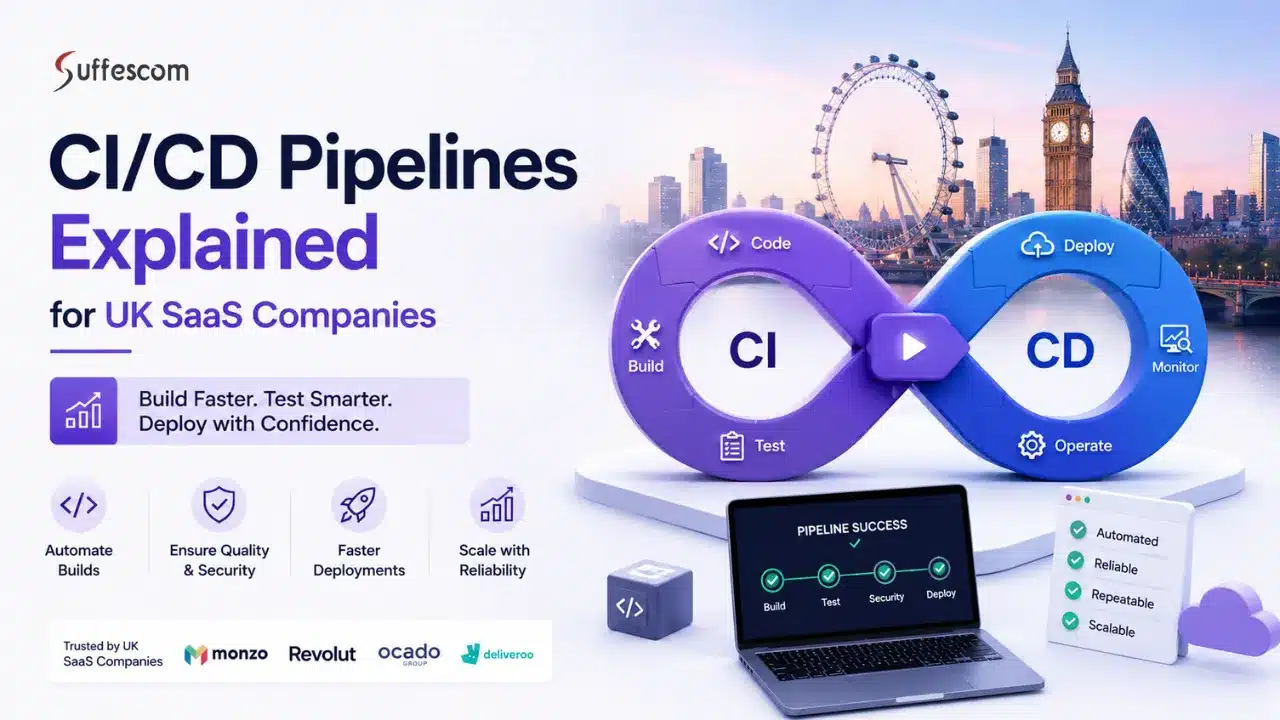
Key Takeaways
- CI/CD can be a competitive edge for any SaaS company since CI/CD allows teams to launch applications quickly, enhance their reliability, and scale engineering processes effectively.
- Modern CI/CD workflows include the automation of the whole process of software delivery, starting from code integration and ending with the monitoring of an application.
- Cloud-based solutions allow building scalable CI/CD systems since Docker, Kubernetes, Infrastructure as Code, and observability systems provide reliable delivery of software.
- Security and compliance are very important aspects of CI/CD. The DevSecOps approach will help SaaS companies to prevent vulnerabilities in the system and follow UK GDPR, ISO 27001, and SOC 2 regulations.
- AI, GitOps, and platform engineering will determine the future of CI/CD and make the process smarter and more effective.
- Efficient CI/CD implementation is based on continuous improvement through proper use of tools and engineering practices.
As the UK SaaS market is getting more competitive, firms need to provide additional functionality to their customers without sacrificing any aspects of security, reliability, or compliance. Manual deployments may result in delays, problems, and downtimes and, therefore, cannot be considered an efficient way of software delivery nowadays.
CI/CD pipelines for UK SaaS companies allow automating the entire software delivery process and, thus, help organisations roll out updates more quickly and efficiently. As a result, they accelerate the deployment process, improve engineering productivity, make applications more reliable, and increase user satisfaction.
Moreover, CI/CD pipelines for UK SaaS companies ensure that businesses comply with various laws and guidelines, including UK GDPR, ISO 27001, Cyber Essentials, and SOC 2, since they incorporate security mechanisms into all stages of software development.
This guide will introduce you to CI/CD pipelines and discuss their advantages, modern architecture, popular tools, security tips, UK compliance requirements, cost of implementation, SaaS examples, and ways of developing a deployment pipeline.
What is a CI/CD Pipeline?
The CI/CD pipeline is a set of automated processes that simplify the whole software development process, starting from integrating code modifications and finishing with deployment to the production environment. It enables software providers to detect issues in advance and automate the testing and security procedures, as well as add new functionality without further effort.
Continuous Integration (CI)
Continuous Integration is a procedure where the developer integrates his/her changes into the source code as frequently as possible. With each new commit, processes such as compilation of code, tests of its quality and security, and code checking are carried out.
Continuous Delivery (CD)
Continuous Delivery is an extension of the Continuous Integration process that includes automatic preparation of validated code for release. When all the quality and security requirements are met, the application is deployed to the staging environment and can be manually approved for release to the production environment.
Continuous Deployment vs Continuous Delivery
Despite being used interchangeably, these two processes differ based on the last deployment phase. In continuous delivery, approval from humans is needed before deployment to the production environment, while continuous deployment involves the automatic deployment of each change that has been validated without any human interaction. It all depends on your particular application requirements, policies, and release process.
Why SaaS Companies Depend on CI/CD More Than Traditional Software
Unlike traditional software, SaaS is run in a continuous delivery environment, whereby updates and bug fixes should be expected at any time without affecting the services. A continuous integration/continuous delivery pipeline allows SaaS companies to release features often, achieve high availability of software, reduce risks of deployment, and scale up development.
Table: CI vs CD vs Continuous Deployment
| Feature | Continuous Integration (CI) | Continuous Delivery (CD) | Continuous Deployment |
| Automation Level | Automates code integration and testing | Automates build, testing, and release preparation | Fully automates the entire release process |
| Approval Required | No | Yes, before production deployment | No |
| Risk Level | Low | Medium | Higher without robust testing and monitoring |
| Release Speed | Fast feedback | Faster, on-demand releases | Continuous, immediate releases |
How a CI/CD Pipeline Works (Step-by-Step SaaS Flow)
A CI/CD pipeline automates every stage of software delivery, ensuring code changes are tested, secured, and deployed consistently. Each stage validates the application before it progresses, reducing deployment risks and enabling SaaS teams to release updates faster with confidence.
Code Commit (Git-Based Workflow)
The pipeline begins when developers commit code to a Git repository such as GitHub, GitLab, or Bitbucket. Using feature branches, pull requests, and code reviews ensures changes are validated before being merged into the main branch, triggering the CI/CD workflow automatically.
Automated Build
Once code is merged, the pipeline compiles the application, installs dependencies, and creates build artefacts or container images. Automated builds verify that the application can be packaged successfully and is ready for testing.
Automated Testing (Unit + Integration + E2E)
The build then passes through multiple testing stages. Unit tests validate individual components, integration tests verify interactions between services, and end-to-end (E2E) tests simulate real user workflows. Automated testing helps detect defects early and prevents unstable code from reaching production.
Security Scanning (DevSecOps Layer)
The security scan will occur concurrently with the tests to uncover any existing vulnerabilities before the deployment process. This could be in the form of a dependency scan, static application security testing (SAST), secrets detection, container image scanning, and software composition analysis (SCA).
Staging Deployment
Once the application passes all quality and security tests, it can now be deployed to a staging environment, which will replicate the production environment. At this point, the team will conduct validations and user acceptance testing as well as performance testing.
Production Deployment
The process is now complete, and the application can now be moved into the production environment using a rolling, blue-green, or canary deployment process. Rollbacks can be done in case there are any problems that emerge during the process of deployment.
Monitoring & Feedback Loops
Deployment is not only about releasing the application, but it also involves constant monitoring of the application regarding its performance, availability, logging, errors, and user experience. Such information is useful for teams to understand the problems that arise and optimise the release process in the future.
SaaS CI/CD Workflow
| Stage | Purpose | Common Tools | Output |
| Build | Compile code and create deployable artefacts | GitHub Actions, GitLab CI, Jenkins, Docker | Successful build or container image |
| Test | Validate functionality and quality | JUnit, Cypress, Selenium, Playwright | Tested and verified application |
| Scan | Detect vulnerabilities and security risks | SonarQube, Snyk, Trivy, OWASP ZAP | Security and compliance reports |
| Deploy | Release the application to staging or production | Argo CD, Kubernetes, Azure DevOps, AWS CodePipeline | Live or staging deployment |
| Monitor | Track performance and application health | Prometheus, Grafana, Datadog, New Relic | Performance metrics, alerts, and feedback |
Accelerate Your Saas Delivery With A Modern CI/CD Pipeline
Key Benefits of CI/CD for UK SaaS Companies
The adoption of CI/CD pipelines makes it possible for SaaS firms in the UK to offer rapid delivery of software, greater stability of applications, and high standards of security. Through automation of repetitive processes and inclusion of tests, innovations can be done quickly while keeping operational risks low.
Rapid Deployment of Features
Through automation of testing and deployment processes, CI/CD makes it possible for software engineers to deploy their features and patches within shorter time frames. Rapid deployment of new features helps SaaS businesses to respond rapidly to feedback from their customers.
Fewer Failed Deployments
As automated testing ensures that issues are detected before deployment, there are fewer chances of deployment failures, and hence downtime is reduced significantly. There is also rapid recovery through automated rollback mechanisms in case of failure of a deployment.
Increased Efficiency of Developers
Automation of the pipeline process saves developers’ time and effort as they have to spend less time on activities like building and deploying software, thus focusing on innovation.
Enhanced Customer Experience
Deployment failures and downtime are minimised, and, therefore, customer experience is enhanced. The customers get better service due to regular releases of new features.
Reduced Engineering Costs
With automation, the level of testing, deployment, and troubleshooting work is reduced, resulting in decreased operational costs in the long run. Robust pipelines help avoid costly production mistakes and cut the amount of labour involved in release processes.
Improved Security and Compliance
Today’s CI/CD pipeline incorporates all security checks in the development process, such as vulnerability scanning, code testing, dependency checks, and audit logging. This way, not only does it make UK SaaS providers able to create better security systems, but it also ensures they are UK GDPR, ISO 27001, Cyber Essentials, and SOC 2 compliant.
Real-World Examples of CI/CD Pipelines in SaaS
Depending on the requirements of their industry, the number of software releases, and the complexity of the IT infrastructure, SaaS providers may have various ways of implementing CI/CD. Below are examples of CI/CD implementation in real-world environments of SaaS companies.
High-Frequency Deployment SaaS (Daily Releases)
Why High-Frequency SaaS Companies Require CI/CD
The SaaS platforms, making updates all the time, require automated processes in order to increase the speed of releases while still providing reliability.
Typical CI/CD Pipeline
Git Commit → Automated Build → Testing → Security Scan → Container Build → Staging → Canary/Blue-Green Deployment → Production → Monitoring
Real-World Example: Netflix
Netflix has one of the largest cloud-native systems in the world, operating over 300 million paid memberships around the world.
In order to manage numerous microservices and frequent software deployments, Netflix created its own system called Spinnaker, an open-source continuous delivery platform.
In 2026, Netflix engineers also shared how improvements to their deployment platform reduced transient deployment failures from 4% to just 0.0001% by modernising workflow orchestration, significantly increasing deployment reliability for business-critical services.
FinTech SaaS with Security-First Pipelines
Why FinTech SaaS Companies Need CI/CD
Financial systems need to be deployed at a fast pace but with strict security, compliance, and auditing requirements. CI/CD can help in automating the testing process, vulnerability scanning, approval, and deployments.
Typical CI/CD Pipeline
Git Commit → Build → Testing → SAST → Dependency Scanning → Compliance Checks → Staging → Approval → Production → Monitoring
Real-World Example: Monzo
Monzo has been created as an engineering system built on automation, cloud-native, and continuous delivery practices.
UK digital bank Monzo has 10+ million customers and does lots of financial transactions, thus requiring solid deployment flows with automatic testing and monitoring.
Monzo’s use of Kubernetes-based infrastructure and automated deployment practices shows how FinTech companies balance delivery speed with security and reliability.
HealthTech SaaS with Compliance Automation
Why HealthTech SaaS Companies Need CI/CD
HealthTech platforms handle sensitive healthcare data, making security, compliance, and availability critical. CI/CD enables automated validation, testing, and monitoring before changes reach users.
Typical CI/CD Pipeline
Git Commit → Build → Testing → Security Checks → Compliance Validation → Staging → UAT → Production → Monitoring
Real-World Example: NHS Digital Services
NHS England has accelerated its digital transformation by adopting cloud-native technologies, DevOps practices, and automated software delivery across services such as the NHS App, NHS Login, NHS 111, and the NHS e-Referral Service. Through its Cloud Centre of Excellence (CCoE), the NHS promotes CI/CD, Infrastructure as Code (IaC), and cloud governance to improve deployment consistency and security.
The initiative has delivered around 40% cloud cost savings through FinOps optimisation, while 92% of NHS trusts will have implemented Electronic Patient Record (EPR) systems by March 2025. Additionally, the NHS App saved over 2 million administrative hours and 890,000 GP hours, highlighting the value of reliable, continuously delivered digital services.
Enterprise SaaS Using Kubernetes + GitOps
Why Enterprise SaaS Companies Need CI/CD
Enterprise SaaS platforms often operate across multiple applications, teams, and cloud environments. CI/CD combined with Kubernetes and GitOps helps maintain consistency, automation, and deployment control.
Typical CI/CD Pipeline
Git Commit → Build → Testing → Security Scans → Container Registry → Kubernetes Deployment → GitOps Sync → Monitoring
Real-World Example: Intuit
Intuit uses cloud-native technologies, Kubernetes, and automated delivery practices across products, including QuickBooks, TurboTax, and Mailchimp.
The company serves over 100 million customers globally, requiring scalable engineering practices to support reliable software delivery across large SaaS ecosystems.
By adopting Kubernetes, Infrastructure as Code, and GitOps principles, Intuit improves deployment consistency and operational efficiency.
Table: CI/CD Impact in SaaS Industries
| Industry | Typical Deployment Frequency | Primary CI/CD Focus | Key Benefits |
| FinTech | Multiple deployments daily | Security automation, compliance, audit trails | Faster releases with stronger reliability |
| HealthTech | Weekly to daily | Compliance, testing, availability | Safer releases and reduced operational risk |
| SaaS CRM | Daily to multiple daily releases | Feature delivery, scalability, QA | Faster innovation and better user experience |
| HR Tech | Weekly to continuous | Automation, cloud deployment, monitoring | Improved stability and engineering efficiency |
CI/CD Pipeline Architecture for Modern SaaS
Modern SaaS CI/CD architectures combine automation, containers, cloud infrastructure, security, and monitoring into a unified delivery workflow. Instead of managing development, testing, and deployment separately, teams automate the entire software lifecycle to achieve faster releases, better reliability, and scalable operations.
Git-Based Development Flow
Git provides the foundation for modern CI/CD workflows by enabling version control, collaboration, and traceability. Developers create branches, submit pull requests, and merge approved code changes, which automatically trigger build, testing, and deployment workflows.
Docker Containerisation
Docker packages applications with their dependencies into portable containers, ensuring consistency across development, testing, and production environments. This reduces environment-related issues and makes deployments faster and more reliable.
Kubernetes Deployment Layer
Kubernetes manages containerised applications by automating deployment, scaling, load balancing, and recovery. It supports advanced release strategies such as rolling, blue-green, and canary deployments to improve application availability.
Infrastructure as Code (IaC)
Infrastructure as Code allows teams to manage cloud resources through version-controlled configurations instead of manual processes. Tools like Terraform and AWS CloudFormation improve consistency, scalability, and infrastructure management.
Observability Stack
Observability provides real-time visibility into application performance through metrics, logs, traces, and alerts. Tools such as Prometheus, Grafana, OpenTelemetry, and Datadog help teams detect issues faster and maintain system reliability.
DevSecOps Integration
DevSecOps integrates security throughout the CI/CD lifecycle by automating code analysis, vulnerability scanning, secrets management, and compliance checks. This helps SaaS companies reduce risks and meet security requirements such as UK GDPR, ISO 27001, and SOC 2.
Want to Build a CI/CD Pipeline Tailored to Your SaaS Model?
Best CI/CD Tools for UK SaaS Companies (2026)
Selecting the right CI/CD platform depends on your team’s size, cloud environment, deployment complexity, and compliance requirements. While startups often prioritise ease of use and affordability, larger SaaS organisations require advanced automation, scalability, security integrations, and enterprise-grade governance. The following tools remain among the most widely adopted CI/CD solutions in 2026.
GitHub Actions
GitHub Actions is a popular CI/CD platform for teams already using GitHub. It offers native workflow automation, extensive marketplace integrations, and seamless support for containerised applications, making it ideal for startups and growing SaaS businesses.
GitLab CI/CD
GitLab CI/CD provides an integrated DevSecOps platform that combines source control, CI/CD, security testing, and deployment automation within a single application. Its built-in security and compliance features make it a strong choice for enterprises and regulated industries.
Jenkins
Jenkins remains one of the most flexible open-source automation servers. With thousands of plugins and extensive customisation options, it supports complex deployment workflows across on-premises, hybrid, and multi-cloud environments. However, it requires dedicated maintenance compared to modern cloud-native alternatives.
Azure DevOps
Azure DevOps offers end-to-end development services, including CI/CD pipelines, source control, project management, and testing. It integrates closely with Microsoft Azure and is well suited for organisations operating within the Microsoft ecosystem.
CircleCI
CircleCI is a cloud-native CI/CD platform known for its fast builds, parallel execution, and developer-friendly configuration. It enables SaaS teams to accelerate testing and deployment while reducing pipeline execution times.
Argo CD
Argo CD is a Kubernetes-native continuous delivery solution built around GitOps principles. It automatically synchronises Kubernetes clusters with Git repositories, making deployments declarative, version-controlled, and easier to audit across multiple environments.
AWS CodePipeline
AWS CodePipeline automates software release workflows across AWS services, integrating with tools such as CodeBuild, CodeDeploy, Amazon ECR, and CloudFormation. It is an excellent choice for SaaS companies building and deploying applications on AWS infrastructure.
CI/CD Tool Comparison
| Tool | Best For | Ease of Use | Enterprise Ready |
| GitHub Actions | GitHub-based startups and growing SaaS teams | Very Easy | Yes |
| GitLab CI/CD | DevSecOps and enterprise software delivery | Easy | Yes |
| Jenkins | Highly customised and self-hosted pipelines | Moderate to Advanced | Yes |
| Azure DevOps | Microsoft Azure ecosystems | Easy | Yes |
| CircleCI | Fast cloud-native CI/CD workflows | Very Easy | Yes |
| Argo CD | Kubernetes and GitOps deployments | Moderate | Yes |
| AWS CodePipeline | AWS-native application deployments | Moderate | Yes |
CI/CD Security Best Practices (DevSecOps for SaaS)
As cyber threats continue to evolve, security must be integrated into every stage of the CI/CD pipeline rather than treated as a final deployment step. A DevSecOps approach embeds automated security checks throughout the software development lifecycle, helping SaaS companies identify vulnerabilities early, reduce deployment risks, and meet compliance requirements without slowing delivery.
Shift-Left Security Approach
Shift-left security introduces security testing early in the development process. By scanning code during development and pull requests, teams can detect vulnerabilities before they progress through the pipeline, reducing remediation costs and accelerating secure releases.
Vulnerability Scanning Automation
Automated vulnerability scanning continuously checks source code, third-party libraries, container images, and infrastructure for known security issues. Integrating these scans into CI/CD pipelines helps prevent vulnerable applications from reaching production.
Secrets Management
Hardcoding API keys, passwords, and access tokens poses significant security risks. Secrets management solutions securely store and inject sensitive credentials during pipeline execution, minimising the risk of unauthorised access and credential leaks.
Dependency Security
Most modern applications rely on open-source packages, making dependency security essential. Automated Software Composition Analysis (SCA) identifies outdated or vulnerable libraries and alerts teams to update dependencies before deployment.
Container Security
Container images should be scanned for vulnerabilities before being deployed to production. Using minimal base images, signing trusted images, and enforcing runtime security policies help reduce the attack surface of containerised applications.
Post-Deployment Monitoring
Security doesn’t end after deployment. Continuous monitoring, log analysis, threat detection, and runtime protection help identify suspicious activity, configuration drift, and emerging vulnerabilities, enabling faster incident response and improved application resilience.
UK Compliance Requirements for CI/CD Pipelines
UK SaaS companies must ensure their CI/CD pipelines support both secure software delivery and regulatory compliance. Embedding compliance controls into the development lifecycle helps reduce security risks, simplify audits, and ensure every deployment meets legal and industry standards.
UK GDPR Compliance
CI/CD pipelines should incorporate security controls that protect personal data throughout the software development lifecycle. Automated testing, encryption validation, access controls, and audit logging help organisations support UK GDPR requirements while minimising the risk of data breaches.
ISO 27001 Alignment
ISO 27001 emphasises information security management through documented processes and risk controls. CI/CD pipelines support compliance by automating change management, enforcing code reviews, maintaining deployment logs, and standardising security practices across development and production environments.
Cyber Essentials Certification
The UK’s Cyber Essentials framework focuses on protecting organisations against common cyber threats. Integrating vulnerability scanning, secure configurations, access management, and patch validation into CI/CD pipelines helps organisations strengthen their cybersecurity posture and support certification requirements.
SOC 2 Readiness for SaaS
Although SOC 2 is a global framework, many UK SaaS companies pursue certification to demonstrate security and operational maturity. CI/CD pipelines for UK SaaS companies contribute by automating security testing, maintaining audit trails, enforcing deployment approvals, and ensuring consistent release processes.
Audit Trails & Change Tracking
Every code commit, build, approval, deployment, and configuration change should be automatically recorded. Comprehensive audit trails improve traceability, simplify compliance reporting, and accelerate incident investigations when security events occur.
Data Residency Considerations
Many UK organisations require customer data to remain within approved geographic regions. CI/CD pipelines should support regional deployment strategies, infrastructure policies, and cloud configurations that align with data residency requirements while ensuring secure and compliant software delivery.
CI/CD Costs for UK SaaS Companies (Based on Complexity)
The cost of implementing a CI/CD pipeline varies depending on the size of the engineering team, deployment complexity, cloud infrastructure, and security requirements. Many of these factors also influence the overall cost of hiring DevOps engineers in the UK, particularly when building and managing CI/CD pipelines at scale, which in turn impacts the overall cost.
What Drives CI/CD Costs?
Several factors influence the overall cost of designing, implementing, and maintaining a CI/CD pipeline.
- Team size: Larger engineering teams require more scalable infrastructure, collaboration features, and governance controls.
- Tooling choices: Open-source platforms may reduce licensing costs but often require more operational effort, whereas managed services simplify maintenance.
- Cloud infrastructure usage: Building runners, container registries, storage, and compute resources directly impacts monthly operating costs.
- Automation maturity: Advanced automation for testing, deployments, rollbacks, and monitoring requires additional engineering investment.
- Security & compliance requirements: Regulated industries often need integrated security testing, audit logging, secrets management, and compliance automation.
Cost by Complexity Level
| Complexity Level | Typical SaaS Stage | Estimated Monthly Cost | Typical CI/CD Setup |
| Low Complexity | Startup | £200 – £2,000 | GitHub Actions, basic testing, cloud-hosted runners |
| Medium Complexity | Growth SaaS | £2,000 – £10,000 | Multi-environment pipelines, automated testing, container deployments |
| High Complexity | Scale-up | £10,000 – £50,000 | Kubernetes, Infrastructure as Code, DevSecOps, observability |
| Very High Complexity | Enterprise | £50,000+ | Platform engineering, GitOps, multi-cloud automation, advanced security controls |
These estimates include typical spending on CI/CD platforms, cloud infrastructure, build environments, monitoring, and ongoing pipeline maintenance. Actual costs vary depending on deployment frequency, engineering team size, cloud provider, and compliance requirements.
Hidden Costs SaaS Companies Often Miss
The direct cost of CI/CD tools is only part of the investment. Many organisations overlook indirect expenses that can significantly impact software delivery and operational efficiency.
Downtime from Failed Deployments
Even brief production outages can affect customer experience, SLA commitments, and revenue. Investing in automated testing and rollback mechanisms is often far more cost-effective than recovering from deployment failures.
Developer Time Loss
Manual builds, repetitive testing, and deployment tasks consume valuable engineering time that could otherwise be spent developing new features or improving existing products. Automation helps teams focus on higher-value work.
Debugging Unstable Pipelines
Poorly designed pipelines often generate inconsistent builds, flaky tests, and failed deployments. Resolving these issues increases engineering effort and slows release cycles.
Security Incident Response Costs
Addressing vulnerabilities after deployment is typically more expensive than detecting them during development. Integrating security into CI/CD pipelines reduces remediation costs and lowers the risk of compliance violations.
Cloud Inefficiencies in Builds
Unoptimized build processes, unused resources, and inefficient test execution can increase cloud infrastructure costs over time. Regular pipeline optimisation helps reduce unnecessary spending while improving build performance.
ROI of CI/CD Automation
Although implementing CI/CD requires an initial investment, organisations typically recover these costs through faster software delivery, fewer production incidents, improved developer productivity, and lower operational overhead. As pipelines mature, automation becomes a strategic advantage that enables faster innovation while maintaining software quality and reliability.
| Metric | Before CI/CD | After CI/CD |
| Deployment Speed | Slow, manual releases | Fast, automated deployments |
| Failure Rate | Higher due to manual errors | Lower with automated testing and validation |
| Recovery Time | Longer incident resolution | Faster recovery with rollback automation |
| Cost Efficiency | Higher operational overhead | Lower costs through automation and optimisation |
Cost Optimisation Strategies
Optimising CI/CD pipelines helps organisations improve performance while controlling operational expenses.
Pipeline Caching
Caching dependencies, packages, and build artefacts reduces build times and lowers cloud compute costs by eliminating repetitive downloads and compilation tasks.
Parallel Builds and Testing
Running builds and test suites simultaneously shortens pipeline execution times, allowing teams to release software faster without increasing engineering effort.
Test Optimisation
Prioritising high-value automated tests and removing redundant or flaky test cases improve pipeline reliability while reducing execution time and infrastructure usage.
Cloud Resource Tuning
Right-sizing build runners, scheduling workloads efficiently, and eliminating idle resources help control cloud spending without affecting deployment performance.
Automated Rollback Systems
Automated rollback mechanisms quickly restore the last stable release when deployment issues occur, minimising downtime, reducing incident recovery costs, and improving overall service reliability.
Common CI/CD Challenges in SaaS Companies
While CI/CD accelerates software delivery and improves reliability, implementing and scaling automated pipelines come with their own challenges. As SaaS applications grow in complexity, engineering teams often encounter issues that affect deployment speed, software quality, and operational efficiency. Identifying these challenges early helps organisations build more resilient and scalable CI/CD workflows.
Flaky Tests
Flaky tests produce inconsistent results, passing in one pipeline run and failing in another without any code changes. They reduce confidence in automated testing, delay deployments, and increase the time developers spend investigating false failures. Regular test maintenance, stable test environments, and reliable test data are essential for improving pipeline consistency.
Slow Pipelines
As applications expand, build and testing times can increase significantly, slowing down releases and reducing developer productivity. Pipeline performance can be improved by using caching, parallel test execution, incremental builds, and optimised CI/CD workflows that eliminate unnecessary steps.
Environment Drift
Development, staging, and production environments often become inconsistent due to manual configuration changes or undocumented updates. Environment drift can lead to deployment failures and difficult-to-reproduce bugs. Infrastructure as Code (IaC), containerization, and automated environment provisioning help maintain consistency across all environments.
Security Bottlenecks
Security reviews performed only before production releases can delay deployments and create development bottlenecks. Integrating automated security testing, vulnerability scanning, secrets management, and policy enforcement into the CI/CD pipeline enables teams to identify and address security risks earlier without slowing delivery.
Scaling Issues
As engineering teams, applications, and deployment frequency increase, CI/CD pipelines must handle higher workloads without compromising performance. Organisations often need to scale and build infrastructure, adopt Kubernetes, implement distributed runners, and standardise deployment processes to maintain efficiency.
Developer Adoption Resistance
Successful CI/CD implementation depends on both technology and culture. Developers may resist new workflows if pipelines are overly complex or disrupt existing processes. Providing clear documentation, standardised templates, training, and developer-friendly automation encourages adoption and helps teams fully realise the benefits of CI/CD.
CI/CD Metrics That Matter (DORA Metrics for SaaS)
Measuring pipeline performance is just as important as automating it. Leading SaaS companies use DORA (DevOps Research and Assessment) metrics to evaluate the speed, stability, and reliability of their software delivery process. Rather than measuring engineering productivity alone, these metrics help teams identify bottlenecks, improve deployment quality, and continuously optimise their CI/CD pipelines. Since 2024, DORA has expanded from the original four metrics to a five-metric model that measures both software delivery throughput and instability.
Deployment Frequency
Deployment frequency measures how often an organisation successfully deploys code to production. Frequent, smaller deployments allow SaaS companies to deliver new features, bug fixes, and security updates faster while reducing the risk associated with large releases.
Lead Time for Changes
Lead Time for Changes tracks the time between a code commit and its successful deployment to production. Short lead times indicate efficient development, testing, approval, and deployment processes, enabling teams to respond quickly to customer needs and market changes.
Change Failure Rate
Change Failure Rate represents the percentage of production deployments that result in service degradation, incidents, hotfixes, or rollbacks. A lower failure rate reflects mature testing practices, deployment automation, and effective quality assurance.
Failed Deployment Recovery Time (Previously MTTR)
DORA now uses Failed Deployment Recovery Time instead of the traditional Mean Time to Recovery (MTTR). This metric measures how quickly teams restore service after a deployment causes an incident. Fast recovery demonstrates effective monitoring, incident response, and automated rollback capabilities.
Deployment Rework Rate
Deployment Rework Rate measures the amount of unplanned deployment work required to fix production issues. This includes emergency patches, hotfixes, rollback deployments, and corrective releases caused by previous changes.
Tracking this metric helps SaaS teams understand how much engineering effort is spent recovering from delivery problems instead of building new features. A lower rework rate indicates better testing, stronger deployment practices, and improved software stability.
Table: DORA Metrics & Performance Goals
| Metric | What It Measures | Goal for Mature SaaS Teams |
| Deployment Frequency | How often are code changes successfully deployed | Frequent releases without reducing stability |
| Lead Time for Changes | Time from code commit to production release | Faster delivery cycles with efficient automation |
| Change Failure Rate | Percentage of deployments causing production issues | Minimise failed releases through testing and validation |
| Failed Deployment Recovery Time | Time required to restore service after deployment failures | Recover quickly through monitoring and automation |
| Deployment Rework Rate | Unplanned deployment effort caused by production issues | Reduce emergency fixes and corrective releases |
Why DORA Metrics Matter
Tracking DORA metrics helps SaaS companies move beyond measuring deployment speed alone. By balancing throughput (deployment frequency and lead time) with stability (change failure rate, failed deployment recovery time, and deployment rework rate), engineering teams gain a clearer view of software delivery performance. These insights support data-driven decisions, improve developer productivity, reduce operational risk, and create a more reliable CI/CD pipeline that scales with business growth.
Leverage Suffescom’s DevOps Expertise and Build a Faster, More Resilient CI/CD Pipeline!
CI/CD Implementation Roadmap for UK SaaS Companies
Implementing a CI/CD pipeline is not just a matter of selecting tools and automating deployments. For SaaS companies, successful adoption requires a structured approach that aligns development workflows, security practices, cloud infrastructure, and business objectives.
A phased implementation roadmap helps teams move from manual deployments to a reliable automated delivery process while minimising disruption to existing operations. Whether a company is a startup building its first pipeline or an established SaaS provider modernising its engineering practices, the following roadmap provides a practical approach.
Phase 1: Assessment
Before introducing automation, SaaS teams should evaluate their current software delivery process. This includes reviewing existing development workflows, deployment methods, testing practices, infrastructure setup, and security controls.
The assessment phase helps identify bottlenecks such as manual deployments, inconsistent environments, slow testing cycles, and a lack of monitoring.
Key activities include:
- Auditing current development and deployment workflows.
- Identifying repetitive manual tasks suitable for automation.
- Reviewing existing tools, cloud infrastructure, and repositories.
- Measuring current delivery performance using DORA metrics.
- Defining CI/CD goals based on business and engineering priorities.
Outcome:
A clear understanding of the current state and a roadmap for CI/CD improvements.
Phase 2: Tool Selection
Choosing the right CI/CD tools depends on factors such as application architecture, cloud provider, team expertise, security requirements, and scalability needs.
Startups may prefer managed solutions such as GitHub Actions or GitLab CI/CD for faster implementation, while larger SaaS companies may require Kubernetes-based deployment platforms, GitOps workflows, and enterprise security integrations.
Key considerations include:
- Source control integration.
- Support for automated testing.
- Cloud and container compatibility.
- Security and compliance capabilities.
- Scalability for future growth.
- Developer experience and maintenance requirements.
Outcome:
A technology stack that supports current requirements while allowing future expansion.
Phase 3: Automation Setup
Once tools are selected, teams can begin building automated CI/CD workflows. This typically starts with continuous integration practices before expanding into automated deployments.
The pipeline should gradually automate critical stages such as code validation, testing, security scanning, and deployment.
Key activities include:
- Creating automated build pipelines.
- Integrating unit, integration, and end-to-end testing.
- Automating application deployments.
- Configuring staging and production environments.
- Implementing deployment strategies such as blue-green or canary releases.
Outcome:
A repeatable pipeline that enables faster and more reliable software releases.
Phase 4: Security Integration
Security should be embedded throughout the CI/CD lifecycle instead of being added after development is complete. This approach, known as DevSecOps, helps SaaS companies detect vulnerabilities earlier and maintain compliance.
Key activities include:
- Adding automated code security scanning.
- Implementing dependency vulnerability checks.
- Managing secrets securely.
- Scanning container images.
- Creating security policies and approval workflows.
Outcome:
A secure delivery pipeline that supports compliance requirements such as UK GDPR, ISO 27001, and SOC 2 readiness.
Phase 5: Scaling Pipelines
As SaaS companies grow, CI/CD pipelines must evolve to support larger teams, more applications, and higher deployment frequency.
Scaling involves improving reliability, reducing pipeline execution time, and introducing advanced automation practices.
Key activities include:
- Implementing Infrastructure as Code (IaC).
- Adopting Kubernetes and GitOps workflows.
- Improving pipeline performance through caching and parallel execution.
- Expanding observability and monitoring.
- Standardising CI/CD practices across engineering teams.
Outcome:
A scalable software delivery platform capable of supporting enterprise-level SaaS growth.
90-Day CI/CD Implementation Plan
| Phase | Timeline | Expected Outcome |
| Assessment | Days 1–15 | Current workflow analysis, CI/CD goals defined, improvement roadmap created |
| Tool Selection | Days 15–30 | CI/CD platform and supporting tools selected based on business requirements |
| Automation Setup | Days 30–60 | Automated builds, testing, and initial deployment workflows implemented |
| Security Integration | Days 60–75 | Security scanning, secrets management, and compliance controls added |
| Scaling Pipelines | Days 75–90 | Advanced automation, monitoring, and optimisation practices introduced |
CI/CD vs DevOps vs GitOps
CI/CD, DevOps, and GitOps are closely connected concepts in modern software engineering, but they solve different problems. While CI/CD focuses on automating software delivery, DevOps represents a broader culture and methodology for improving collaboration between development and operations teams. GitOps extends these practices by using Git as the central source of truth for infrastructure and application deployments.
Understanding the differences between these approaches helps SaaS companies choose the right strategy for building scalable, secure, and efficient software delivery processes.
DevOps Explained
DevOps is a software development approach that combines development and operations practices to improve collaboration, automation, and continuous delivery. Instead of developers and operations teams working separately, DevOps encourages shared responsibility throughout the software lifecycle.
A DevOps culture typically includes:
- Automated testing and deployment.
- Infrastructure automation.
- Continuous monitoring.
- Faster feedback loops.
- Cross-functional collaboration.
For SaaS companies, DevOps helps reduce release delays, improve application reliability, and create a more efficient engineering workflow.
GitOps Explained
GitOps is an operational model that applies Git-based workflows to infrastructure and application management. In a GitOps approach, Git repositories act as the single source of truth for desired system states.
When changes are committed to Git, automated tools such as Argo CD or Flux detect those changes and synchronise the actual environment with the defined configuration.
GitOps provides:
- Version-controlled infrastructure changes.
- Automated deployment synchronisation.
- Improved auditability.
- Easier rollback capabilities.
- Consistent environments across development and production.
GitOps is particularly valuable for SaaS companies using Kubernetes and cloud-native architectures.
How CI/CD Fits into DevOps
CI/CD is one of the core technical practices within DevOps. It provides the automation layer that enables teams to continuously integrate code changes, test applications, and deliver software reliably.
A simple relationship looks like this:
DevOps → Culture and practices
CI/CD → Automation of software delivery
GitOps → Git-based approach for managing deployments and infrastructure
For example:
- Developers commit code to Git.
- CI pipelines automatically build and test the application.
- Security checks validate the changes.
- CD pipelines deploy approved changes.
- GitOps tools maintain the desired production state.
Together, these practices create a faster and more reliable SaaS delivery workflow.
When GitOps Is Better
GitOps is especially useful for SaaS companies that operate complex cloud environments with Kubernetes, multiple applications, or frequent deployments.
Organisations benefit from GitOps when they need:
- Multiple environment management.
- Strong deployment audit trails.
- Automated infrastructure synchronisation.
- Easier disaster recovery.
- Greater consistency across cloud environments.
However, GitOps is not a replacement for CI/CD. Instead, it enhances the continuous delivery process by improving deployment control and infrastructure management.
CI/CD vs DevOps vs GitOps Comparison
| Model | Primary Focus | Main Use Case |
| CI/CD | Automating code integration, testing, and deployment | Faster and more reliable software releases |
| DevOps | Collaboration, automation, and shared ownership between teams | Improving the complete software delivery lifecycle |
| GitOps | Managing infrastructure and deployments through Git workflows | Kubernetes-based and cloud-native application operations |
Which Approach Should UK SaaS Companies Choose?
Most modern SaaS companies do not choose between CI/CD, DevOps, and GitOps; they use them together.
A mature SaaS engineering environment typically follows this progression:
DevOps culture → CI/CD automation → GitOps-driven deployments
Startups may begin with CI/CD automation using managed platforms, while larger SaaS organisations often adopt GitOps practices to manage Kubernetes environments and enterprise-scale deployments.
By combining these approaches, UK SaaS companies can achieve faster releases, stronger security controls, improved operational visibility, and a scalable foundation for future growth.
Insights from 100+ SaaS CI/CD Pipeline Audits
With experience delivering software solutions for startups, enterprises, and technology-driven businesses, Suffescom’s engineering teams have worked with diverse SaaS environments involving modern application architectures, cloud platforms, automated workflows, and scalable deployment practices.
Through 100+ SaaS CI/CD pipeline audits, we have observed that successful delivery automation is rarely limited by tools alone. The biggest differences between fragile and high-performing pipelines come from engineering processes, automation maturity, security integration, and how teams prepare their infrastructure for scale.
During these audits, our experts typically evaluate key areas, including:
- Source control and branching strategies.
- Build and deployment automation.
- Testing coverage and quality gates.
- Cloud infrastructure and environment consistency.
- Security practices within development workflows.
- Monitoring, rollback, and incident recovery processes.
These assessments reveal recurring patterns that help SaaS teams improve release velocity, reduce deployment risks, and build more reliable software delivery systems.
Common Mistakes Across SaaS Teams
Automating Releases Without Building Pipeline Foundations
One of the most common patterns identified during SaaS CI/CD reviews is teams attempting to automate deployments before establishing reliable engineering foundations.
A deployment pipeline can only be as reliable as the processes supporting it. Teams often struggle when they have:
- Limited automated testing coverage.
- Inconsistent development and production environments.
- Manual approval dependencies.
- Lack of deployment monitoring.
Our recommendation is to build CI/CD maturity gradually—starting with automated builds and testing before introducing advanced deployment strategies such as blue-green releases, canary deployments, or GitOps workflows.
Why Teams Delay Automation
Across SaaS environments, we often see organisations postpone CI/CD modernisation because existing manual processes appear sufficient during early product stages.
However, as applications grow, these approaches create operational challenges:
- Developers spend more time managing releases instead of improving products.
- Deployment processes become dependent on individual team members.
- Production changes become harder to track and reproduce.
- Security validation becomes slower and more expensive.
The SaaS companies that scale successfully usually treat CI/CD as an investment in engineering efficiency rather than just a technical upgrade.
Hidden Costs of Manual Deployments
During CI/CD assessments, one of the biggest challenges we identify is the hidden operational cost of manual deployment workflows.
These costs often include:
- Engineering hours spent on repetitive release activities.
- Longer time-to-market for new features.
- Higher probability of configuration errors.
- Increased difficulty recovering from production incidents.
Automated pipelines help organisations create predictable release processes where deployments become repeatable, measurable, and easier to improve.
High-Performance Pipeline Patterns
From reviewing SaaS delivery workflows, we consistently find that mature engineering teams share several common practices.
Automated Testing as a Release Foundation
High-performing teams do not rely on manual validation before deployment. They integrate automated testing throughout the pipeline to maintain release confidence.
Cloud-Native Deployment Practices
Many scalable SaaS platforms use:
- Containers for application consistency.
- Kubernetes for orchestration.
- Infrastructure as Code for repeatable environments.
- Automated monitoring for operational visibility.
Security Embedded Into Delivery
Leading SaaS teams integrate security checks directly into CI/CD workflows instead of treating security as a final approval stage.
This includes:
- Dependency scanning.
- Code security analysis.
- Secret detection.
- Container security validation.
What Actually Improves Stability
Our experience reviewing SaaS CI/CD workflows shows that stability improves when teams focus on continuous optimisation rather than simply increasing deployment frequency.
The most impactful improvements include:
- Measuring pipeline performance through DORA metrics.
- Reducing flaky tests and improving automation reliability.
- Maintaining consistent environments across development stages.
- Implementing automated rollback strategies.
- Improving observability through logs, metrics, and alerts.
A successful CI/CD pipeline is not defined only by how quickly it delivers code. It is defined by how confidently a SaaS business can release, monitor, and improve its product at scale.
Expert DevOps & SaaS Engineering Insights (UK Focus)
Building and scaling SaaS platforms requires more than implementing CI/CD tools. Through our experience delivering expert DevOps services for businesses in the UK, we have seen that successful DevOps transformation depends on creating reliable delivery processes, improving collaboration, and embedding security throughout the software lifecycle.
For UK SaaS companies, these priorities have become even more important as businesses face increasing expectations around security, compliance, availability, and faster product delivery. Engineering leaders must balance rapid innovation with operational stability, especially when managing customer-facing applications and sensitive business data.
CTO Priorities in CI/CD Modernisation
From our experience working with SaaS engineering teams, CTOs typically focus on three major outcomes when modernising CI/CD pipelines for UK SaaS companies:
Faster and More Predictable Releases
As SaaS products evolve, manual release processes can slow down innovation. CTOs increasingly prioritise automation to reduce deployment friction and help development teams deliver improvements faster.
Key priorities include:
- Automated build and deployment workflows.
- Faster testing cycles.
- Standardised release processes.
- Improved visibility into delivery performance.
A modern CI/CD approach enables engineering teams to release smaller, safer updates while maintaining product reliability.
Building Scalable Engineering Foundations
Growth-stage SaaS companies often face challenges when their initial development practices cannot support increasing product complexity.
We commonly see CTOs investing in:
- Cloud-native architectures.
- Containerization.
- Infrastructure as Code.
- Automated environment management.
- Observability platforms.
These improvements help teams scale applications efficiently while reducing operational complexity.
Improving Security Without Slowing Delivery
Security is now a core engineering priority for SaaS leaders. Instead of treating security as a separate review process, modern CTOs are adopting DevSecOps approaches that integrate security into CI/CD workflows.
This includes:
- Automated vulnerability scanning.
- Secure dependency management.
- Secret protection.
- Compliance-focused controls.
For UK SaaS businesses, this approach supports stronger security practices while maintaining development speed.
Security Leaders on Pipeline Risk Reduction
From our engineering experience, security teams are increasingly focused on reducing risks introduced during the software delivery lifecycle.
Common pipeline security improvements include:
Earlier Vulnerability Detection
Finding security issues during development is significantly more efficient than addressing them after deployment. Integrating automated security checks allows teams to identify vulnerabilities before they reach production.
Better Supply Chain Security
Modern SaaS applications rely heavily on third-party libraries and open-source dependencies. Security teams are therefore prioritising:
- Dependency monitoring.
- Software composition analysis.
- Package verification.
- Container image scanning.
Stronger Access Controls
Secure CI/CD pipelines require controlled access to repositories, deployment environments, and infrastructure resources.
Best practices include:
- Role-based access control.
- Secure credential management.
- Audit logging.
- Environment-specific permissions.
DevOps Architect Recommendations
Based on our experience designing and improving software delivery workflows, we recommend that SaaS companies focus on the fundamentals before adopting advanced DevOps practices.
Start With Pipeline Reliability
Before scaling deployment frequency, teams should ensure their pipelines are:
- Fast.
- Repeatable.
- Observable.
- Easy to troubleshoot.
Automate Gradually
Successful CI/CD adoption usually happens in stages:
- Automate builds.
- Introduce automated testing.
- Add security validation.
- Automate deployments.
- Implement advanced practices such as GitOps and platform engineering.
Measure Continuous Improvement
Using metrics such as deployment frequency, lead time, failure rates, and recovery time helps teams identify areas for improvement and make informed engineering decisions.
Future of SaaS Delivery Pipelines
Based on current SaaS engineering trends, delivery pipelines are becoming increasingly intelligent, automated, and cloud-native.
We expect future SaaS delivery environments to focus on:
- Greater AI assistance in development workflows.
- More autonomous testing and deployment decisions.
- Increased adoption of platform engineering.
- Stronger security automation.
- Improved self-healing capabilities.
The role of DevOps is evolving from managing deployments to building intelligent delivery systems that enable teams to innovate faster while maintaining reliability.
AI in CI/CD Pipelines (2026–2030 Outlook)
AI is becoming a key capability in modern CI/CD pipelines, helping SaaS teams improve code quality, testing, security, and deployment efficiency. Based on our experience working with software teams, AI delivers the best results when combined with strong DevOps practices and engineering processes.
According to the 2025 DORA State of AI-Assisted Software Development Report, based on feedback from nearly 5,000 technology professionals, AI adoption is accelerating across software teams and is reshaping how developers build and deliver applications.
Key AI-driven CI/CD advancements include:
- AI-assisted code reviews: Identifying potential issues, suggesting improvements, and improving development feedback cycles.
- Intelligent testing: Generating test cases, improving coverage, and reducing testing bottlenecks.
- Predictive deployments: Analysing code changes and historical data to identify release risks before production.
- AI-powered DevSecOps: Detecting vulnerabilities, monitoring dependencies, and improving security automation.
- Self-healing pipelines: Automatically detecting failures and supporting faster recovery.
SaaS companies that combine AI capabilities with reliable CI/CD practices, automation, and security-first engineering will be better prepared to scale software delivery from 2026 onward.
Future of CI/CD in the UK SaaS Industry
The future of CI/CD is moving from basic automation toward intelligent, self-optimising software delivery systems. As UK SaaS companies compete in fast-moving markets, engineering teams are focusing on improving release speed, security, reliability, and operational efficiency.
Based on current DevOps evolution and our experience working with software teams, the next generation of CI/CD will be shaped by AI automation, cloud-native practices, and stronger engineering platforms.
Self-Healing Deployments
Self-healing deployments use automation, monitoring, and AI-driven insights to detect failures and take corrective actions automatically.
Future CI/CD systems will increasingly support:
- Automatic failure detection.
- Automated rollback decisions.
- Infrastructure issue detection.
- Faster incident recovery.
For SaaS businesses, this means reduced downtime and improved reliability as applications scale.
Platform Engineering Growth
Platform engineering is becoming a major focus for SaaS organisations as engineering teams look for ways to simplify cloud complexity and improve developer productivity.
The 2025 DORA research found that around 90% of organisations have adopted at least one internal platform, highlighting the growing importance of platform engineering in modern software delivery.
Internal developer platforms help SaaS teams:
- Standardise CI/CD workflows.
- Provide self-service development environments.
- Reduce operational overhead.
- Improve developer experience.
As SaaS applications grow, platform engineering will become a key foundation for scalable CI/CD operations.
GitOps Expansion
GitOps adoption is expected to continue growing as SaaS companies increasingly rely on Kubernetes and cloud-native architectures.
The CNCF 2026 Cloud Native Survey reported that 82% of container users are now running Kubernetes in production, showing how deeply cloud-native infrastructure has become embedded in modern software delivery.
GitOps supports this evolution by enabling:
- Git-based infrastructure management.
- Automated environment synchronisation.
- Better deployment visibility.
- Easier auditing and rollback.
For SaaS companies managing multiple environments, GitOps provides greater consistency and control.
Autonomous Release Systems
Autonomous release systems represent the next stage of CI/CD evolution, where automation and AI assist with deployment decisions.
Future systems may analyse:
- Code changes.
- Test results.
- Infrastructure health.
- Customer impact signals.
They can help teams decide when and how to release changes safely through strategies such as automated approvals, progressive deployments, and intelligent rollback.
Based on current AI and DevOps trends, we expect autonomous release capabilities to become increasingly common between 2026 and 2030. However, human oversight will remain essential for critical production decisions.
Future-Proof Your Software Delivery with AI-Powered CI/CD Solutions
Conclusion
CI/CD is no longer just a DevOps practice; it has become a strategic advantage for SaaS companies looking to innovate faster, maintain software quality, and scale with confidence.
By embracing automated testing, continuous integration, and streamlined deployments, UK businesses can reduce release risks, improve operational efficiency, and deliver better user experiences. As digital expectations continue to grow, investing in a robust CI/CD strategy is essential for long-term success.
Whether you’re building a new SaaS platform or modernising an existing one, Suffescom can help you establish scalable CI/CD workflows. As an experienced software development company in the UK, we help businesses create reliable delivery pipelines that support faster innovation and long-term scalability.
Key Takeaways for UK SaaS Leaders
Modern SaaS leaders should focus on building CI/CD pipelines that enable:
- Faster and more reliable software releases.
- Automated testing and security validation.
- Better deployment visibility through monitoring and metrics.
- Scalable cloud-native delivery processes.
- Continuous improvement using DORA performance metrics.
The goal is not simply to deploy more frequently but to create a delivery system that supports long-term product growth.
Why CI/CD Is Now a Competitive Advantage
In the SaaS industry, speed and reliability directly impact customer retention and business growth. Companies that can release improvements faster, resolve issues quickly, and maintain secure operations gain a stronger market advantage.
A mature CI/CD pipeline helps businesses:
- Respond faster to customer needs.
- Reduce deployment risks.
- Improve engineering productivity.
- Build greater customer trust.
As software expectations continue to increase, CI/CD is becoming a core business capability rather than just an engineering function.
Next Steps: Audit Your Deployment Pipeline
The first step toward improving CI/CD maturity is understanding your current delivery process.
A pipeline audit can help identify:
- Manual deployment bottlenecks.
- Testing and automation gaps.
- Security risks.
- Infrastructure inefficiencies.
- Opportunities for optimisation.
By evaluating your existing workflows against modern DevOps practices, you can create a clear roadmap for improving speed, reliability, and scalability.
Request CI/CD Strategy Consultation
Ready to modernise your CI/CD pipeline? Compare leading DevOps service providers to find the right partner for implementing secure, scalable, and automated delivery pipelines.
Book a Consultation
Frequently Asked Questions
What is a CI/CD pipeline in SaaS?
A CI/CD pipeline is an automated workflow that helps SaaS teams build, test, secure, and deploy software changes efficiently. It enables faster releases while reducing manual errors and improving application reliability.
Why is CI/CD important for UK SaaS companies?
CI/CD helps UK SaaS companies release features faster, improve software quality, and meet increasing security and compliance expectations. It also supports scalability by creating consistent and automated delivery processes.
How does CI/CD improve software delivery?
CI/CD improves delivery by automating repetitive tasks such as code testing, security checks, and deployments. This allows engineering teams to release updates faster while reducing deployment risks.
What is the difference between CI and CD?
Continuous Integration (CI) focuses on automatically building and testing code changes. Continuous Delivery or Deployment (CD) focuses on preparing and releasing those changes into staging or production environments.
How much does CI/CD cost in the UK?
CI/CD costs depend on factors such as application complexity, team size, tooling, cloud infrastructure, and security requirements. A basic SaaS pipeline may cost a few hundred pounds monthly, while enterprise-grade implementations can require significantly higher investment.
What tools are best for CI/CD pipelines?
Popular CI/CD tools include GitHub Actions, GitLab CI/CD, Jenkins, Azure DevOps, CircleCI, Argo CD, and AWS CodePipeline. The right choice depends on your application architecture, cloud environment, and scalability requirements.
Is Jenkins still used in 2026?
Yes, Jenkins remains widely used, especially in enterprise environments with complex customisation needs. However, many SaaS teams are also adopting managed CI/CD platforms such as GitHub Actions, GitLab CI/CD, and cloud-native solutions.
How long does CI/CD implementation take?
Implementation timelines vary based on existing infrastructure and automation maturity. A basic pipeline may be created within weeks, while complex SaaS environments with security, Kubernetes, and multi-cloud requirements may take several months.
What is DevSecOps in CI/CD?
DevSecOps integrates security practices directly into CI/CD workflows. It helps teams identify vulnerabilities earlier through automated security testing, dependency scanning, and compliance checks.
How does CI/CD support GDPR compliance?
CI/CD supports GDPR compliance by enabling secure development practices, audit tracking, controlled deployments, and automated security checks. However, compliance requires broader organisational policies beyond the pipeline itself.
Can startups use CI/CD effectively?
Yes. Startups can benefit from CI/CD from the early stages by reducing manual work, improving release speed, and creating scalable engineering processes before complexity increases. Since hiring a dedicated DevOps team can be expensive, many startups begin with a DevOps outsourcing model to accelerate implementation while managing costs.
What are the risks of CI/CD automation?
Common risks include poorly configured pipelines, insufficient testing, security gaps, and unreliable automation. These risks can be reduced through proper pipeline design, monitoring, and security integration.
What is GitOps and how is it different?
GitOps uses Git repositories as the source of truth for managing application and infrastructure changes. While CI/CD automates software delivery, GitOps extends automation into infrastructure management and deployment control.
How do CI/CD pipelines reduce costs?
CI/CD reduces costs by automating repetitive tasks, minimising deployment failures, improving developer productivity, and reducing downtime caused by manual errors.
What metrics should SaaS teams track?
SaaS teams should track DORA metrics, including Deployment Frequency, Lead Time for Changes, Failed Deployment Recovery Time, Change Failure Rate, and Deployment Rework Rate.
How does Kubernetes fit into CI/CD?
Kubernetes provides a scalable platform for deploying and managing containerised applications. It works with CI/CD pipelines by enabling automated, consistent, and reliable application deployments.
What causes CI/CD pipeline failures?
Common causes include flaky tests, configuration issues, dependency conflicts, environment differences, security checks failing, and poorly maintained automation workflows.
What is the future of CI/CD in SaaS?
The future of CI/CD will focus on AI-assisted automation, self-healing deployments, platform engineering, GitOps adoption, and increasingly autonomous release workflows. These advancements will help SaaS teams deliver software faster with greater reliability.

Senior Content Strategist
Jonathan Raabe is the Content Strategist at Suffescom Solutions and has more than 7 years of experience in developing data-driven content strategies for technology-centric organizations. He is proficient in the areas of mobile app development, software development, AI, cloud computing, fintech, healthcare, and digital transformation. Jonathan collaborates with industry leaders, developers, and business heads in creating high-value, SEO-optimized content that helps companies in increasing their visibility on the search engines, establishing trust, and driving business inquiries.
Need Help With
Development?