Key Takeaways
- Enterprise RAG can cost £80,000–£120,000 to build initially, with complex implementations costing more. The real investment also includes infrastructure, AI usage, security, integrations, and ongoing maintenance.
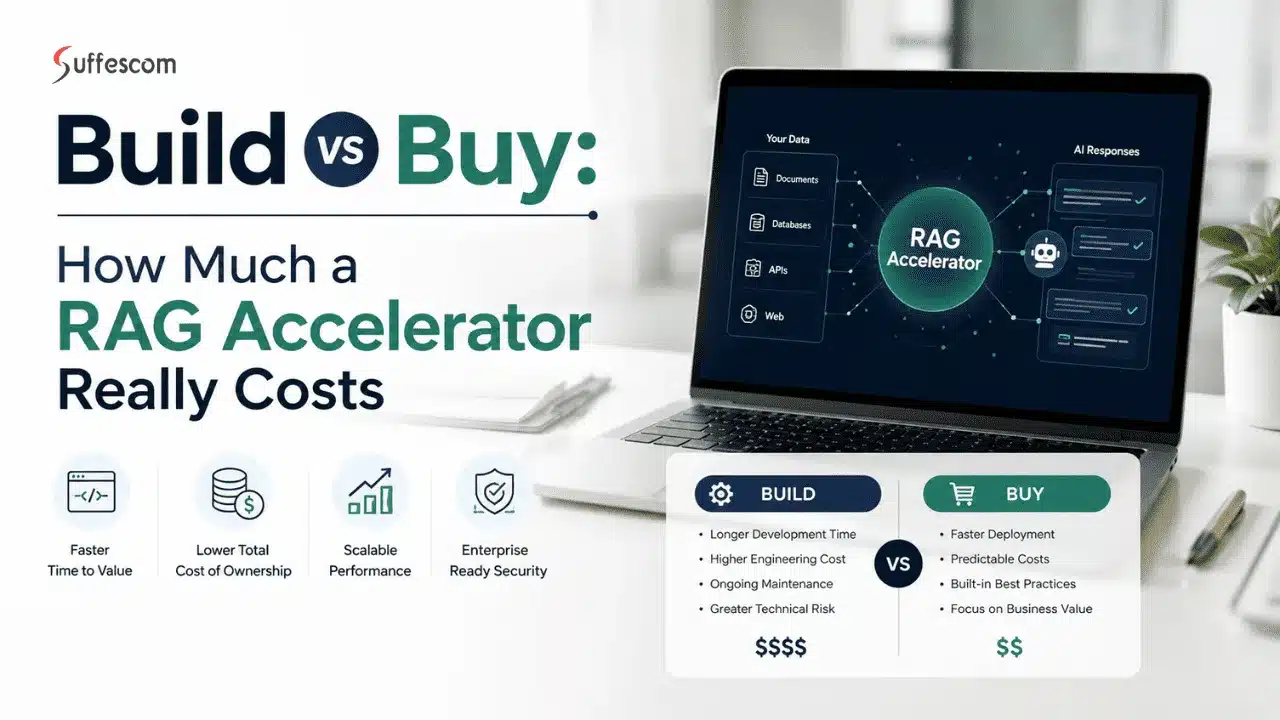
- Build gives you more control; Buy gets you to production faster. The right choice depends on whether customisation and ownership matter more than speed and reduced engineering effort.
- Don’t compare only the upfront price. A three-year TCO should include development, licensing, infrastructure, maintenance, and the cost of delayed deployment.
- Hybrid is often the middle ground. Enterprises can buy the core RAG infrastructure and build the proprietary workflows, retrieval, and integrations that create business value.
- The best approach depends on your organisation’s readiness. If you have strong AI talent, governed data, security capabilities, and a strategic reason to own RAG, Build can make sense. Otherwise, Buy or Hybrid is often more practical.
Did you know that building a production-level RAG solution can cost roughly £80,000–£120,000 for the initial build?
And that is only the upfront engineering cost. You still need to account for various factors. For example, infrastructure costs. Then, there is API usage, reindexing, vector database hosting, and ongoing maintenance. If we add enterprise requirements such as role-based access control (RBAC), data governance, and evaluation frameworks, the costs quickly add up; all these factors will further drive up development costs.
Over three years, a complex enterprise RAG implementation can reach roughly £250,000–£500,000+ in total ownership costs.
This level of investment makes the Buy vs. Build decision a critical one for C-suite and technology leaders.
Building in-house gives you more control and flexibility. But it also ties up valuable technical talent. It increases delivery risk and creates an ongoing maintenance burden.
Buying an off-the-shelf solution can get you to value much faster. However, you may have to compromise on flexibility or long-term control over your data.
So how do you decide?
In this guide, we look at the factors UK enterprises need to consider. We cover hidden operational costs, UK compliance requirements, and technical feasibility. We help you make the right architectural choice for your organisation.
Why RAG Development Is a Critical Business Decision
Higher Investment Vs Greater Control
Building also means the burden is on the business to invest in development, infrastructure, testing, security, and optimisation. This means that the business case needs to be strong enough to justify the increased investment. According to IBM’s research, only 25% of AI projects ever returned expected ROI, reinforcing the need for leadership to carefully weigh the value of their projects before making large investments.
Proof of concept doesn’t mean a successful production build
The proof of concept for your RAG will tell you if retrieval and generation will work. However, it won’t tell you if you can successfully roll this out securely, with the right controls, integrate with systems you rely on, do it performantly, or monitor and fix it.
According to Deloitte, just 68% of organisations report having fully transitioned less than 30% of their GenAI experiments into a production environment. Although this report discusses GenAI and not RAG in particular, the takeaway value of understanding these transition rates can offer insight into the larger task of producing an AI application.
Data Quality Directly Affects RAG Performance
RAG depends on the information it’s being fed. If your data sources are poorly defined, duplicated, out-of-date, have weak metadata and controls, or are in silos, RAG’s retrieval will also be of lower quality. This will increase the effort of the project before launch. In its 2025 CEO Study, IBM also found that 72% of leaders believe that proprietary data holds a critical advantage to unlock value with GenAI, and 68% said a robust, enterprise-wide, integrated data architecture is key for their strategies. This implies that much of RAG investment is in data preparation and governance.
Build, Buy, or Outsource
The Build option provides the greatest control and specificity. Buy offers reduced development cycles and time to market. Outsource leverages specialised talent without fully building an internal team. The choice will depend on your organisation’s specific strategy, budget, and time-to-market requirements.
The Short Answer
Buying or licensing a RAG system is more realistic for most firms in the United Kingdom compared to developing one from scratch. It could help save on initial engineering costs, make deployment fast, and avoid the expenses of designing and managing all components of the RAG system. Developing would be ideal where there is a requirement for customised retrieval, infrastructure control, or RAG is critical to competitiveness.
Why?
An industry estimate for 2026 expects production RAG implementation costs to fall between £40K–£80K. Enterprise-grade RAG systems can range from £80K–£150K+, in which case infrastructure costs for running hundreds to several thousand pounds per month, depending on the workload and design, come on top.
But development costs only represent half of the build vs buy consideration. The time-to-value consideration is more significant. If an owned or licensed RAG platform brings your application to production significantly quicker, then the increased license price may be justified via realised time-to-value. Building has strategic long-term control advantages if the enterprise has already built the necessary engineering expertise and if RAG is a strategic differentiator.
RAG Build vs Buy: Quick Comparison
| Factor | Build | Buy / License |
| Initial implementation cost | ~£80K–£150K+ | ~£40K–£100K+ |
| Infrastructure cost | Higher — fully managed internally | Lower upfront — often included or usage-based |
| Internal engineering cost | High | Low–Moderate |
| Integration cost | High | Moderate |
| Security & compliance cost | Higher internal responsibility | Shared with vendor |
| Licensing cost | None | Recurring |
| Maintenance cost | High — internal responsibility | Lower — partly vendor-managed |
| Time to production | Longer | Usually faster |
| Time to first business value | Later | Earlier |
| 3-year TCO | Higher upfront and ongoing engineering costs | Lower upfront, but recurring licence and usage costs |
| Overall ROI potential | Potentially higher at scale if usage is high and RAG is strategic | Potentially faster ROI because value is realised sooner |
| Control & customisation | Very High | Moderate–High |
| Vendor dependency | Low | High |
| Operational complexity | Very High | Low–Moderate |
| Overall outcome | Best when RAG is strategically important, and the organisation can support the long-term cost and complexity | Best when speed, lower internal effort and faster time-to-value matter most |
Know What Your RAG Investment Could Really Cost?
Understanding the True Cost of Enterprise RAG (Beyond Infrastructure)
Enterprise RAG costs extend far beyond cloud infrastructure and LLM usage. A realistic business case needs to account for engineering talent, data integration, security, maintenance, licensing, and the business value lost while the system is being built.
Direct Costs Every CFO Notices
The most visible costs are usually infrastructure and technology expenses. These can include cloud compute, storage, vector databases, LLM or API usage, software licenses, implementation services, and enterprise platform fees.
However, these costs can vary considerably with usage. A platform serving 500 employees and one serving 10,000 users will have very different infrastructure and model requirements.
Hidden Costs Most Budget Plans Miss
Some of the highest costs appear outside the initial technology estimate.
Enterprise RAG often requires data cleaning and preparation, connector development, permission mapping, security testing, evaluation frameworks, integration with existing business systems, and specialist engineering support.
These activities can add high cost before the first production user ever interacts with the system.
The Internal Engineering Cost of RAG
Building RAG internally means paying for more than AI developers. A production-grade platform can require expertise across AI/ML, data engineering, backend development, cloud infrastructure, DevOps, security, testing, and product management.
The internal resource requirement also continues after launch. Teams need to maintain connectors, improve retrieval quality, monitor model behaviour, manage infrastructure, and respond to changing enterprise requirements.
This makes engineering capacity one of the most important differences between Build and Buy.
| Resource Area | Build | Buy | Hybrid |
| AI/ML engineering | High | Low–Moderate | Moderate |
| Data engineering | High | Moderate | Moderate |
| Backend/platform engineering | High | Low–Moderate | Moderate |
| Cloud & DevOps | High | Low | Moderate |
| Security & compliance | High | Shared | Shared |
| Product & integration | Moderate–High | Moderate | High |
The exact team size depends on the number of users, repositories, integrations, security requirements, and level of customisation. Enterprises should therefore estimate people costs over the full lifecycle, rather than treating engineering as a one-time development expense.
Operational Costs After Go-Live
RAG does not become cost-free once it reaches production.
Data sources change. Connectors need updates. Documents may need to be re-indexed. Models and embedding systems evolve. Retrieval quality needs continuous evaluation, while security controls, monitoring, and infrastructure must be maintained.
For a Build strategy, most of these responsibilities sit with the internal team. With Buy, some are absorbed by the vendor, although the enterprise still retains responsibility for areas such as data governance, configuration, integrations, and adoption.
The Opportunity Cost of Delayed Deployment
The cost of building RAG is not limited to what the organisation spends. It also includes the value it could have generated while development was still underway.
A simple way to estimate this is:
Cost of Delay = Expected Monthly Business Value × Additional Months to Production
For example, if an enterprise expects its RAG deployment to generate £50,000 in monthly productivity and operational value, a six-month delay represents £300,000 in deferred business value.
This is why a cheaper Build option can still produce a weaker business case if it takes significantly longer to reach production.
Where Enterprise RAG Budgets Actually Leak Money
The biggest RAG budget problems are not always the obvious infrastructure expenses. Money often leaks through duplicated engineering, poorly maintained integrations, unnecessary reprocessing, fragmented AI projects, and technical debt.
Rebuilding Commodity Components
Teams can spend months recreating connectors, indexing pipelines, monitoring dashboards, and other capabilities already available through mature platforms.
Connector Maintenance Nobody Budgets For
Enterprise APIs change. Authentication rules evolve. Data structures are updated. Every connector therefore carries an ongoing maintenance cost that should be included in the RAG TCO.
Re-indexing Costs After Model Changes
Changing embedding models or retrieval strategies can require large portions of the knowledge base to be processed again. At enterprise scale, this creates additional compute, storage, and engineering costs.
Shadow AI Projects Across Business Units
Different departments may independently build RAG assistants for similar use cases. This creates duplicated infrastructure, licences, integrations, and governance work.
Technical Debt That Compounds After Year One
Technical debt arises because the team cuts corners during development processes, either to launch the system quickly or to reduce development effort. Such shortcuts might appear cheap at the start but may result in additional development and maintenance expenses as the RAG system grows.
| Technical Debt Area | Initial Approach | Year 1 Impact | Year 2–3 Impact |
| Weak permission model | Basic access controls implemented quickly | £20K–£40K remediation | £50K–£100K+ redesign and testing |
| Poorly structured integrations | Custom connectors built without standardisation | £30K–£60K maintenance | £75K–£150K+ refactoring |
| Limited evaluation framework | Basic accuracy testing only | £20K–£40K additional evaluation work | £50K–£100K+ to rebuild monitoring and evaluation |
| Tightly coupled architecture | Components designed for initial use case | £30K–£50K adaptation costs | £100K–£200K+ architectural refactoring |
| Weak documentation | Knowledge concentrated in original developers | £10K–£25K onboarding/recovery | £30K–£75K+ redevelopment effort |
| Potential cumulative impact | Lower initial effort | £110K–£215K | £305K–£625K+ |
Note: These figures are illustrative estimates to help explain how technical debt can increase costs over time. They are not fixed industry benchmarks. Actual costs will vary depending on the system, team, integrations, security needs, and work required to fix the debt.
Build vs Buy RAG Accelerator: Complete Cost Comparison
The headline development price does not tell you the real cost of an enterprise RAG implementation. A meaningful comparison should include development, infrastructure, people, models, licensing, security, and ongoing maintenance.
Initial Development Cost
Build requires substantial upfront engineering. Buy typically reduces initial development by providing an existing RAG foundation. Hybrid sits between the two.
Infrastructure Cost
Build teams directly manage cloud, storage, databases, compute, and supporting services. Buy models may bundle some infrastructure into licensing or usage fees.
Engineering Team Cost
A custom platform requires engineers to build and maintain the system. Buying reduces the number of specialists required, although integration and product teams are still needed.
AI Model Cost
Both approaches can incur LLM and embedding costs. The difference is primarily in how these costs are managed, bundled, or passed through.
Vendor Licensing Cost
Buying introduces recurring license or usage fees. These should be assessed against the engineering and infrastructure costs avoided.
Security & Compliance Cost
Build requires the organisation to implement and evidence its own controls. Buying can reduce the burden for the vendor-controlled layer, but internal governance and configuration responsibilities remain.
Ongoing Maintenance Cost
A build requires continuous investment in connectors, retrieval, infrastructure, models, security, and monitoring. A platform transfers part of this responsibility to the vendor.
A Worked 3-Year Enterprise RAG Cost Example
To make this comparison easier to understand, let’s return to the same hypothetical enterprise. Here’s a quick overview of the scenario:
- 5,000 employees using the system
- 15 million documents
- Six enterprise data repositories
- Regulated business information
- A three-year investment horizon
The organisation could compare its expected costs across Build, Buy, and Hybrid approaches:
| Cost Category | Build In-House | Buy RAG Accelerator | Hybrid Approach |
| Initial implementation | £400K–£800K | £200K–£500K | £300K–£600K |
| Internal engineering | £900K–£1.8M | £300K–£700K | £500K–£1.1M |
| Infrastructure | £300K–£700K | £150K–£400K | £200K–£500K |
| AI/LLM usage | £150K–£400K | £150K–£400K | £150K–£400K |
| Enterprise integrations | £250K–£600K | £150K–£350K | £200K–£500K |
| Security & compliance | £200K–£450K | £100K–£250K | £150K–£350K |
| Ongoing maintenance | £500K–£1M | £200K–£500K | £300K–£700K |
| Platform licensing | — | £500K–£1.2M | £250K–£700K |
| Estimated 3-year TCO | £2.7M–£5.75M | £1.75M–£4.3M | £2.05M–£4.85M |
Note: These figures are illustrative planning estimates for the hypothetical enterprise rather than industry-wide benchmarks. Actual costs can vary significantly based on vendor pricing, usage volume, number of integrations, AI model consumption, security requirements, deployment architecture, and contract terms.
Total 3-Year Ownership Cost
The above example illustrates that enterprises must go beyond the development costs to make a proper comparison between Build and Buy. A Build option might lead to increased internal engineering and maintenance costs, while a Buy approach may lower such costs but will bring license and usage fees for the platform.
In a hybrid approach, enterprises could enjoy the best of both approaches by acquiring mature RAG capabilities but maintaining internal control of strategic elements.
Based on the above analysis, it is imperative for enterprises to consider three- or five-year TCO along with time to production, internal resources, vendor dependency, and business value before reaching any decision.
Time-to-Value: Which RAG Approach Generates ROI Faster?
Cost is only half of the decision. The other half is how quickly the system starts delivering business value.
Average Deployment Timeline
A custom enterprise RAG build generally takes longer because teams must design, integrate, test, secure, and operationalise each layer. Buying an established platform can shorten this process, while hybrid approaches depend on the amount of custom development involved.
Cost of Delayed AI Adoption
Every month spent developing instead of deploying postpones potential savings, productivity gains, and revenue opportunities.
Productivity Loss During Development
Employees may continue relying on manual search, document review, support processes, or repetitive knowledge work while the RAG system is being built.
Business Value Lost While Waiting
The real cost of delay depends on the value the solution could generate after launch. A longer development timeline therefore increases the opportunity cost even when the project’s direct budget remains unchanged.
Time-to-Production and Value Realisation
| Measure | Build | Buy | Hybrid |
| Month 1 | Architecture & development | Platform setup | Platform + custom architecture |
| Month 3 | Core development | Pilot/early production | Pilot/early production |
| Month 6 | Integration & testing | Scaling & optimisation | Production rollout |
| Month 12 | Mature production | Optimised deployment | Mature custom layer |
| First meaningful value | ~Month 9–12 | ~Month 2–3 | ~Month 4–6 |
| Illustrative monthly value after production | £50K | £50K | £50K |
| Illustrative value realised in first 12 months | £0–£150K | £450K–£550K | £300K–£450K |
| Overall outcome | Maximum control, but slowest time-to-value | Fastest value realisation, but recurring vendor costs | Balanced control, cost and time-to-value |
Build vs Buy RAG Across Different Enterprise Sizes
The best RAG strategy changes as an organisation grows. Smaller businesses usually benefit from avoiding heavy infrastructure and specialist hiring, while larger enterprises may have the resources to justify more custom development.
SMEs: Up to 500 Employees
For most SMEs, buying is the practical starting point. Building a RAG platform internally can require specialist AI and engineering talent that may be difficult to justify for a limited user base.
A managed platform can provide the required RAG capabilities with lower upfront investment and faster deployment.
Mid-Market Businesses
A Buy or Hybrid strategy may make sense for Mid-Market businesses. Internal developers may be able to modify the built RAG components of a commercial offering, avoiding bearing all the development costs of building any RAG component from the ground up.
Hybrid becomes the go-to strategy where platform capabilities meet foundation requirements, but the business has a need to integrate custom workflows and domain-specific retrieval processes.
Large Enterprises
Large enterprises are more likely to have scope to adopt building or hybrid strategies. Large internal AI groups and large datasets that can be readily indexed and complex integrations into an existing enterprise stack, as well as large usage, can make building more economically viable.
Buying still makes sense when support, standardisation, and time-to-market are a priority above complete control.
Global Regulated Enterprises
Highly regulated businesses will be strongly swayed by security, governance, data residency, auditability, and compliance. The reliance on vendor-managed infrastructure and controls makes buying attractive, whereas building may be preferred for businesses where they have unique architecture requirements, or their application of AI requires them to have complete control of sensitive payloads.
Build vs Buy RAG: Enterprise Size Comparison
| Organisation Size | Typical Priority | Recommended Approach | Main Consideration |
| SME | Speed and affordability | Buy | Avoid specialist hiring and infrastructure costs |
| Mid-market | Flexibility and control | Buy / Hybrid | Customise without rebuilding the foundation |
| Large enterprise | Scale and integration | Hybrid / Build | Balance internal capabilities with platform efficiency |
| Global regulated enterprise | Control and compliance | Hybrid / Build / Buy | Data, security, governance and deployment requirements |
Ready to Assess Your RAG Readiness?
When Building Your Own RAG Platform Actually Makes Sense
A ground-up RAG build makes sense when the benefits of owning the technology justify the increase in cost, complexity, and upkeep. It usually means there’s a strategic or technical justification in most organisations to build rather than simply taking ownership of the technology for ownership’s sake.
Proprietary Retrieval Is Your Competitive Advantage
Build when retrieval quality is central to what you sell, or is a significant source of competitive differentiation. The custom ranking, domain-specific retrieval, and the proprietary data processing justify buying into the RAG stack.
Highly Regulated or Air-Gapped Environments
Organisations that have firm requirements around data residency, data isolation, data security, or the need for air-gapped systems may require the RAG platform to operate in a controlled environment. The constraints on data can make the commercial platforms unsuitable for the organization.
Huge Scale Economics
For very high query volumes or very high user counts, recurring platform/ usage costs might exceed the costs for a self-hosted platform. Companies at these scales should rather estimate a crossover point than trust the license to be ever cheaper.
Existing AI Platform Engineering Team
If your organisation is already equipped with experienced AI, data, platform, security, and DevOps teams, then the cost and effort involved in building is lower. Your internal resources require less training, less hiring, and less ramp-up time.
Long-term Platform Vision
Build when the RAG is planned to become a strategic enterprise asset, not just a one-off application. Owning the platform allows full control over the development of your models, integration with other systems, choice of retrieval mechanisms, and product strategy.
Build if RAG is strategically important, technologically unique, or economically compelling at your scale. Otherwise, it’s generally simpler to buy, possibly with a mixed-use approach.
When Buying a RAG Accelerator Delivers Better Business Value
Buying a RAG accelerator can make more sense when the priority is speed, lower execution risk, and predictable operations rather than owning every layer of the technology.
Faster Time to Production
A ready-made RAG foundation can reduce development time by providing core capabilities such as connectors, retrieval, indexing, security controls, and monitoring.
Lower Execution Risk
Mature platforms reduce the need to develop and operationalise every RAG component internally. This can lower the risk of delays, integration failures, and technical issues during deployment.
Easier Compliance
Enterprise RAG platforms may provide established security controls, audit capabilities, certifications, and governance features. These can simplify compliance assessments, although organisations remain responsible for their own data and configurations.
Reduced Talent Dependency
Buying reduces the need for a large specialist team to build and maintain the entire RAG stack. Internal teams can focus instead on integration, business workflows, customisation, and adoption.
Predictable Operational Costs
A commercial platform can make RAG spending easier to forecast through defined license, usage, and support costs. Organisations should still model usage growth, renewal increases, integration work, and other additional charges before committing.
The Enterprise RAG Decision Scorecard: Is Your Organisation Ready to Build?
To build an enterprise RAG platform, you will not only need an AI development team, but also credible enterprise data, strong security controls, AI governance, and sufficient budget for the platform’s ongoing operation.
A readiness score can give you some clues about your current status before deciding to build.
Technical Readiness Score
Focus on your technology and internal teams. Do you have the engineers already onboard (AI/ML engineers, cloud and DevOps expertise, developer resources) required for the development and ongoing productionisation of the RAG platform?
- High readiness – You already have an existing AI platform team with extensive experience taking and scaling AI solutions into the enterprise.
- Medium readiness – You have some internal talent but would need to supplement that by bringing in or hiring some of the required team members/skills.
- Low readiness – You need to recruit or build much of the team and the necessary platform capabilities.
Data Readiness Score
RAG is only good as the data that can be retrieved back; ask your own enterprise data if this is available, has a clean and proper structure, is governed, and can be connected to solid source systems.
- High readiness: The Data Sources available are permitted, have excellent governance, and are ready for the indexing layer.
- Medium readiness: Some data can be recovered; however, it needs a lot of cleaning and integration, and some perm mappings.
- Low readiness: The data sources can be found, but the process is ugly, poorly governed, and fragmented.
Security Readiness Score
Enterprise RAG adds an additional layer of security due to the need to retrieve information on a per-user, per-permission basis.
- High readiness: Your organization already has well-developed processes around identity management, access control, testing for security vulnerabilities, monitoring, and incident response.
- Medium readiness: Existing controls are generally strong, but need to be adapted to accommodate generative AI and retrieval applications.
- Low readiness: AI-specific access controls and security controls are under development.
AI Governance Score
Development of RAG systems entails determining how the system will be evaluated, monitored, and governed.
- Readiness Level High: Evaluation, monitoring, and governance of AI systems are well-defined and in place.
- Readiness Level Moderate: Governance practices are in place, but they have not yet been extended to include RAG.
- Readiness Level Low: No established process for governance of enterprise AI.
Budget Readiness Score
Finally, you need to examine whether the budget allocated is sufficient for all phases of the RAG lifecycle, including its initial development.
An accurate budget needs to cover engineering, cloud architecture, machine learning models, integration, security, compliance, monitoring, maintenance, and scalability down the road.
- High readiness: There is enough money for not only the implementation but also for continuous operation.
- Medium readiness: There is funding for the initial development phase, while the remaining needs more modelling.
- Low readiness: The organisation is mostly concerned about reducing the cost of initial development.
Final Interpretation
Once you have assessed all five areas, look at the overall pattern rather than relying on a single score.
| Readiness Level | Likely Approach | What It Means |
| Mostly low | Buy | A commercial RAG accelerator can fill capability gaps while reducing internal development and operational demands. |
| Mostly moderate | Hybrid | Use an established RAG foundation while developing the components that require deeper customisation. |
| Mostly high | Build | Your organisation has the technical, data, security, governance, and financial foundations to consider owning the platform. |
Scorecards should not be a replacement for a full business case. It could even turn out to be more cost-effective to purchase something, even for a well-endowed firm where speed to market is important. In the same breath, there could be a requirement for a custom application despite poor capability within an organization to satisfy some specific requirements.
Build vs Buy RAG Decision Matrix by Industry
The economics of building or purchasing a RAG accelerator depend on industry demands. Information security needs, compliance requirements, technology framework, and the intricacies of business processes all play a role.
Healthcare
Healthcare organisations tend to deal with confidential clinical and patient data; therefore, security, access control, auditability, and data management become crucial for such organisations. Procurement helps save resources on developing platforms, whereas a hybrid approach allows better control over clinical workflows.
Financial Services
Technology groups and data are quite mature within banks and other financial organisations. Building models using hybrid or building techniques may be appropriate in scenarios where RAG can assist in proprietary risk, compliance, research, or finance operations.
Insurance
RAG can bring advantages for insurers for use in their policies, claims, underwriting, and corporate knowledge management. In situations where the main need is to use a standard document search mechanism, buying or hybrid solutions might be appropriate.
Manufacturing
The integration of RAG may need to be done with the manufacturers’ technical manuals, engineering drawings, maintenance history, and operational systems. The hybrid solution works well for cases where there is a platform that can retrieve and another for operationally specific information.
Retail
The retail industry often values speed, scalability, experience, and compatibility with the commerce platform. Purchasing can save time on implementation, especially in use cases such as knowledge search, customer support, and product information.
Logistics
RAG can be used by logistics organisations in shipment documentation, operations processes, supplier details, and customer service. A buy or hybrid model may facilitate quicker implementation, as well as integration with the logistics systems.
Public Sector
Data sovereignty, security, procurement, accessibility, and governance take precedence in public-sector organisations. What is required here depends a great deal on deployment requirements and how suitable the existing platform is to the organisation’s security and data processing requirements.
Industry Build vs Buy Comparison
| Industry | Primary Considerations | Suitable Approach |
| Healthcare | Sensitive data, security, auditability | Buy / Hybrid |
| Financial Services | Scale, proprietary workflows, governance | Hybrid / Build |
| Insurance | Documents, claims, underwriting | Buy / Hybrid |
| Manufacturing | Technical data, operational integration | Hybrid |
| Retail | Speed, scale, customer experience | Buy |
| Logistics | Operational systems, documentation, scale | Buy / Hybrid |
| Public Sector | Sovereignty, security, governance | Buy / Hybrid / Build |
It is obvious that industry alone should not define the architecture. The best approach is to choose the RAG architecture according to the organisation’s data, regulations, technologies, and business goals.
Not sure whether to Build or Buy?
Get an expert view before you decide.
Enterprise RAG Risk Assessment
Risks associated with RAG include much more than just model accuracy. Risks for enterprise implementations include technical risks, costs, vendor dependency, compliance risks, security risks, and adoption risks. Evaluating such risks beforehand may save money on implementing RAG solutions.
Technical Risks
RAG systems are subject to problems of poor retrieval, inconsistent results, integration failure, latency, and scalability. The development process creates the burden of designing, testing, and maintaining all the different layers.
Financial Risks
First estimations might fail to take into account data preparation, development effort, infrastructure expansion, use of the model, security tests, and after-launch maintenance. A small starting investment doesn’t mean that the overall cost will be small.
Vendor Lock-in Risks
Purchases may create a dependence on the vendor’s API structure, pricing policy, special features, or data infrastructure. It is necessary to review data portability and migration before entering into an agreement for several years.
Compliance Risks
RAG technologies might handle confidential business or customer information. It is important for the companies to look at data handling, storage, access, auditability, and relevant regulatory compliance while choosing the technology and/or the provider.
Security Risks
Improperly set retrieval permissions can leave information accessible to individuals who are supposed to lack such access. Thus, security is required throughout the entire chain of events from ingestion through storage and retrieval to response generation.
Change Management Risks
Despite being designed well, an organisation may find it difficult for its employees to adopt the RAG technology. This is due to factors such as mistrust in the AI-powered response, resistance to workflow changes, and insufficient training in using the system.
Enterprise RAG Risk Matrix
| Risk | Potential Impact | Build Risk | Buy Risk | Key Mitigation |
| Technical complexity | Delays and reliability issues | High | Medium | Production testing and architecture reviews |
| Cost overruns | Higher TCO | High | Medium | Model full lifecycle costs |
| Vendor lock-in | Difficult migration | Low | High | Review exit and portability terms |
| Compliance gaps | Regulatory and reputational exposure | Medium | Medium | Security and compliance assessment |
| Data exposure | Security incident | High | High | Permission-aware retrieval and monitoring |
| Low adoption | Limited business value | Medium | Medium | Training and change management |
A safe choice may not always be the one that poses less risk. The safe choice is the one that allows you as an organisation to handle the risks.
Hidden Procurement Questions Every Enterprise Should Ask RAG Vendors
RAG vendor comparison must move well beyond just licensing cost and feature list. Procurement personnel should understand what they are paying for, data ownership, what warranties are provided by the vendor, and what happens at contract termination.
Pricing Issues:
- What is covered under the base license?
- Are there any additional charges for ingestion, storage, query, tokens, or API calls?
- How does the pricing vary with more users, documents, or queries?
- Is there separate pricing for implementation, support, or other additional services?
Data Ownership Questions
Clarify:
- What are the ownership rights of your data uploaded to the platform?
- Is the customer’s data used to train the models?
- Where is your data stored and processed?
- Is it possible to export your data, embeddings, metadata, and configurations?
- What will be the fate of your data after the end of the agreement?
SLA Questions
Understand:
- What uptime does the vendor guarantee?
- What response and resolution times apply to critical incidents?
- Are support levels different across pricing tiers?
- What service credits apply when SLAs are missed?
- Does the SLA cover the entire RAG service or only specific components?
Compliance Questions
Ask for evidence of:
- Relevant security certifications and independent assessments
- Data protection and privacy controls
- Data residency options
- Subprocessor management
- Audit and compliance documentation
- Data retention and deletion procedures
AI Governance Questions
A vendor should also explain:
- How RAG responses are evaluated for accuracy and groundedness
- What monitoring is available for model and retrieval performance
- How model changes are communicated
- Whether customers can control model selection
- What audit logs and evaluation data are available
Exit Strategy Questions
Before signing a long-term contract, establish:
- Can all business data be exported in usable formats?
- Can configurations, metadata, and indexes be migrated?
- How long does data export take?
- What assistance does the vendor provide during migration?
- How and when is customer data permanently deleted after termination?
RAG Vendor Procurement Checklist
Before choosing a vendor, ensure the procurement team has clearly answered questions about pricing, data ownership, SLA, compliance, AI governance, and exit strategy.
ROI Framework: How to Calculate the Business Case for Enterprise RAG
Enterprise RAG should be evaluated on more than development cost. An effective business case evaluates the total investment against the tangible benefits realised through productivity, time saving, lesser manual effort, and greater AI usage.
Cost Formula
Start by calculating the full cost of ownership rather than looking only at the initial build or licence.
Total RAG Cost = Development + Infrastructure + AI Usage + Integration + Security + Maintenance + Licensing
For a multi-year business case, use the same period for both costs and benefits.
Productivity Formula
Determine the savings from having fewer employee hours spent on looking for information or repeating knowledge work.
Productivity Savings = Employees × Hours Saved Per Employee × Hourly Payroll Cost Per Employee
Take conservative numbers and consider only those activities that can be measured both pre- and post-deployment.
Time Savings Formula
For situations whereby RAG reduces the time taken to perform an activity:
Time Savings Per Year = Number of Activities Per Year × Time Saved per Activity ÷ 60
Multiply the number of hours obtained above by the labour cost.
AI Adoption Formula
A RAG system only creates value when people actually use it. Measure adoption alongside productivity.
AI Adoption Rate = Active RAG Users ÷ Target Users × 100
Tracking adoption helps explain why a technically successful implementation may still deliver limited ROI.
Payback Period
Payback period shows how long it takes for cumulative benefits to recover the initial investment.
Payback Period = Initial Investment ÷ Monthly Net Benefit
A shorter payback period generally indicates a stronger business case, but enterprises should also consider strategic value, risk reduction, scalability, and long-term operating costs.
Enterprise RAG ROI Formula Table
| Metric | Formula | What It Measures |
| Total RAG Cost | Development + Infrastructure + AI Usage + Integration + Security + Maintenance + Licensing | Full investment |
| Productivity Value | Employees × Hours Saved × Hourly Cost | Value of employee time recovered |
| Time Savings | Tasks × Minutes Saved ÷ 60 | Hours saved through RAG |
| AI Adoption Rate | Active Users ÷ Target Users × 100 | Actual system adoption |
| Payback Period | Initial Investment ÷ Monthly Net Benefit | Time required to recover investment |
The strongest RAG business cases combine these measures rather than relying on a single ROI percentage. Cost savings show efficiency, adoption shows usage, and payback shows how quickly the investment begins to return value.
Common Enterprise Mistakes When Choosing Build vs Buy
The wrong RAG decision is rarely caused by choosing the wrong technology. More often, organisations compare incomplete costs, overlook operational requirements, or underestimate what it takes to move from a working prototype to a reliable enterprise system.
Underestimating Internal Engineering Costs
Build estimates often focus on the initial development team and overlook architecture, DevOps, security, data engineering, testing, and product management. These costs can grow as the system moves into production.
Ignoring Maintenance
RAG requires ongoing work. Models change, data sources evolve, connectors break, retrieval quality needs monitoring, and infrastructure must be maintained. Maintenance should be included in the original business case.
Chasing the Lowest Licence Price
The cheapest RAG platform is not necessarily the lowest-cost option. A low licence fee can be offset by expensive integrations, usage charges, limited support, customisation costs, or migration difficulties.
Poor Data Quality
RAG cannot compensate for unreliable source data. Duplicated, outdated, incomplete, or poorly permissioned information can reduce retrieval quality and undermine user trust.
Skipping AI Governance
Treating governance as a post-launch task can create problems around accuracy, access, auditability, privacy, and accountability. Governance requirements should be considered before selecting the architecture or vendor.
Measuring Only Infrastructure Costs
Cloud and model costs are only part of the picture. A meaningful comparison should also include people, integrations, security, compliance, licensing, maintenance, adoption, and the cost of delayed deployment.
The best build-vs-buy decision comes from comparing the full business case, not the most attractive line item in a vendor proposal or development estimate.
The Hybrid Approach: Why Many Enterprises Choose Both
A hybrid RAG strategy combines a commercial foundation with custom development. Instead of building every component internally or outsourcing the entire stack, enterprises can buy commodity capabilities and build the layers that require greater control or differentiation.
What to Buy
Common capabilities to source from a RAG platform or specialist vendor include:
- Enterprise data connectors
- Document ingestion and indexing
- Vector search infrastructure
- Model access
- Monitoring and observability
- Standard security features
These components can reduce development time and ongoing infrastructure ownership.
What to Build
Custom development is usually better suited to capabilities that directly reflect the organisation’s requirements, such as:
- Domain-specific retrieval logic
- Business workflows
- Custom user experiences
- Proprietary evaluation frameworks
- Internal applications and integrations
- Organisation-specific AI agents
Example Enterprise RAG Architecture
A typical hybrid architecture could follow this flow:
Enterprise Data Sources → Connectors & Ingestion → RAG Platform → Custom Retrieval & Business Logic → LLM → Enterprise Applications
Security, permissions, monitoring, and governance sit across the architecture rather than being treated as separate final-stage components.
Governance Ownership Model
A hybrid model also requires clear ownership.
| Area | Vendor | Enterprise |
| Platform infrastructure | ✓ | Oversight |
| Connectors | ✓ / Shared | ✓ |
| Enterprise data | — | ✓ |
| Access permissions | Shared | ✓ |
| Custom retrieval | — | ✓ |
| Model configuration | Shared | ✓ |
| Monitoring | Shared | ✓ |
| AI governance | Support | ✓ |
| Compliance | Support | ✓ |
The advantage of this model is selective ownership. Enterprises do not need to recreate commodity RAG infrastructure, but they can retain control over the data, workflows, retrieval logic, and governance capabilities that matter most to their business.
Ready to Build the Right RAG Strategy for Your Enterprise?
Conclusion
The decision to either build or acquire an enterprise RAG accelerator is a business choice in addition to being a technical one.
If the RAG capabilities of the enterprise form the cornerstone of its competitive advantage, and if the enterprise possesses the required expertise internally, then build your own RAG accelerator. If rapid deployment, easier execution and predictable operations are important factors, then go ahead and buy the RAG accelerator.
Before you make the decision, do not just focus on the initial development cost or license cost. Instead, take into account your total cost of ownership, security, compliance issues, maintenance, scalability, talent needs, and time to value.
For some enterprises, the decision will also change over time. The enterprise could start off with an accelerator and then gradually add their own proprietary capabilities to it.
Still uncertain? Suffescom Solutions can help you analyse your business, identify opportunities, and find the right strategies to move forward.
With experience across industries and business needs, we’ve helped many businesses make better decisions and take confident steps toward growth. Connect with us now.
FAQs
What is the average cost of building an enterprise RAG platform?
The price tag depends on several variables like the amount of data, integrations, security needs, AI models, the number of users, and customisation, among others. The simplest RAG setup for an enterprise will cost many thousands of dollars, while a sophisticated one will need much more money.
Is buying a RAG accelerator cheaper than building from scratch?
Purchasing is cheaper at the start since the basic RAG framework is ready to use. But additional costs such as licensing, utilisation charges, integration, customisation, and support services may push up the cost of ownership over time. The comparison should be in three years’ total cost of ownership.
How long does enterprise RAG implementation usually take?
Time to implementation is affected by the number of data sources, integration, security needs, customisation, and extent of deployment. An off-the-shelf acceleration system will be easier to implement into production compared to a complete custom development because many building blocks are already there.
What hidden costs are often missed in RAG projects?
The often-neglected costs include preparing data, maintaining connectors, security tests, evaluation, engineering efforts, model use, re-indexing, monitoring, user training, and maintenance.
What factors affect enterprise RAG pricing the most?
The major pricing considerations may involve data volumes, user numbers, query volumes, number of integrations, artificial intelligence models utilisation, infrastructure, security requirements, customisation, and support. The vendor’s pricing models may also differ greatly.
Is a hybrid build-and-buy strategy better for large organisations?
This may be possible. With a hybrid approach, businesses are able to procure commodity RAG infrastructure and develop their own retrieval, workflows, integration or user experience components.
How much internal engineering resource is required for a custom RAG platform?
An enterprise-ready RAG platform might necessitate the need for AI/ML Engineers, Back-end Developers, Data Engineers, DevOps, cloud engineers, Security, and Product teams. The number of people needed would depend on the scale of the platform.
Can RAG accelerators integrate with Microsoft 365, Salesforce and SharePoint?
Most of the enterprise RAG solutions offer integration options for applications like Microsoft 365, Salesforce, SharePoint, and others. Nonetheless, organisations have to ensure that their supported version, permissions, methods of synchronisation, integration costs, and connector capabilities are compatible.
How do UK organisations calculate ROI for enterprise RAG?
UK organisations can compute the RAG ROI through the comparison between the cost of ownership and the value provided by productivity improvements, faster processing, cost savings, and AI adoption. This computation will also have to consider the implementation period and operational costs.
Which industries benefit most from buying a RAG accelerator?
Industries with large amounts of internal knowledge and document-intensive processes may gain substantially. Typical industries would be financial services, health care, insurance, manufacturing, retail, logistics, and government.
How can enterprises avoid vendor lock-in when selecting a RAG platform?
Consider data portability, API availability, export options, contractual obligations, fee alterations, model adaptability, and migration tools before signing. Additionally, enterprises must not depend excessively on proprietary aspects that will be difficult to replicate or migrate.
What security and compliance certifications should a RAG vendor provide?
Certification requirements will be dictated by the particular situation and context. In their purchasing decisions, buyers should consider security and privacy certifications, independent security assessments, data protection controls, encryption, access controls, audit trails, subprocessors, and data residency along with any required certifications.
When does building an in-house RAG platform become financially viable?
Construction is economically feasible if the usage scales up enough, RAG offers a unique selling proposition, the need for retrieval is highly specific, or the company already has the technical capacity to run the platform. It must always be considered in light of the Total Cost of Ownership.
What questions should procurement teams ask before signing a RAG contract?
The questions that the procurement team should pose include pricing, data ownership, data residency, SLA, security, compliance, model use, support services, restrictions, data export, contract termination, and vendor lock-in. All these have material effects on the cost and risks associated with the platform.
What are the biggest risks after deploying an enterprise RAG solution?
Risks after deployment can be deteriorating retrieval performance, out-of-date source data, integration failures, security configuration problems, increasing cost, model evolution, low adoption, and lack of monitoring. Evaluation and governance have to be continuous.
What trends will shape enterprise RAG investment beyond 2026?
RAG investment in enterprises will probably be driven by multimodal retrieval, agentic workflows, advancements in retrieval and evaluation methods, development of specialised models, stronger governance of AI, and more focus on security and observability in enterprise data. Organisations will also pay more attention to business outcomes rather than the adoption of AI itself.

Senior Content Strategist
Jonathan Raabe is the Content Strategist at Suffescom Solutions and has more than 7 years of experience in developing data-driven content strategies for technology-centric organizations. He is proficient in the areas of mobile app development, software development, AI, cloud computing, fintech, healthcare, and digital transformation. Jonathan collaborates with industry leaders, developers, and business heads in creating high-value, SEO-optimized content that helps companies in increasing their visibility on the search engines, establishing trust, and driving business inquiries.
Need Help With
Development?