Key Takeaways
- Companies based in the UK find themselves increasingly exposed to regulatory pressures in regard to anti-money laundering, know your customer, consumer duty, operational resilience, and data protection regulations.
- Compliance processes that rely on manual efforts prove to be costly, hard to scale, and risky from a regulatory point of view.
- RegTech helps organisations streamline their reporting, auditing, and risk management through automation and AI.
- The new paradigm of compliance involves shifting from compliance checks at intervals to constant compliance monitoring.
- The main advantages of compliance automation are cost optimisation, rapid audits, increased efficiency, and low regulatory risk.
- Organisations typically get the best results by automating compliance areas with the highest impact first, such as AML monitoring, customer onboarding, KYC checks, and compliance reporting.
- Firms that invest in scalable compliance solutions today will be well-prepared for the more complicated regulatory environment of 2026 and later.
By 2026, regulatory compliance will be among the top-3 biggest business challenges for organisations throughout the UK, far from being a simple back-office function. Financial institutions, Fintechs, insurance companies, payment providers, crypto-businesses, and other regulated enterprises must currently comply with a growing list of regulations. This has increased transparency expectations from regulators with demands for enhanced reporting capabilities.
The change is clearly reflected in new regulatory standards, including the FCA Consumer Duty, stronger AML standards, increasing scrutiny from the PRA, and stringent new operational resilience requirements, which have transformed the operational landscape for compliance teams.
According to various research reports, the total compliance costs for the UK financial services industry are between £33.9bn and £38.3bn each year, often exceeding 13% of a company’s operational expenses. Several businesses continue to use spreadsheets for their compliance processes. As a result of the increasing complexity and changes in regulations, companies find it increasingly difficult to handle their compliance tasks manually, and hence compliance departments have to do more work than ever before, but with fewer and fewer resources available. The implementation of Regulatory Technology (RegTech) solutions, which incorporate ML, AI, automation, and analytics, assists in automating regulatory compliance.
RegTech helps in the automation of compliance tasks, fast detection of risks, improves the accuracy of reporting, and ensures that businesses are prepared for audits at all times.
It changes the traditional approach to compliance into a continuous process made possible through technology. This guide looks into how UK organisations can make the best of RegTech in automating their regulatory compliance and minimising regulatory risks in 2026 and onwards.
What Are RegTech Solutions?
RegTech stands for regulatory technology. RegTech aims to use the power of software, data, and AI for more accurate and automated compliance with regulations. While the regulatory technology boom was first initiated in finance in the aftermath of the 2008 recession, the technology now shows signs of developing into one of the world’s fastest-growing software sub-industries.
How RegTech Enables Compliance Automation
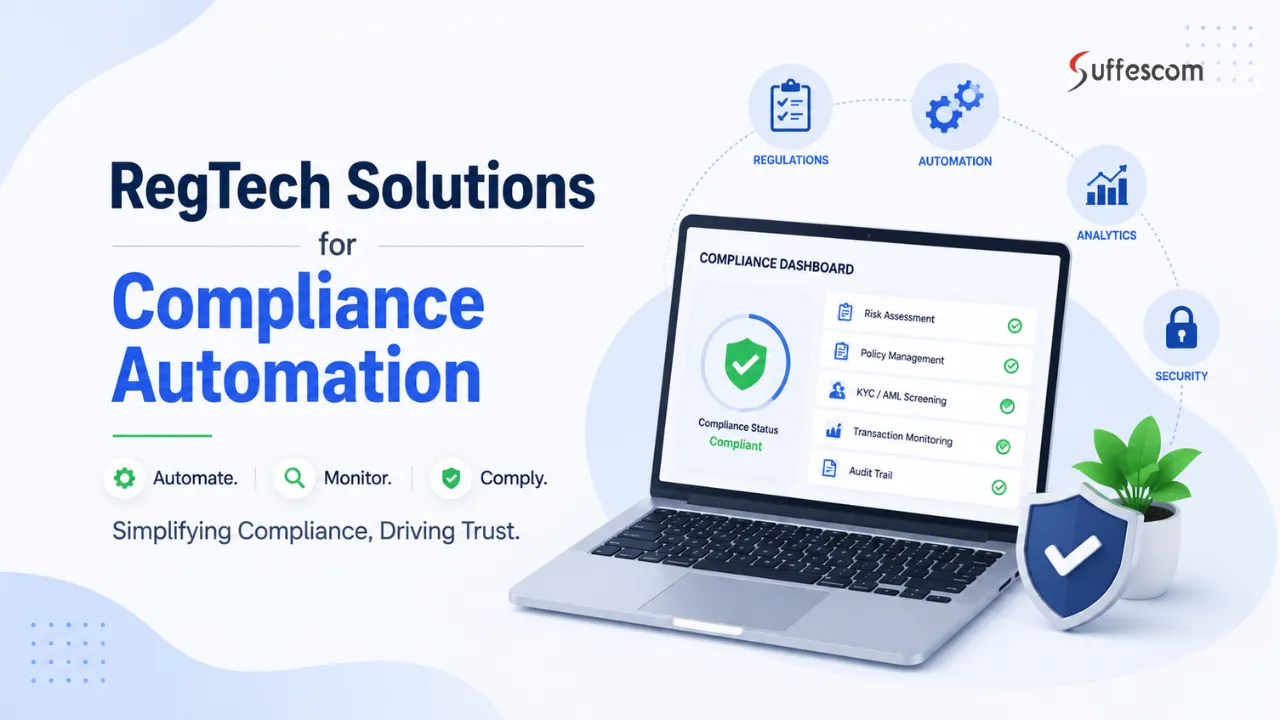
The current day’s RegTech platforms have mechanised the majority of RegTech-related repetitive activities that are typically done by a firm’s compliance department, which include aspects such as KYC, regulatory reporting, transaction monitoring, AML screening, policy management, risk assessment, and audit trail generation. By replacing the cumbersome nature of Excel files and manual procedures, businesses can slash down the operational cost, ensure better accuracy, and take rapid action to address regulatory shifts.
Evolution of RegTech in the UK Regulatory Landscape
Increased regulation has raised the bar in the UK over the past couple of years, with stringent AML regulations, Consumer Duty obligations, operational resilience and regulatory supervision impacting financial firms to an unprecedented level. Companies are embracing RegTech to move from being reactive to compliance management to providing continuous compliance monitoring.
RegTech vs Traditional Compliance Management Systems
Many legacy compliance systems still depend on manual data review, monthly reporting, and a patchwork of disconnected data. RegTech offers real-time compliance risk transparency, automated reporting, and enhanced proactive compliance management. As such, your team will be free to shift their attention from the compliance admin burden and towards broader compliance risk oversight.
Core Technologies Behind Modern RegTech Platforms
These tools cover AI, ML, RPA, Cloud, API integrations and advanced analytics. In essence, by availing these tools, organisations can continuously check the implementation of their controls, find out risks at an early stage, and efficiently expand compliance efforts without expanding the workforce size.
Ready to move from reactive compliance to continuous monitoring?
Why Compliance Automation Is a Strategic Priority
FCA and PRA Regulatory Pressure in the UK
This shift towards a more robust framework involves a focus from regulators across the UK on enhanced risk management, operational resilience, better customer outcomes, and fraud and financial crime. The need to demonstrate consistent ongoing compliance is now a key demand on firms rather than ad-hoc reviews and manual data reporting.
Rising Financial Crime and AML Risks
As fraud, money laundering, sanction busting, and cyber financial crime become more complex, the need for organisations to evolve and increase their capabilities for monitoring and detection becomes essential. Manual processes rarely catch suspicious activity quickly enough to keep up with contemporary standards.
Increasing Cost of Compliance Operations
Businesses are seeing increasing costs of compliance because of greater regulatory obligations and large reporting processes, combined with increased customer/transaction volumes of data. This is forcing a greater number of businesses to realise they cannot simply scale up the existing compliance team.
Human Error and Regulatory Exposure
Spreadsheet-driven workflows, fragmented systems, and human review all heighten the chance of reporting errors, overlooked alerts, and a lack of process consistency. A small error can quickly lead to regulatory violations, fines, and public embarrassment.
Shift Toward Continuous Compliance Monitoring
Today, we are no longer focusing on reactive assessments and once-yearly audits; we are seeing the widespread adoption of a real-time monitoring approach. And compliance automation ensures issues are being flagged faster and regulatory changes are being addressed in a timely manner. Compliance automation no longer looks like an initiative to improve efficiencies for a number of our UK clients; it is actually turning out to be a crucial requirement for risk and cost control, and to build regulator confidence.
UK Regulatory Landscape Driving RegTech Adoption
FCA Compliance Requirements
For UK companies within a regulated sector, there is a growing expectation from the FCA with respect to how they manage the business – with greater attention on governance, consumer protection, financial crime prevention and operational resilience. Businesses must be able to show not only their compliance outcomes but also the systems and processes by which these are being driven.
PRA Supervisory Expectations
As usual, the Prudential Regulation Authority is focusing heavily on risk management, operational resilience, stress testing and the governance structures of large banks, insurers and other large financial services firms.
UK GDPR Data Protection Rules
Organisations that process customer information have a number of legal obligations related to data capture, usage, storage and security that are enshrined within UK GDPR. A breach of data protection rules may result in serious penalties and cause severe damage to your reputation.
Anti-Money Laundering (AML) Regulations
AML compliance requirements will only be increasing. Customers are seeing greater regulatory emphasis being placed on customer due diligence (CDD), sanctions screening, beneficial ownership controls, and suspicious activity reporting. To meet these growing regulatory requirements and avoid penalties and reputational damage, businesses need automated KYC and transaction monitoring capabilities.
Consumer Duty Requirements
The FCA Consumer Duty is arguably the biggest piece of regulation we’ve seen in years, with firms mandated to achieve good outcomes for customers and be able to provide evidence of doing so in their product development, communications, and service provision to customers.
Operational Resilience Standards
UK regulators are increasingly expecting financial services firms to identify critical business services, identify the dependencies on the important business services, set and operate within impact tolerances and demonstrate resilience in times of operational disruption.
ESG and Reporting Expectations
Environmental, Social, and Governance reporting is also increasingly a part of the compliance agenda, with significant additional reporting and data management for most UK organisations. With regulatory compliance requirements expanding further across so many sectors, many are opting to use RegTech tools to aggregate and coordinate compliance functions, increase transparency and decrease regulatory risk through automation.
How RegTech Solutions Automate Compliance Processes
Automated Regulatory Reporting
Collecting the data needed to prepare reports can involve a considerable portion of the compliance team’s time and a high chance of manual errors occurring. Through a RegTech solution’s data gathering, validation and report building capabilities, organisations are able to deliver their reporting requirements much quicker and with a far higher level of precision.
Workflow-Based Compliance Automation
Nowadays, compliance processes are changing a lot. What used to take a long string of emails and spreadsheets has turned into smooth workflows or approved actions. This can significantly make things more predictable and manageable teamwide.
Real-Time Transaction Monitoring
This allows the RegTech to identify suspicious behaviour, sanctions breaches, and financial crime risks on the fly rather than waiting for period-end checks to identify the issues.
Regulatory Change Management
Compliance requirements are dynamic. But with the help of automation software, businesses can peek into the new changes and easily overview the implications of those changes. Alongside, they can update the appropriate control frameworks and policies to stay compliant.
AI-Powered Risk Detection
Machine learning models are used to sift through the high volumes of customer, transactional, and operational data in order to uncover anomalies and new risk trends that are not being caught by the current set of rule-based models.
Policy and Controls Automation
RegTech solutions automate policy distribution, control testing, attestations, and evidence gathering, minimising administrative workload and optimising audit readiness.
Audit Trail Generation
With the help of automated recording of all compliance activities, businesses can audit activities and approvals even better.
Continuous Compliance Monitoring
Companies can achieve a real-time view of compliance position through live dashboards, real-time alerts and automated risk reports rather than conducting an audit on a biannual or annual basis.
Automation of some manual compliance process activities will provide the business with greater cost savings, accuracy and relieve the compliance team from manual and mundane activities.
Let’s build compliance systems that scale with regulation.
RegTech Maturity Model: Compliance Automation Readiness
All companies aren’t in the same stage of their compliance automation journey. Assessing how sophisticated you are helps you spot where your systems fail you, what you should be investing your dollars in and then mapping a practical pathway to smarter compliance.
Level 1 – Manual Compliance Processes
Reporting involves manually reviewing emails, spreadsheets and disparate systems. The audits that are completed can be laborious, visibility is restricted, and all compliance tasks occur reactively.
Level 2: Digitised Compliance Systems
The company switches from paper to digital and from manual to centralised. Easy access to data; however, many parts of the workflow can still only be completed manually.
Level 3: Automated Workflows
There are normal day-to-day compliance activities such as alerts, reporting and monitoring. All these don’t really require the human brain. That’s why it is smarter to opt for workflow automation services and save on efficiency for better use.
Level 4: AI-Assisted Compliance
AI/ML begins supporting risk detection, anomaly identification, case prioritisation, and predictive analytics all in one single system. And that’s how compliance teams shift from a reactive to a proactive mindset.
Level 5: Autonomous Compliance Ecosystem
The compliance process is driven by real-time tracking, self-learning, and autonomous decision-making engines that evolve in accordance with the risks and regulatory updates, with humans in the loop only to the minimum.
For now, the majority of organisations across the UK have a compliance process at level 2 to level 3; the major banking institutions and digital agile fintech companies are transitioning towards AI-enhanced compliance models.
Industry Applications of RegTech Solutions
RegTech may have started in finance, but the benefits of compliance automation are now rippling across various industries in how risk and compliance are managed.
Banking and Financial Services Compliance
Banks and other financial companies and institutions use RegTech solutions to automate AML screening, KYC due diligence and identity verification, transaction monitoring, sanctions scanning, regulatory reporting, and anti-fraud measures, helping firms meet increasing compliance requirements without always having to hire more compliance staff.
FinTech Regulatory Automation
One of the most dynamic and fast-moving regulated sectors is Fintech. As RegTech providers, our tools allow for automated customer onboarding, digital identity verification, regulatory reporting, fraud prevention and detection, AML monitoring, managing financial crime and meeting the requirements of the Consumer Duty, allowing businesses to grow rapidly.
Insurance Compliance Systems
Compliance automation for insurers enables effective conduct risk management, customer outcomes, claims governance, fraud detection, regulatory reporting, and efficient operation.
Crypto and Digital Asset Compliance
Crypto exchanges and digital asset companies are under increased pressure to ensure they comply with AML and sanctions requirements and have the capabilities to monitor wallets and track transactions. Compliance with high-volume activities like this can be addressed using RegTech solutions.
Healthcare Compliance Automation
Healthcare organisations are using compliance technologies to strengthen data governance, privacy controls, audit trails, and regulatory reporting obligations while protecting sensitive patient information.
Enterprise GRC Systems
Major organisations are now looking at implementing RegTech functionalities into broader Governance, Risk, and Compliance (GRC) platforms in order to introduce a more consolidated and pre-emptive system of managing risk. While regulatory and reporting responsibilities might look extremely diverse across sectors, at heart the issue is quite similar: how to regulate increasingly stringent reporting mandates without incurring excessive additional administrative expense.
AI and Machine Learning in Compliance Automation
It’s hard to deny that artificial intelligence is one of the more promising technologies currently being adopted by compliance departments today. As regulatory demands continue to expand in scope, the transaction volume continues to skyrocket, and businesses are leveraging AI capabilities to enhance their capacity for compliance as opposed to simply scaling headcount to handle more volume.
Predictive Risk Detection Models
With standard systems, businesses normally uncover the risks after they have broken their standards. Through machine learning models that consider your behaviours, your history, and your financial transactions, businesses will see that a risk may be emerging before it actually turns into a compliance situation.
NLP for Regulatory Updates
By automatically scanning massive quantities of policy papers, public notices, regulatory updates, consultations and other texts – including many in public service jargon – Natural Language Processing (NLP) can speed up the way that compliance teams stay ahead of changes in regulations.
Automated Compliance Intelligence
With the ability to gather insights from numerous internal and external data sources, an AI platform can present the compliance teams with current views, risk levels, and actions in order to have the most efficient response and prioritisation capabilities.
Fraud Detection Systems
Machine learning algorithms can detect anomalies or suspicious behaviour that signals the risk of fraud, money laundering, account misuse, and sanctions avoidance-including risks that may not be identified by standard rule-based approaches.
Limitations of AI in Compliance
AI offers a number of benefits but is not a substitute for compliance experience or regulatory intuition; model governance, interpretability, bias and the human in the loop are critical elements for any smart compliance automation approach. Rather than substituting compliance professionals, innovative companies are augmenting their teams with AI to eradicate drudgery, boost judgment and free up experts to tackle strategic, regulatory initiatives.
Benefits of RegTech Solutions
Amid rising regulatory expectations, we’re seeing an increased trend among organisations implementing RegTech for more than just maintaining a good regulatory record. They are implementing the technology to deliver more effective, scalable, and resilient compliance operations.
Reduced Compliance Costs
Automation drastically slashes time spent on repetitive tasks like gathering data, reporting, monitoring and evidence collection – assisting organisations to get to grips with mounting compliance costs without ever increasing staff numbers.
Improved Regulatory Accuracy
When automating workflows, manual mistakes can be avoided, records are kept consistent, and errors in reporting, recording of actions for audit or outstanding duties can be avoided.
Faster Audit Preparation
Having a centralised record system, the automated documentation and evidence gathering in place for business internal audits or for reviews that take place for regulators, will make preparing for audits a great deal less time-consuming.
Better Risk Visibility
Compliance teams are gaining greater visibility of emerging risks and have an earlier opportunity to identify and remediate issues through real-time dashboards and monitoring solutions.
Increased Operational Efficiency
Automation can take over much of the work in the compliance space so that employees can concentrate on other areas like policy, regulation and risk management.
Scalable Compliance Operations
When companies expand, so does the volume and complexity of compliance tasks. However, RegTech solutions enable companies to effectively cope with customer acquisition, the increase of transactions and the need for reporting, without this translating into a proportionate increase in costs and resources. In conclusion, the real benefit of automating compliance procedures isn’t just to lighten the load, but it is that of empowering the organisation to be more proactive, reactive, agile and able to adapt to an evolving regulatory landscape.
RegTech Solutions Cost Overview (Based on Complexity)
The price tag for RegTech ranges from tens of thousands to many millions. It all comes down to the regulations, the volume of transactions, complexity, level of automation needed and amount of integration. An off-the-shelf solution is a lot quicker to install than a fully customisable end-to-end regulatory management system, perfect for very large and highly regulated organisations that are used to their own, and very specific, processes.
Key Factors Affecting Pricing
The various components that determine the total cost for your compliance automation program will typically include:
- Regulation complexity (FCA, AML, Consumer Duty, UK GDPR).
- Amount and complexity of customer, transaction, and reporting data.
- Integration with bank accounts, payment systems, CRM, and other third-party software.
- AI, analytics, risk scoring functionality.
- Custom workflows, approval flows, and reporting functions.
Cost by Complexity Level
Here is how much software development agencies in the UK usually charge for developing compliance automation software:
| Complexity Level | Typical Business Type | Estimated Annual Cost (UK) |
| Basic | Startups and early-stage firms | £5,000–£25,000 |
| Standard | SMEs and growing businesses | £25,000–£100,000 |
| Advanced | Mid-market regulated firms | £100,000–£300,000 |
| Enterprise | Large financial institutions | £300,000–£1M+ |
Cost vs Value Insight
The cost of a compliance solution needs to be factored into budgets; however, many organisations find this investment recouped through increased automation in terms of reduced manual workload, a streamlined audit process, lower operating expenses and fewer regulatory fines to contend with. Many organisations see a return on their investment within just 12 – 24 months, especially when it comes to AML processing, regulatory reporting, onboarding and compliance monitoring, which tend to have a higher volume of manual work.
How prepared is your business for the next wave of FCA scrutiny? Let’s assess your readiness!
RegTech ROI Calculator: Measuring Business Value
It’s easier to defend a decision to invest in compliance automation when you can actually demonstrate the impact it has both financially and operationally. We can’t quote exact figures as it really depends on the sector and how complex your compliance needs are, but it’s safe to say most will see the value in all three key areas.
Cost Savings from Automation
Automating processes, like generating reports, AML surveillance, and client registration, among many others, such as the creation of audit documentation, can reduce your hours on compliance activities.
Simple Formula:
Annual Hours Saved × Average Employee Cost = Estimated Annual Savings
Reduction in Compliance Staffing Needs
The organisation is not suggesting automation is the alternative for compliance teams, but is using it to enable greater scalability without scaling heads with the pace of compliance regulations.
Risk Reduction Metrics
Lowering the risk of missed compliance events, errors in reports, and skipped alerts helps reduce the probability of compliance issues resulting in investigation, penalty, rework costs, and damage to reputation.
Audit Efficiency Improvements
A constant flow of evidence, along with automatic document generation, can minimise the preparation time needed for an audit and other inspections.
Compliance KPIs to Measure
Businesses should track a combination of financial and operational metrics, including:
| KPI | Measurement |
| Cost Reduction | % of operational savings |
| Audit Time | Hours reduced |
| Risk Events | Reduction in incidents |
| Productivity | Increase in cases handled |
| Reporting Speed | Faster submission cycles |
Best-in-class compliance programmes don’t just look at savings. Benefits like agility, confidence and operational resilience provide longer-term benefits that are hard to quantify but strategically critical.
Common Challenges in RegTech Implementation
Although the potential operational and compliance benefits RegTech offers can be vast, there will need to be adequate planning, control and management as well as realistic expectations regarding any RegTech solution.
Legacy System Integration Issues
Organisations will often find themselves with complex technology stacks, involving core banking systems, CRMs, payment systems, and internal databases that were never intended to speak with compliance tools of the future. Integration complexity can quickly become one of the biggest challenges in an implementation.
Poor Data Quality
Compliance automation systems aren’t any stronger than the information they depend on. The absence of information from clients, variation in styles of knowledge, and duplicate knowledge sources can degrade the effectiveness of monitoring, reporting, and the scoring systems of risks.
User Adoption Barriers
At the end of the day, even the slickest compliance platform in the market is not going to add much value to the organisation if its employees continue to use existing legacy processes or develop their own manual workarounds. The key to successful adoption is Training & Change Management.
Regulatory Interpretation Complexity
Typically, regulations don’t provide step-by-step technical implementation guidance. Organisations still have to interpret and operationalise the legal and regulatory obligations into practical controls, procedures, workflows and monitoring rules.
Cybersecurity Risks
Customer, financial and operational data processed by compliance systems is frequently sensitive. Security architecture, encryption, access controls and governance controls must be inherent in the initial design, not as afterthoughts. When considering RegTech initiatives, best-in-class organisations tend to view a compliance transformation programme as a convergence of technology, process and people, not just the deployment of an application.
Compliance Automation Roadmap
Successful compliance automation projects aren’t an overnight sensation. By segmenting implementation into distinct phases, organisations can limit risk, increase adoption, and see faster ROI.
Phase 1 – Compliance Assessment (Days 1–15)
Identify the compliance requirements, the areas in high-risk use, those in need of manual support and which areas add the most to your operational workload to get started. These are essential for setting up your automation priorities and benchmarks.
Phase 2 – Vendor Selection (Days 16–30)
To make this a smooth transition, you need to identify and choose a RegTech that offers proven regulatory understanding, possesses the right features, will be easy to integrate and scalable, and complies with data security standards. Select a RegTech vendor that meets all of your current needs as well as your company’s future goals.
Phase 3 – System Integration (Days 31–60)
Connect the solution to existing banking systems, CRMs, customer onboarding, and data systems; also apply to all reporting solutions and data sources. Testing from day one uncovers potential data problems and workflow issues to prevent post-launch hiccups.
Phase 4 – Testing and Deployment (Days 61–75)
Confirm workflow accuracy, testing of reports, alert settings, and risk models against real-world scenarios to confirm control effectiveness.
Phase 5 – Training and Optimisation (Days 76–90)
Training for the compliance teams, tracking Adoption rates, improving workflows, and defining KPIs to measure improvements in performance and ROI in the long run. However, although times differ for varying degrees of complexity and regulatory impact, enterprises that adopt a staged implementation usually show faster results and lower risk of deployment.
RegTech vs GRC vs Compliance Software
Despite being commonly confused, RegTech, GRC platforms and classic compliance tools can tackle very different issues.
Key Differences Explained
RegTech is essentially a blend of regulatory compliance and technology utilising the power of AI, automation, and real-time analytics to address areas of AML monitoring, KYC checks, regulatory reporting, transaction monitoring, fraud detection and much more.
GRC tools give the enterprise a wider picture of the management of the internal controls, audit, corporate governance, policies, and risks within the organisation.
Traditional Compliance Software automates the digitisation and management of reporting, processes, etc., but generally requires many manual steps and a less-than-continuous approach to management.
Feature Comparison
| Feature | RegTech | GRC | Compliance Software |
| AI Capability | High | Medium | Low |
| Real-Time Monitoring | Yes | Limited | Limited |
| Automation | High | Medium | Low |
| Regulatory Intelligence | High | Medium | Low |
| Predictive Analytics | High | Medium | Limited |
| Scalability | High | Medium | Medium |
Cost Comparison
Typically, most traditional compliance software will be cheapest to implement but has few of the automation advantages of the alternatives. GRC platforms often come with high cost, but their enterprise-wide applicability means RegTech solutions tend to see a high ROI in the more regulated companies because of their strong focus on automation.
Best Use Cases for UK Firms
- RegTech generally makes more sense for a fintech startup, financial institution, payments provider, insurance provider, or regulated business with complicated regulatory needs.
- The GRC tool more commonly applies to large enterprises that want governance and risk management functionality across their entire organisation.
- Traditional software tools that comply can work in a smaller business setting if regulatory demands are simpler.
Many organisations find that a strategy of incorporating RegTech features into a more comprehensive GRC strategy will offer them more benefits than going with a single-solution RegTech approach.
How to Choose the Right RegTech Vendor
Choosing a RegTech vendor is not merely selecting software-it is a strategic choice in both your operations and compliance for years to come. Your RegTech solution needs to be flexible enough to accommodate evolving regulations and not just current requirements.
Regulatory Expertise
Check their experience with FCA-regulated industries, AML regulations, KYC processes, Consumer Duty compliance and UK data privacy rules. The regulatory know-how is often the more crucial element.
Product Capability Assessment
Assess whether the platform has the capability to handle your unique use cases such as monitoring, compliance, reporting, CDD, scoring, workflow, audit and more.
Security Standards
Compliance solutions are processing the most sensitive of customer and financial data. Review encryption protocols, user access protocols, audit logs, security certifications, and incident response processes before committing.
Integration Flexibility
A top RegTech solution would need to provide native and comprehensive integration capabilities with core banking, CRM, payment gateways, identity solutions, and internal risk platforms using APIs and modern integration frameworks.
Pricing Transparency
It’s also worth taking a close look at the total cost of ownership: how license fees translate, including implementation, integration and ongoing support and customisation costs, not to mention costs to scale. Successful RegTech projects tend to focus on the ‘why’, starting with business objectives, regulatory imperatives, and operational concerns, not by looking at features and capabilities alone.
Real-World RegTech Case Studies
RegTech is the solution for regulated companies to ease their compliance journey. The constantly changing demands of regulation can be eased using technology to lower the compliance operating cost, bring about enhanced transparency, and augment their risk and control processes.
Banking AML Transformation
A retail bank successfully automated its transaction monitoring, sanctions screening and suspicious activity identification with AI-driven risk models and real-time analytics, which helped speed up investigations, enhance alert prioritisation and cut the amount of manual work the compliance teams had to deal with.
FinTech Regulatory Automation Success
This fast-growing fintech company used automated workflows to streamline customer onboarding, KYC processes, etc. Using compliance reporting software, they can keep up with their growth without proportionately growing their compliance team. Automation accelerated time-to-onboard while staying compliant.
Insurance Compliance Optimisation
An insurance provider introduced workflow automation for conduct monitoring, audit evidence collection, and reporting activities. This reduced administrative effort and improved visibility into compliance obligations across multiple business units.
Enterprise Risk Reduction Outcomes
A massive regulated enterprise brought all compliance monitoring, policy management, and risk reporting under one RegTech platform and improved consistency, strengthened governance, and gained much-improved audit readiness throughout the organisation. Across industries, regulatory adoption may vary, but the result is always the same: less human labour and more visibility and scalability of regulatory compliance operations.
Compliance Automation Checklist (FCA-Regulated Firms)
If your FCA-regulated firm isn’t already implementing compliance automation for the high-priority tasks of risk management, resilience and ongoing operational activities, as well as regulatory reporting, you can start now with the help of the checklist below, which includes some of the top-priority actions to consider.
AML Controls
- Automated sanctions and PEP screening.
- Real-time transaction monitoring and alerting.
- Suspicious activity escalation workflows.
- Ongoing customer risk assessments and monitoring.
KYC Controls
- Digital identity verification processes.
- Automated customer due diligence workflows.
- Beneficial ownership verification.
- Periodic customer review and refresh mechanisms.
Reporting Controls
- Automated regulatory reporting processes.
- Centralised evidence and document management.
- Audit-ready reporting records.
- Compliance dashboard visibility across teams.
Consumer Duty Controls
- Customer outcome monitoring.
- Complaint trend analysis.
- Product governance tracking.
- Customer communication oversight.
Operational Resilience Controls
- Critical service mapping.
- Incident response workflows.
- Dependency monitoring and reporting.
- Business continuity testing documentation.
| Control Area | Priority |
| AML | High |
| KYC | High |
| Reporting | High |
| Risk Monitoring | High |
By automating these fundamental controls, these firms enjoy quicker audits, more effective governance, and greater visibility of compliance risks.
Future Trends in RegTech
The RegTech platform of the future will not just be automated but also intelligent and agile, with compliance ecosystems ready to adapt to evolving regulatory requirements immediately.
Autonomous Compliance Systems
Compliance systems are slowly changing from a purely rule-based automation approach to autonomous systems that proactively detect risk, suggest remedies and make automated routine decisions.
Real-Time Regulatory Intelligence
AI-powered regulatory intelligence engines are beginning to analyse consultation papers, regulatory updates, enforcement actions, and policy changes automatically, helping organisations react faster to new obligations.
ESG Compliance Automation
The increased demand for ESG reporting has led businesses to turn to automation tools for managing and reporting sustainability data under different regulations.
Open Banking Compliance
Open banking ecosystems keep expanding to new business areas, resulting in an increasingly difficult regulatory environment in the field of consent management, API management, data protection, and third-party risk management.
Cross-Border Compliance Automation
With firms operating in more than one jurisdiction, the compliance function needs a platform to handle conflicting regulations using a single operating model.
The organisations that get the most benefit from RegTech over the next 10 years will not be the most regulated firms but the first movers to automate and then scale effectively.
Best Practices for Implementation
Technology in isolation is not enough for effective compliance automation; successful companies have a combination of platform, data, clear governance and objectives.
Compliance Gap Analysis
Start by mapping your existing compliance gaps, manual process bottlenecks, redundant work and areas of high risk. Identifying the key current problem will highlight where you should focus your automation efforts for the greatest impact.
Risk Prioritisation
It’s not necessary to automate all compliance steps on day one. Target those that involve the greatest compliance risk and operational workload, and have a direct bearing on the financial bottom line, for instance: compliance on monitoring, client diligence, and regulatory submissions.
Governance Framework Setup
Ownership of processes and procedures, approval chains, escalation procedures, and responsibility models should all be clarified pre-deployment. Effective governance practices help automation of regulatory compliance stay current with regulatory expectations and the business goals and requirements.
KPI Tracking
There is no single metric that proves success, but companies should be tracking reporting turnaround, time spent preparing for audits, false positive rates, operational spend, and the volume of incidents. Ongoing tracking makes process improvement and the highest possible ROI possible.
Compliance Leader Perspectives
At many financial institutions in the UK, compliance and risk leaders are moving the needle from manually monitoring activities towards an automated approach to risk and compliance management. The question for those at UK financial institutions isn’t really when they should automate their compliance efforts, but which activities provide the best value by automating those areas first? When those in the UK financial services have asked this question, the common themes have been the operational burden or regulatory exposure in areas such as AML monitoring, Customer onboarding, Regulatory reporting, and audit management.
Regulatory Trends to Watch
The following trends are likely to influence compliance operations in the future:
- Increased regulation on issues of operational resilience and customer outcome.
- Greater reliance on artificial intelligence and machine learning for risk management.
- More emphasis on continuous compliance as opposed to periodic assessments.
- Expansion of ESG and sustainability reporting regulations.
- More attention to third-party and supply chain risks.
Companies that make investments in robust compliance infrastructures at an early stage are more likely to be able to cope with any future regulatory changes.
Common Implementation Mistakes
Although there are compelling business cases for them, compliance automation initiatives often fall short because companies:
- Try to automate flawed or ineffective processes.
- Underestimate the complexities of integrating into legacy systems.
- Do not consider data quality and governance considerations.
- Prioritise the functionalities of the software over its business purposes.
- Do not develop measurable success criteria.
The best RegTech initiatives start with a good understanding of compliance risks, operational needs, and business strategies before anything else.
Additional Resources & Regulatory References
Organisations that adopt compliance automation should make sure to follow relevant guidance from regulators and standard-setting bodies to ensure that their controls keep up with expectations.
FCA Official Guidance
There is plenty of guidance available from the FCA, including on issues such as Consumer Duty, financial crime controls, operational resilience, reporting, and other regulatory expectations of authorised firms.
PRA Publications
PRA publications are useful in providing insights regarding supervisory expectations, governance frameworks, operational resilience, and risk management.
ICO Data Protection Resources
Companies that process their customers’ data must consult UK GDPR guidance, cybersecurity guidelines, and data governance standards.
FATF AML Guidance
The Financial Action Task Force offers internationally recognised recommendations on issues such as anti-money laundering, counter terrorist financing and customer due diligence controls.
NCSC Cybersecurity Guidance
Cybersecurity has become an important aspect of modern compliance programs, especially those dealing with sensitive customer and financial information.
UK Government Regulatory Resources
Governments’ guidance is helpful when trying to figure out what your obligations under financial crime, sanctions, operational resilience, and digital regulation are.
Future-proof your compliance strategy with intelligent automation.
Conclusion
There are increasing expectations regarding AML, KYC, Consumer Duty, operational resilience, and data protection that make UK companies’ compliance more complicated than ever before. Manual processes become too costly and hard to scale as a result, which makes it more necessary for the company to use RegTech tools for automation of reporting, improving accuracy, audit readiness, and reducing regulatory risks.
Businesses that build compliance automation into the early stages of software development will have the greatest advantage in the coming years. It is possible for a company to create a smart and robust compliance function that is ready for new regulations in 2026 with the help of proper technology and implementation. For businesses that are going to make their next move in compliance, our team helps organisations identify where compliance automation can deliver the greatest reduction in cost, risk, and operational burden. Talk to our expert now!
FAQs
What are RegTech solutions?
The RegTech solution is an automated software platform with AI and analytics that help organisations meet their regulatory obligations. Common use cases are: AML, KYC, Regulatory Reporting, risk management, and Audit.
How does compliance automation work?
Compliance automation refers to the use of software to automate compliance processes that include collecting data, generating reports, carrying out customer due diligence, transaction monitoring and policy management.
What industries use RegTech?
RegTech solutions are applied extensively in banking, fintech, insurance, payments, healthcare, crypto, and many other highly regulated industries that need to handle numerous compliance tasks.
Can RegTech help with FCA compliance?
Yes. The use of RegTech platforms can assist in automating reporting, monitoring regulatory risks, improving audit trails, Consumer Duty compliance, and financial crime control for compliance with the FCA.
What is AML automation?
Anti-money laundering automation is where software is used to automate AML processes such as customer screening, sanctions checking, transaction monitoring, detection of suspicious activities, and continuous assessment of risks posed by customers.
What is KYC automation?
The KYC automation process makes use of digital identity verification, document validation and workflow automation in order to help in automating customer onboarding and due diligence processes.
How much does RegTech cost?
When it comes to price, RegTech cost is an interesting topic because it hinges on variables like how complex the RegTech is, integration requirements, how many transactions the organisation processes, and, of course, how strict regulations are. It’s a good rule of thumb that British businesses will be looking to pay anything from £5,000 to upwards of £1m annually for this type of solution.
What is the ROI of compliance automation?
Return on investment (ROI) for most companies is realised through less manual processing, faster audits, more efficient reports, and reduced exposure to regulatory risks. The majority of companies can see ROI within 12 to 24 months.
How long does implementation take?
The duration of the implementation varies according to the complexities of the project and the integration. Small-scale implementations might be done within a few weeks, while large-scale implementations may require months.
Is RegTech secure?
RegTech solutions typically have built-in encryption, audit logs, access controls and security monitoring in order to ensure the safety of your customer and regulation-related data.
What is the difference between RegTech and FinTech?
FinTech refers to the application of technology to improve financial products and services, while RegTech focuses on how businesses manage regulatory and compliance needs.
Can SMEs use RegTech solutions?
Yes. A number of cloud-based RegTech solutions are tailor-made for SMEs and fast-growing businesses that require affordable and scalable compliance solutions.
What are the biggest challenges in implementation?
. These are some of the common problems: Legacy systems integration, data quality, resistance to adopting the system, understanding regulations, and cybersecurity.
How does AI improve compliance?
AI helps in enhancing compliance through pattern recognition, risk prioritisation, investigation automation, analysis of regulatory changes, and minimisation of false positives in the monitoring system.
What is the future of RegTech?
RegTech of the future will have such features as autonomous compliance systems, AI-powered regulatory intelligence, real-time monitoring and cross-border compliance automation.

Senior Content Strategist
Jonathan Raabe is the Content Strategist at Suffescom Solutions and has more than 7 years of experience in developing data-driven content strategies for technology-centric organizations. He is proficient in the areas of mobile app development, software development, AI, cloud computing, fintech, healthcare, and digital transformation. Jonathan collaborates with industry leaders, developers, and business heads in creating high-value, SEO-optimized content that helps companies in increasing their visibility on the search engines, establishing trust, and driving business inquiries.
Need Help With
Development?