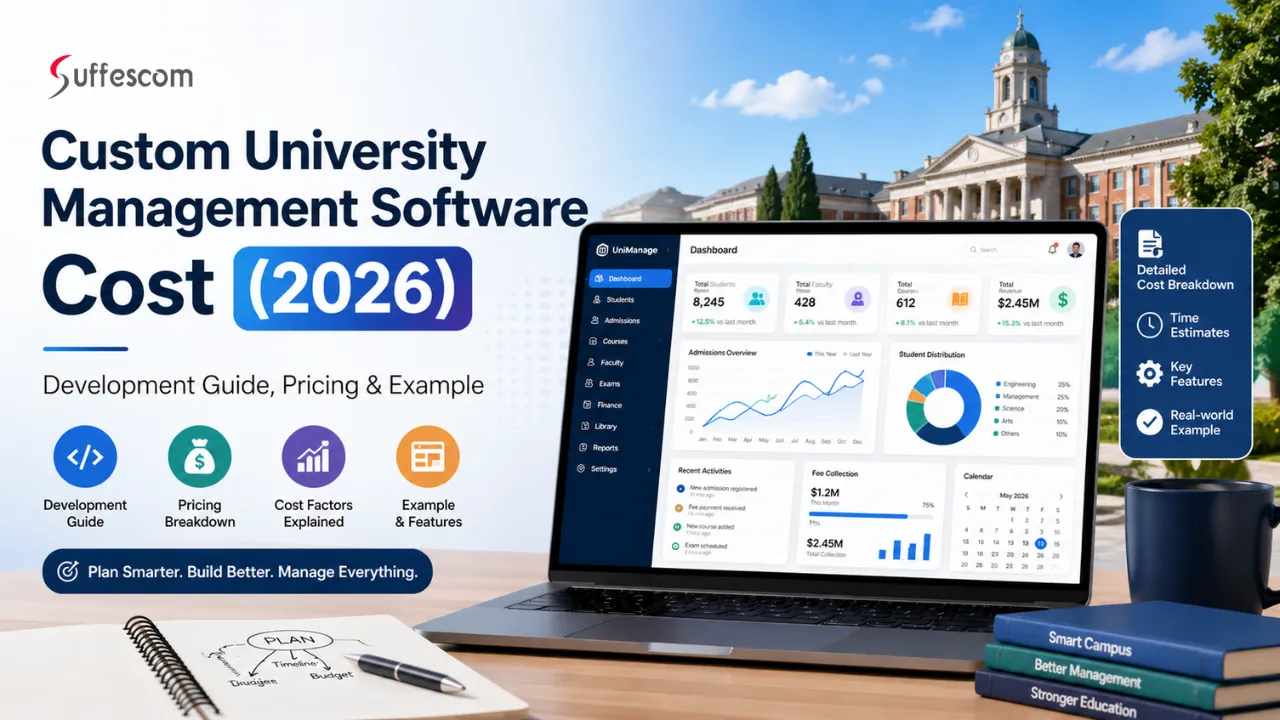
University management software is a system that universities use to manage their daily operations. This includes things like admissions and student records, finance, timetables, and staff management and reporting. University management software brings all these things into one platform, which makes it more efficient. It also makes the data more accurate.
In the United Kingdom, many universities are now moving away from systems that you can buy. They are investing in systems that are built just for them. They are doing this because they need something that can work better with the systems they use, and they need to follow the rules, and they want to make things better for their students. The systems that you can buy often cannot handle workflows or the special needs of each university, which is why more and more universities are choosing to have their systems built just for them.
When we talk about how much university management software development costs, there is no fixed price. However, in 2026, the prices for custom university management software in the United Kingdom are usually between £7,000 and £40,000 or more. This depends on the size and complexity of the system. At the end, which is £7,000 to £15,000, you usually get a basic system. This system may include things like student enrolment, simple reporting, and user management. These systems are good for colleges or as a starting point.
If we look at the range, which is £15,000 to £25,000, we see that these systems are more advanced. They often include modules such as admissions, finance and learning management integration and staff portals. They also have a design and stronger security. This is the common range for medium-sized universities in the United Kingdom. At the end, which is £25,000 to £40,000+ or more, you are looking at a full enterprise-level university management system. These systems can support thousands of users. They include complicated integrations, such as CRM and ERP, and government databases, and they meet strict requirements. Large universities with campuses usually need systems like this.
There are things that can affect the final cost of university management software. The biggest thing is the scope of the project. Every extra feature can add thousands of pounds. If the system needs to work with systems, or if it needs to be very secure, or if it needs to be accessible on mobile devices, these things can also increase the price significantly. It is also important to think about the costs that come after the system is built. Maintenance, updates, and hosting can add 15 to 25 percent of the cost each year, and many organisations do not think about this.
In summary, custom university management software is an investment, but it is worth it in the long run because it makes things more efficient, allows the university to grow, and gives it more control. The key is to start with an idea of what you want and a realistic budget before you begin building the system. University management software is a part of this, and it is something that universities should think carefully about when they are planning for the future and looking at university management software.
What is Custom University Management Software?
Custom University Management Software is something that universities really need. It helps them manage all the stuff like academic and administrative tasks in one place. This software is different from tools because it is made to work the way a university actually works. One of the things about Custom University Management Software is the Student Information System. The Student Information System manages all the information about students like when they apply, when they come to class, what grades they get and other personal details. The Student Information System keeps all these records neat and easy to find.
Another important part of Custom University Management Software is the Learning Management System. The Learning Management System helps with learning by letting teachers put up course work, track how students are doing and manage their assignments and exams. Custom University Management Software may also have tools for admissions and managing relationships with customers. These tools help universities manage applications, talk to students who might want to come and make the process of enrolling easier.
Custom University Management Software also often has things like finance, human resources and reporting. These things handle payments, salaries for staff, budgeting and making reports. When you put all these things together in Custom University Management Software, it makes things more efficient. Helps people make better decisions about the university.
Custom vs Off-the-Shelf Software
Custom software is made for a university from the very beginning. This means the university can make the workflows how they want them to be, and they own the system completely. It also helps that the software can grow and get better as the university gets bigger. It usually takes a longer time to make and costs more money.
Off-the-shelf software is already. Can be used right away. You pay a subscription fee to use it. It can be set up fast. Does not cost as much at first. However, it might not work perfectly with the university’s way of doing things. It also does not give room to make changes.
To put it simply, making custom software gives a university control and the ability to make changes. Buying off-the-shelf software gives them speed and ease of use. What a university chooses depends on what they want to achieve, how much money they have, and what they plan for the future.
Real Cost of Custom University Management Software in the UK (2026)
Actual Price Ranges (2026)
The cost of custom university management software in the UK in 2026 is different because of how big and complicated the system is. Custom university management software can cost between £7,000 and £15,000 for a system. This kind of custom university management software is good for colleges and it has important things like student records and basic administration for the custom university management software.
There is also a scale system for custom university management software that can cost between £15,000 and £25,000. This custom university management software is for universities that need things like admissions management and finance modules, and the ability to work with other platforms for the custom university management software.
For institutions, they can get an enterprise system for custom university management software that costs £25,000 to £40,000 or more. This custom university management software supports campuses and a lot of users and it has good reporting and strong security, for the custom university management software.
Cost Overview Table
| System Type | Ideal For | Estimated Cost | Timeline |
| Basic MVP | Small colleges | £7K – £15K | 3–6 months |
| Mid-Level System | Universities | £15K – £25K | 6–9 months |
| Enterprise Platform | Multi-campus | £25K – £40K+ | 9–18 months |
MVP vs Full System Cost
When you are trying to decide between an MVP development and a full system, it is a decision. The Minimum Viable Product costs around sixty thousand pounds to one hundred and twenty thousand pounds. It only has the basic features, so you can get it out there fast. This is a way to test your ideas and not spend too much money at first.
A full system is different. It costs between one hundred and fifty thousand pounds and five hundred thousand pounds or more. It has all the features you need, and it can handle a lot of users. It will last a long time. This makes it perfect for universities like Cambridge University that have a lot of complex needs and want a Minimum Viable Product is not enough; for them, they need a full system.
Cost Breakdown by Modules of Custom University Management Software
The cost of custom university management software is based on the parts that are included. Each part does something, so universities can save money by picking only the parts they need. The cost will be different depending on the custom university management software that is chosen. Universities can get the custom university management software they want by selecting the parts.
Core Modules
Core modules are essential for everyday university operations. These are usually the starting point for any system.
| Module | Estimated Cost | Description |
| Student Management | £5K – £8K | Manages student records, attendance, grades, and profiles |
| Admissions | £3K – £10K | Handles applications, enrolment, and communication with applicants |
| LMS | £7K – £12K | Supports online learning, course content, and assessments |
| Finance & Payroll | £5K – £9K | Manages fees, staff salaries, and financial reporting |
These modules can form a complete system for small to mid-sized institutions.
Advanced Modules
Advanced modules are available for universities with complex needs. These modules add features. However, they also make it more expensive.
| Module | Estimated Cost | Description |
| AI Analytics | £4K – £7K | Provides data insights, reporting, and predictive analysis |
| Research Systems | £8K – £12K | Manages research projects, funding, and publications |
| Multi-Campus | +£5K – £9K | Supports operations across multiple campuses |
So when we talk about the core modules, they do the things that we need. The advanced modules make things work better and help us do more. We have to pick the core modules and advanced modules to get what we want without spending too much money. This way, you can get the balance between what the core modules and advanced modules cost and what they can do for us.
Get a Custom Quote for Your University Software Project
Key Factors That Affect the Cost to Develop University Management Software
The cost of custom university management software in the UK depends on key things. These things affect how much the software costs and how long it takes to develop. How well it works.
Software Complexity
How complex the software is plays a role in the cost. A simple university management system with modules like student records and attendance will cost less. A system with features like automation, AI tools, and real-time dashboards costs more to develop.
Number of Users
The number of users also affects the price. A system for a college with few users is easier and cheaper to build. A system for a large university with many students, lecturers, and admin staff needs a high-performance system, a better database, and strong scalability, which increases the cost.
Integrations Required
Modern education management software needs to work with other systems like payment gateways, learning platforms, and government portals. Each integration adds development time, testing, and maintenance costs. The more complex the integration, the higher the final cost.
Development Team Location
Where the software development company is located affects the cost. In the UK, developers charge a lot per day. Offshore development teams may charge less per day. Communication and project management need to be carefully considered.
UI/UX Requirements
A user interface and user experience (UI/UX) design for university software makes it easier for students and staff to use. A simple interface costs less. A customised, modern, and responsive design costs more. Good UX is important for adoption. Adds to the budget.
Security & Compliance
Security is critical in any student information system. Universities must comply with regulations like GDPR. Features like data encryption, role-based access, and secure cloud hosting increase development costs. They are essential to protect sensitive academic and financial data.
In summary, these factors together shape the cost of a custom-built university management platform. Understanding them helps institutions plan a budget and choose the right development approach for their university management software.
Cost Per Student Model in a University Software
The cost per student model is a way to see the value of a custom university management system. It is useful because it does not just look at the cost of developing the software. Universities can use it to see how much they are spending on each student. This helps the people who make decisions understand what they are getting for their money in the run.
Why This Metric Matters
The cost per student model is important for a reason. First, it helps show that the money spent on education management software is an investment when asking for budgets from senior management or funding committees. It shows that the software directly helps each student.
Second, universities use this model when planning their budgets because it is a way to compare the costs of different systems. It does not matter if a university has a small number of students or a large number of students, like 1,000 students or 10,000 students. The cost per student model makes it easier for universities to plan their finances.
Cost Per Student Table
| University Size | Total Cost | Cost per Student |
| 1,000 students | £10,000 | £10 |
| 5,000 students | £25,000 | £5 |
| 20,000 students | £40,000 | £4 |
If you look at the table you can see that bigger institutions save money because they can buy things in bulk. This means that when a university has students it does not have to spend as much money on software for each student.
Insight:
One important thing we learned from this is that bigger universities spend money on each student so making their own systems is a good idea in the long run. Even though it might cost more to get started with software it is worth it because the system gets better and better as more people use it.
To put it simply, the bigger the university is, the more money it has to spend on the system for each student, so making custom systems is a great way for big institutions, like universities, to save money on software.
Build vs Buy vs Hybrid Model (2026 Decision Framework)
When you are trying to pick a university management system schools, in the United Kingdom usually have to choose between making their system by buying a university management system that is already made or using a mix of both. This choice affects how much it costs to develop the software, how flexible the university management system is, how well the university management system can grow and how money the university management system will make in the long run.
Comparison Table
| Approach | Upfront Cost | Flexibility | Long-Term Cost | Best For |
| Custom Build | High | Full | Lower | Large universities |
| SaaS | Low | Limited | Higher | Small colleges |
| Hybrid | Medium | High | Medium | Growing institutions |
A university software system needs a lot of money to start with but it gives the university full control over what it can do and how it works. This is really good for universities that have a lot of complicated things to deal with.
On the other hand, software that is already made and sold as a service is cheaper to start using and can be set up quickly. However, it does not give the university much freedom to make changes and it costs money every month, which can add up over time.
The hybrid model is a mix of both options, so it is a balance.
Hybrid Model Explained
The hybrid model for university software takes the things from custom-built and sold as a service software. For example a university might build its system for student information but also sell as a service system for managing what students learn.
This way, the university can save money on development. Still have control where it is needed. It also means universities can use tools for teaching and learning quickly while still having a system for student data that is tailored to their needs.
Additionally, the hybrid model makes it easier for universities to grow because they can update or replace parts without having to rebuild the whole system. This makes it a practical choice for universities that are growing and want to control costs without losing functions.
Overall the best choice depends on how much money the university has, how big it is and what its long-term plan is, for using digital technology and what the university software system will be used for, like university software system.
Real Budget Planning Framework
Planning a budget for a custom university management software is really important. This is because we need to avoid spending a lot of money and having delays. When we have an idea of what things cost universities can see where the money is going and how to keep the overall cost of developing the software under control. This way universities can manage the budget for their custom university management software better.
Budget Allocation Table
| Category | % Allocation | Example (£30K Project) |
| Development | 50% | £10,000 |
| UI/UX | 10% | £4,000 |
| Integrations | 15% | £6,000 |
| QA & Testing | 10% | £5,000 |
| Contingency | 15% | £5,000 |
In projects to develop education software, the biggest part of the money goes to making the software. This includes making the main parts like the Student Information System, admissions and tools to handle money. The university platforms also need to look good and be easy to use for students and staff so we need to spend money on that
We also need to connect the system to systems like payment gateways, tools for learning and cloud services. This takes a part of the money too. We need to make sure the system is stable, safe and follows the rules of GDPR.
Key Budgeting Tips
One important thing to remember when planning the cost of software is to have some extra money, about 10 to 20 percent, in case something unexpected happens. This helps when we need to make changes, add things, or fix technical problems while we are making the software.
Another important thing to know is that it can cost more than we think to connect our system to other systems. Many universities focus on making the parts of the software but they forget that connecting to other systems can take more time and money.
In summary, if we plan the budget for university IT, it will be easier to finish the project. We will have surprises and the university will get more value from the money they spend on the software.
Hidden Costs Often Missed in Developing a University Management Software
When planning a custom university management system (UMS) budget many schools focus on development costs. There are several hidden software costs that can add up over time. Knowing these helps universities avoid financial pressure.
Maintenance & Support
After the system launches we need software maintenance and support to keep it running smoothly. This includes bug fixes, security updates, performance improvements and small feature enhancements. Usually maintenance costs are 15-25% of the original development cost per year. Over time, this becomes a part of the total cost of owning university software.
Hosting & Infrastructure
Another hidden cost is hosting and IT infrastructure. Universities need servers, databases and backup systems to store sensitive student and financial data. Costs can go up depending on traffic, storage size and performance requirements. As more users join, hosting expenses also increase. University management system (UMS) requires hosting.
Training & Change Management
A new education management system needs training for staff, lecturers and administrators. This includes workshops, user manuals and onboarding sessions. Change management is also key because staff need time to adapt to workflows. These training costs are often. Are essential for successful system adoption of university management system (UMS).
Data Migration
Moving data from systems to a new student information system (SIS) can be complex and time-consuming. Data must be cleaned, structured and securely transferred. Poor planning in data migration projects can lead to delays and extra costs especially when dealing with historical records. University management system (UMS) data migration requires planning.
In summary these hidden costs play a role in the overall university software budgeting process, for university management systems (UMS). Factoring them in early helps institutions avoid surprises and ensures long-term operation of the university management system (UMS).
Custom vs SaaS Cost Comparison
When you are trying to pick a university management system you have to think about what’s best for your school. You have to choose between getting someone to make software just for you or using a Software as a Service solution. These two options are very different when it comes to how much they cost to make, how flexible they are, who owns them and how good they are in the long run.
The special software is made for your university. You have to pay a lot of money at first. Then you have complete control over it and it can grow with your school. The other option is to use a Software as a Service platform. This is faster to set up and cheaper at first. It has some limits on what you can do with it and you have to keep paying for it every month. A university management system is what you need to run your school so you have to think carefully about which one to choose: a university management system that is custom made or a university management system that is a Software as a Service solution.
Cost Comparison Table
| Factor | Custom Solution | SaaS Solution |
| Upfront Cost | High | Low |
| Long-term Cost | Lower | Higher |
| Flexibility | Full | Limited |
| Ownership | Yes | No |
Key Insights
When universities get custom software made, they have to pay a lot of money at the start because the system is made from scratch. Then the university owns the system completely, so they can change it, make it bigger, and add any tools they want without any problems. This usually means that the university saves money in the long run.
On the other hand, universities that are not very big like to use software that is already made because they do not have to pay a lot of money to start using it. They have to pay a little money every month or every year, and this can add up to a lot of money over time. Also, these universities might not be able to change the software much, or get all the information they need, or use it with other systems they already have.
If we think about what universities get for their money, custom software is better for universities that need a lot of special things.. Software that is already made is better for smaller universities that do not need as much.
In the end the university has to think about how much money they have, how big they want their system to be and what they want to do with technology in the long run to make a decision, about custom university software development and SaaS-based education platforms and custom university software development.
Timeline to Build University Management Software in UK
The development timeline for a custom university management system depends on the size, features and complexity of the university management system. A clear software development lifecycle helps universities plan budgets, resources and rollout strategies for the university management system effectively.
Development Timeline
For projects a Minimum Viable Product of the university management system can usually be delivered in 3–6 months. This version of the university management system includes core features like student management, admissions and basic reporting for the university management system. It is often used by colleges or institutions that want to test the university management system before full investment in the university management system.
A full university management system takes longer typically 6–12+ months. Larger or more complex university management systems with modules such as Student Information System, Learning Management System, finance, HR and integrations require more development time, testing and deployment planning for the university management system.
Delays can also occur due to integration requirements UI/UX design changes and data migration from legacy systems to the university management system.
Agile vs Fixed Approach
There are two approaches to building education software solutions for university management systems:
Agile Development Approach:
This method delivers the university management system in phases or “sprints.” It allows feedback, faster changes and better flexibility for the university management system. Many modern software development companies prefer Agile because it reduces risk and improves product quality over time for the university management system.
Fixed Approach:
This is a traditional method where the entire university management system is planned and built in one fixed timeline. It is less flexible. Can be useful when requirements are clearly defined from the start for the university management system.
In summary Agile is better for complex and evolving university IT systems like the university management system while the fixed approach works for well-defined projects, for the university management system.
Get a Detailed Software Project Timeline
Know how long your university management system will take from idea to launch.
Cost Saving Strategies in University Management Software Development (2026)
Building a custom university management system can be very expensive. However there are ways to save money. These ways help reduce the cost of making the software without making it worse. In 2026 universities are using planning and new tools to stay within their budget. They want a university management system that works well and does not cost much. Universities are looking for ways to make a university management system without spending a lot of money.
Cost Optimization Table
| Strategy | Cost Reduction | Risk |
| MVP approach | Up to 40% | Low |
| Offshore dev | 50–70% | Medium |
| AI tools | 20–50% | Low |
| Hybrid model | ~30% | Low |
Key Cost Saving Strategies
One good way to start is with a Minimum Viable Product. This means you focus on the things that a student management system needs, like admissions and simple reporting. This approach helps you get started faster. Can save you a lot of money which is great for schools that do not have a lot of money to spend.
Another way to save money is to work with software developers in other countries. These countries often charge less for the work so you can save up to 50-70% of your money. However, you have to be careful and make sure you can communicate well with the developers and that you are working in the same time zone or it can cause problems with your project.
Nowadays, people are also using tools that use Artificial Intelligence to help build education software. These tools can do a lot of the work for you like writing code, testing and looking at data, which saves you time and money 20-50%.
Finally, some schools use a mix of building their system and using a system that is already made, called SaaS. For example, a university might build its own student information system but use a SaaS platform for its learning management system. This can save them around 30% of their money. Still give them the freedom to make changes as they need to.
In summary, using these methods together helps universities build systems that can grow with them without spending much money on a Minimum Viable Product and other software development methods.
Real Examples of University Software Pricing
University management software prices vary a lot depending on the size of the university, the features they need and how much they want to customize the system. In the United Kingdom and other countries the cost can be very different between commercial systems and open-source systems.
Enterprise Systems
Big universities with students and several campuses need special software to manage everything. This kind of software usually includes systems for student information, learning, money, staff, analysis and connections to systems.
These systems are very expensive. The price can be more than £50,000 and even over £70,000. This is because they take a long time to develop, have to follow strict rules to protect personal data, have strong security and can be used for a long time.
Big public universities or universities with campuses use these systems because they need something that is very reliable and can be controlled from one place.
Open Source Alternatives
There is another option for universities, which is to use open-source software. This kind of software is free to use. The cost at the start is lower.
However universities still have to pay for customising the software hosting it, maintaining it and developing it technically.
Open-source systems are cheaper to start with. They need more work from developers to make them work properly, add new features and make sure they are secure.
So even though the initial cost is lower the total cost can still go up over time if it is not managed properly.
In summary, commercial university management software systems are expensive. Work well and can be used for a long time while open-source systems are cheaper at first but need more technical work. The best choice for a university depends on their budget, what their IT team can do and their long-term plan for using technology. University management software is a thing to consider when thinking about university management software pricing and how it affects university management. The cost of university management software is a part of university management.
Is Custom University Software Worth the Cost?
So you want to know if a custom university management system is a good idea. It really depends on how big the university’s what it wants to achieve. A university management system has to fit the university’s needs. If a university is very big, it might need a system that can handle a lot of things.
The cost of making a custom university management system can be very high. In the long run, a custom university management system can be very useful for many universities.
ROI Factors
One of the reasons universities choose custom systems is the return on investment. A built education management system can save money and add value in several ways.
Automation savings:
Universities can save money by automating tasks like processing admissions, tracking attendance and managing fees. This reduces the work that staff have to do and lowers costs over time.
Admin workload:
Staff spend less time on repetitive tasks and more time helping students and working on important projects. This makes the university run smoothly.
Improved student experience:
A modern digital platform helps students access learning materials, communicate with staff and use services more easily. This makes students happier and more likely to stay at the university.
Together, these benefits often help universities get their money back, over time while improving how well they work.
When Custom Software Isn’t The Best Option
However, custom software isn’t always the choice. For schools with basic needs, a fully custom system can be too pricey and unnecessary.
If a college only needs things like student records, attendance and basic reporting a university system based on software as a service or an open-source solution might be more affordable. In cases the high initial development cost of a custom platform may not give enough extra value.
In short, custom university software is most useful for growing schools with complicated needs. For organisations simpler solutions might offer better value, for money and quicker setup.
How to Get Accurate Cost Estimates
Getting an idea of how much it will cost to develop custom university management software is really important before you start a project. Planning carefully helps universities avoid spending a lot of money and understand the total cost of developing the software.
Discovery Phase
The discovery phase is the step in figuring out the cost. During this time, the team that will develop the software looks at what the university needs, decides what parts the system will have, and figures out what technical things are required. For a university management system, this might include a Student Information System, connecting it to a Learning Management System, tools for managing money, and features for making reports.
This phase also involves making drawings of what the system will look like, planning out how users will interact with it, and creating a basic plan for the project. If the discovery phase is done well, it reduces the chance of problems. Make sure the final estimate is more accurate.
Cost Formula
A simple way to calculate the cost of developing software is to use a formula:
Hours × Rate = Total Cost
For example, if a project will take 2,000 hours to develop and the hourly rate is £50, the total cost will be £100,000.
This method helps universities see how changes to the project, like adding or removing features or connecting it to systems, will affect the final cost. It is a way to estimate the cost of custom software.
Vendor Selection Tips
Choosing the right software development company is critical for getting accurate pricing and successful delivery.
- Always compare multiple vendors to understand market rates
- Check experience in education software development or similar systems
- Ask for a detailed breakdown of features, timelines, and hidden costs
- Ensure the vendor offers post-launch support and maintenance
- Prefer teams that follow Agile development for better flexibility
In summary, accurate UMS cost estimation depends on proper planning, transparent pricing models, and selecting the right development partner.
Conclusion
In summary, getting the price for university management software depends on planning carefully, being clear about costs, and picking the right software development agency.
The cost of custom university management software in the UK in 2026 is not set in stone. It depends on a lot of things, like how complicated the system is, how many people will use it, what other systems it needs to work with, and what the school needs from it. A small school will not cost as much as a big university with lots of advanced features like learning management systems, student information systems, artificial intelligence, and finance systems.
Most of the time, the total cost is between £7,000 and £40,000 or more. Small schools usually start at the end, while big universities with complicated systems and high security needs are at the higher end.
A good way for schools to start is with a version of the software that has the most important features, like taking applications, managing students, and basic reports. Once it is working well, they can add features, connect it to other systems, and automate things. This helps keep costs under control and reduces risks.
Picking the technology partner is just as important as deciding how much to spend. Working with a company that knows about education software development means you will plan better, get an accurate idea of costs, and be able to grow in the long term. For example, software development companies like Suffescom Solutions build custom university management systems, learning management platforms, and big EdTech systems that are tailored to what schools need. They know a lot about making custom software, designing user interfaces, and connecting systems, which helps schools build systems that will work well and last.
If you are planning a university software project in the UK, the next step is to ask for a custom price quote or to talk to a software development company about your needs. This means you will get a budget, a clear plan, and the right way to develop the software, for what your school wants to achieve.
Schedule Your Free 30-Minute Consultation
Take the first step toward a smarter, more efficient university management system.
FAQs
1. What is the average cost of custom university management software in the UK?
The average cost of a custom university management system in the UK is eighty thousand pounds to three hundred thousand pounds, depending on the features, integrations, and scalability needs of the university management system.
2. What is the budget required for a university software system?
A basic education management software usually starts from seven thousand pounds to forty thousand pounds, covering modules like student records and admissions for the university software system.
3. Why is custom university software expensive?
Custom university software is expensive because of the complexity of the software, the system integrations like Learning Management System and Enterprise Resource Planning, General Data Protection Regulation compliance, data security, and the need for an architecture for the university management system.
4. How long does it take to build a university management system?
A full custom university management system development project usually takes six months to one year, depending on the modules like Student Information System, Learning Management System, finance, and Human Resource systems for the university software.
5. Is SaaS cheaper than custom university software?
Yes, Software as a Service-based university software is cheaper at first because of the subscription pricing. Custom university software development often has lower costs in the long run and is more flexible for the university management system.
6. What are the ongoing costs of university software?
The ongoing software maintenance costs include hosting, updates, security patches, and support, which is usually fifteen percent to twenty-five percent of the development cost per year for the university software system.
7. Can small universities afford custom software?
Yes, small universities can start with a university software Minimum Viable Product approach or phased development strategy to reduce the university management system implementation cost.
8. What factors affect university software cost the most?
The main factors that affect the cost of university software are the complexity of the software, the number of integrations, the scale of users, and the custom feature requirements for the university management system.
9. How much does a Learning Management System cost?
A custom Learning Management System development cost in the UK ranges from thirty thousand pounds to one hundred thousand pounds, depending on the features like learning, assessments, and analytics for the Learning Management System.
10. Can Artificial Intelligence reduce university software development costs?
Yes, AI development and integration in Education Technology software can reduce development time. Costs range from twenty percent to fifty percent for the university software system.
11. What is the difference between Enterprise Resource Planning and university software?
An Enterprise Resource Planning system is a business management platform, while a university management system is specifically designed for academic workflows, student lifecycle management, and education operations for the university.
12. Do all universities need custom software?
Not only do universities with workflows, multi-campus operations, or advanced integration need fully custom-built education software solutions for the university management system.
13. What is the Return on Investment timeline for university software?
The Return on Investment for custom university software is usually achieved within one to three years through automation, efficiency gains, and reduced administrative workload for the university software system.
14. Is software development safe for universities?
Yes, offshore development teams are safe when managed with contracts, Agile workflows, and experienced education software vendors for the university management system.
15. How to choose the university software vendor?
Choose a software development company with experience in Education Technology, transparent pricing, strong case studies, Agile delivery, and proven university system implementations, for the university software system.

Senior Content Strategist
Jonathan Raabe is the Content Strategist at Suffescom Solutions and has more than 7 years of experience in developing data-driven content strategies for technology-centric organizations. He is proficient in the areas of mobile app development, software development, AI, cloud computing, fintech, healthcare, and digital transformation. Jonathan collaborates with industry leaders, developers, and business heads in creating high-value, SEO-optimized content that helps companies in increasing their visibility on the search engines, establishing trust, and driving business inquiries.
Need Help With
Development?