Quick Summary
Vibe Coding is revolutionising software development by integrating advanced artificial intelligence tools with human expertise to enable faster product development. Businesses can move from idea validation to MVP development with a better approach and can reduce a lot of the delays associated with traditional development strategies.
This guide highlights how vibe coding is making it easier to develop digital products, validate ideas, and optimise development costs without compromising quality.
Key insights:
- Covers the end-to-end journey from idea validation to MVP build, testing, launch, and scaling using Vibe Coding, along with typical timelines and workflow steps
- Includes cost analysis of Vibe Coding projects ranging from around £1,000 for simple builds to £250,000+ for complex enterprise-level applications compared to traditional development
- Explains key AI-powered tools used such as GitHub Copilot, Cursor, ChatGPT, cloud platforms, no-code tools, and automated testing systems
- Highlights core challenges and real-world applications in different industries along with emerging trends like AI agents and autonomous development workflows
Keep reading to learn how Vibe Coding app development is helping organisations turn ideas into products with better speed and flexibility.
The need for quicker software development has never been higher. Both startups and enterprises need to launch their software products to meet market demand as quickly as possible. However, outdated software development processes require more planning and more implementation costs.
The rise of artificial intelligence is changing this scenario. A report states that the Vibe coding market size is projected to grow above $15.52 billion by 2031. This growth shows the increasing adoption of AI-powered development technologies in different industries.
One of the best approaches emerging from this shift is Vibe Coding. It involves not only developing AI-assisted software but also using the technique to significantly shorten development times from months to just several days. And if you are the founder of a startup without any technical skills or just want to implement your ideas in a timely manner, then Vibe Coding is perfect for business goals.
In this guide, we will discuss what Vibe Coding is and how businesses can use it to change concepts into fully launched products with better efficiency and quicker validation.
What Is Vibe Coding?
Vibe Coding is an AI-assisted software development approach in which software applications are developed using natural language instructions and quick iteration rather than manual programming.
Nowadays, the Vibe coding approach is utilised by all business types to boost product development and decrease product launch cycles. It also helps decrease barriers associated with creating digital products. Rather than replacing software engineering practices, Vibe Coding combines human expertise with AI tools to improve development efficiency and speed up innovation.
How AI-Powered Development Changes Software Creation
The rise of AI is transforming software engineering practices by automating different aspects of development. Today’s advanced development tools, like GitHub Copilot or ChatGPT, can generate code blocks and detect bugs very easily.
As a result, development teams can:
- Build prototypes significantly faster
- Generate functional code from product requirements
- Automate repetitive programming tasks
- Accelerate debugging and testing processes
- Improve collaboration between technical and non-technical stakeholders
- Focus more on product strategy and user experience
While AI is capable of creating major parts of the application, the responsibility for the decision on architecture, coding standards, implementing security and maintaining the system rests with experienced software developers.
Core Principles Behind Vibe Coding
Human-AI Collaboration
AI is used as a collaborator rather than a developer replacement, where humans determine the strategy and make product decisions.
Rapid Iteration
Idea iteration, improvement, and refinement happen rapidly since there is no need for long software or app development times.
Accessibility
Non-engineering professionals such as founders and business partners get more involved in product development.
Automation Driven Efficiency
Routine coding and documentation tasks can be automated. It helps decrease development issues.
Continuous Learning and Optimisation
Products are developed through continuous improvements, experiments, and AI assistance without long-term releases.
Why Non-Technical Founders Are Adopting Vibe Coding
Traditionally, non-technical founders needed considerable funds before starting their projects and hiring engineers. This process is changed significantly with vibe coding.
Many startups now use AI assisted development to:
- Market validation before making big investments
- Rapid release of MVPs
- Cost-effective development
- Testing out various product ideas
- More efficient communication of product requirements
- Faster demonstration and customer feedback
These advantages make it possible for founders to concentrate on solving the customers’ problems with less effort put into development processes.
Vibe Coding vs Traditional Coding
There are many similarities and differences between Vibe Coding and traditional development in terms of goal achievement.
| Factor | Vibe Coding | Traditional Development |
| Development Speed | Faster | Slower |
| Technical Expertise Needed | Low | High |
| Cost | Lower | Higher |
| Iteration Cycles | Rapid | Lengthy |
| Accessibility | High | Limited |
Turn Your Product Idea Into Reality
Launch your MVP faster with AI development and bring your concept to market with confidence.
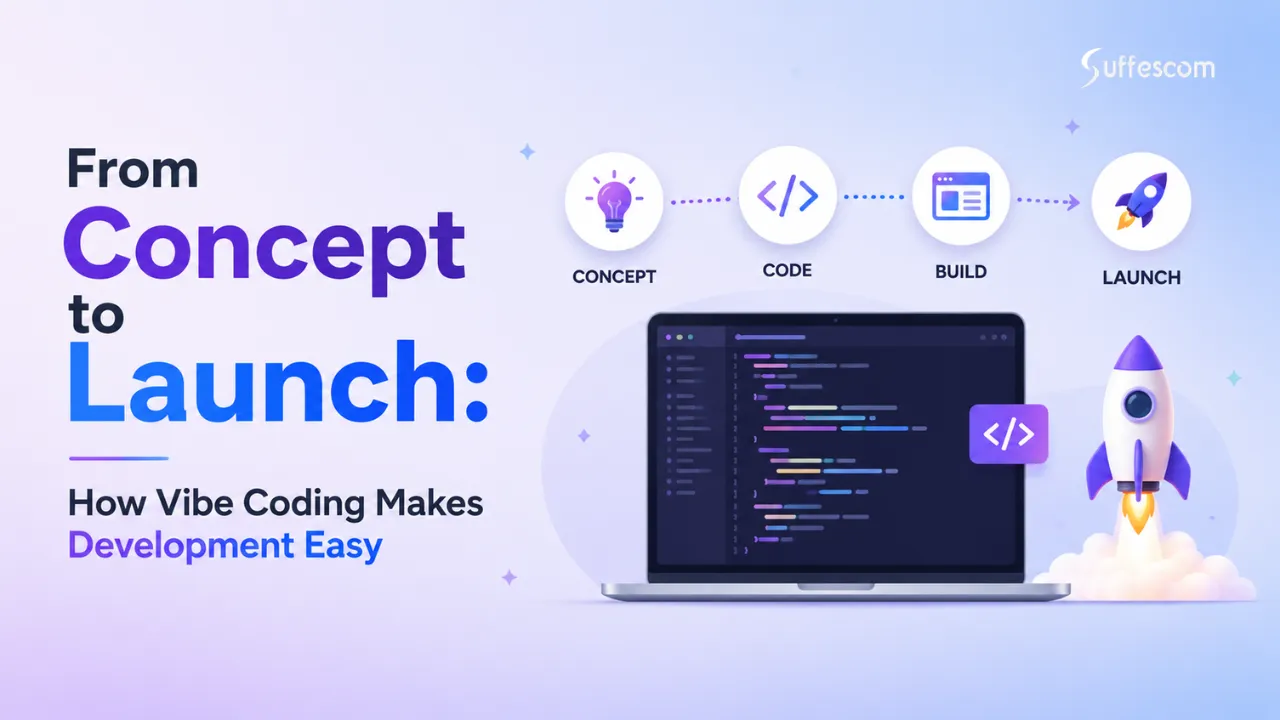
The Journey From Idea to Product Launch Using Vibe Coding
Successful products rarely begin with code. They start with a clearly defined problem and a process for validating assumptions. This is where Vibe Coding simplifies the process by merging human ingenuity and artificial intelligence to deliver a solution at an accelerated pace compared to conventional software development methods.
Although each project may vary, most successful Vibe Coding cases tend to follow a consistent methodology.
1 – Identify the Problem
Successful products tackle specific user problems. Before writing code and creating interfaces, it’s crucial to understand what problem needs to be addressed and who experiences it.
Founders and product teams should begin by answering questions such as:
- What challenges are users facing?
- How are people currently solving this problem?
- What limitations exist in existing solutions?
- Is the problem significant enough for users to seek an alternative?
While some aspects of market research and competitors’ analysis can be automated using AI tools, it’s vital to validate the demand through conversations with potential users anyway. Rapid prototyping is great, but creating the correct product matters even more.
2- Convert Ideas into Requirements
Once a problem has been validated, the next step is to create product requirements from scratch. While conventional development processes spend weeks formulating product requirements, a product built with Vibe Coding requires just a fraction of that time with Artificial Intelligence.
Using AI-powered tools, teams can transform high-level concepts into:
- User stories
- Feature lists
- Functional requirements
- Application workflows
- Database structures
- Technical specifications
For instance, a simple prompt in customer support software may generate recommendations for user journeys, feature prioritisation, and system architecture. This helps to concentrate efforts on developing a product strategy, instead of drafting documentation.
3- Build a Prototype
The creation of a functional prototype in just a couple of hours is one of the most valuable benefits of Vibe Coding. One does not need to spend weeks preparing wireframes and interfaces; instead, one can easily prepare an interactive prototype.
These prototypes allow stakeholders to:
- Visualise their product concepts
- Verify their usability assumptions
- Present their ideas to investors
- Get feedback from customers
Modern AI development platforms can generate workflows and navigation structures from natural language instructions. It helps decrease the time required to move from concept to demonstration.
4- Develop an MVP
Once prototypes have been validated, app developers move on to creating their first Minimal Viable Products (MVPs). Unlike full products, MVPs don’t require completion of a full product but a smaller version. Rather, they need only function well enough for the team to receive initial user feedback.
AI-assisted development accelerates this stage by helping generate:
- Application logic
- API integrations
- Database models
- Authentication systems
- User dashboards
- Administrative features
Nonetheless, professional engineering reviews are still required to guarantee optimal performance, security, and code quality.
5- Test and Improve
No product launches in the best state. User testing plays a very important role in finding usability issues and opportunities for improvement.
Vibe Coding makes the process quick because of the ability to implement updates fast. In most cases, any necessary changes and fixes can be made in a matter of hours instead of weeks or months.
Key testing activities include:
- Usability testing
- Feature validation
- Performance assessments
- Bug identification
- User feedback collection
- Conversion optimisation
This ongoing feedback cycle will enable you to enhance the quality of your products without wasting resources on building features that customers don’t want.
6- Launch to Early Users
With validation of the core functionality completed, the product is now ready to go live with early users. Early users will provide critical insights that uncover opportunities that would otherwise go unnoticed when relying solely on internal testing.
During launch, teams should focus on monitoring:
- User onboarding performance
- Feature adoption rates
- Engagement metrics
- Customer feedback
- Technical stability
- Support requests
In other words, the goal is to understand the product very quickly, identify areas for improvement and adjust accordingly.
Vibe Coding allows quicker response times during this phase because new features and improvements can be incorporated and deployed efficiently.
7- Scale the Product
Validation marks the beginning of growth and not the end of development. Once users consistently use the product and key metrics indicate demand, teams can focus on scaling operations and expanding functionality.
At this stage, priorities typically shift towards:
- Infrastructure optimisation
- Performance improvements
- Advanced feature development
- Security enhancements
- Automation of operational processes
- Expansion into additional user segments
Despite the speed benefits of AI in development, scaling still requires proper planning and technical work. Businesses that successfully integrate Vibe Coding into their processes gain an advantage in further development.
How Vibe Coding Accelerates Product Development
Speed is one of the main drivers of Vibe Coding adoption by businesses. The traditional software development cycle requires multiple stages where handovers occur between different teams, including product managers, designers, developers, testers, and operations, thus potentially making the project development process slower. However, Vibe Coding mitigates this issue by incorporating AI to speed up coding and iteration.
While the use of AI does not mean that app developers are not needed anymore, it allows for speeding up certain activities related to development so that teams can focus on solving problems and enhancing their products.
Instant Code Generation
Another prominent advantage of Vibe Coding is the instant generation of the code. While traditionally all code had to be written manually, AI-based code creation tools can produce all necessary APIs, database schemas, UI elements, and even full code solutions for the software.
For instance, when you seek to develop a healthcare app that allows customers to schedule appointments, you just need to describe all necessary features, and an AI coding assistant will generate the foundation.
Faster Feature Deployment
Product teams regularly have a need to deploy a new set of features as per feedback and demand in the market. The traditional development process requires much planning and implementation of these features, along with testing.
Vibe Coding development ensures the implementation is faster due to the use of artificial intelligence. It helps in generating code and even debugging in some scenarios.
For instance, if users want a dashboard filter or reporting capability, developers can use AI tools to generate the initial implementation and then customise it to meet product needs.
Reduced Development Bottlenecks
Software development processes face bottlenecks due to the time required to perform repetitive tasks or debug issues. Vibe Coding can help mitigate some of these bottlenecks by automating parts of the development process.
Common tasks that can be accelerated include:
- Writing boilerplate code
- Creating API endpoints
- Generating documentation
- Producing test cases
- Refactoring existing code
- Identifying common coding errors
For instance, a start-up company with few developers may employ assistance from AI-based development tools to automate tedious coding activities, while focusing on architectural design and innovations.
Continuous Iteration and Improvement
In modern software development, testing and improvement are done continuously, as opposed to long cycles before releases. Vibe Coding helps to achieve this through ease of testing, change implementation, and deployment.
For instance, when users report difficulties at checkout, the team does not need to wait until the next release cycle; instead, they can develop other options and test them to ensure performance.
Time Savings Across Development Stages
As mentioned above, the development process takes varying amounts of time depending on the nature of the project, but it is considerably shorter with the help of AI technology.
| Development Stage | Traditional Timeline | Vibe Coding Timeline |
| Planning | 2–4 Weeks | 2–5 Days |
| Prototype | 2–6 Weeks | 1–3 Days |
| MVP Build | 2–5 Months | 2–6 Weeks |
| Testing | 1–3 Weeks | 3–7 Days |
| Deployment | 1–3 Days | Few Hours–1 Day |
How Much Does Vibe Coding Cost? A Practical Cost Breakdown
One of the major benefits of Vibe Coding app development is its ability to reduce costs compared to other development processes. With the aid of AI-powered coding, testing, fast prototypes, and optimised workflow, organisations can develop their products within minimal time and at reduced costs.
Vibe coding software development costs depend on factors such as complexity, required features, integrations, and security measures. For example, developing a simple tool for an organisation may only take a few days, but designing a complex SaaS solution may not necessarily come cheap.
Vibe Coding Cost Comparison by Project Complexity
| Complexity Level | Typical Features Included | Estimated Timeline | Vibe Coding Cost Range | Traditional Development Cost Range |
| Simple | Landing page, contact forms, basic automation, content website | 1–7 days | £1000–£2,000 | £1,500–£10,000 |
| Low Complexity | User authentication, dashboards, simple database, admin panel | 1–3 weeks | £3,000–£7,500 | £10,000–£35,000 |
| Medium Complexity | Subscription billing, CRM integration, user roles, analytics, API connections | 2–6 weeks | £5,000–£25,000 | £35,000–£100,000 |
| High Complexity | SaaS platforms, marketplaces, workflow automation, AI integrations, mobile responsiveness | 1–3 months | £15,000–£75,000 | £100,000–£300,000+ |
| Enterprise Complexity | Multi-tenant architecture, advanced security, compliance requirements, custom AI systems, large-scale infrastructure | 3–12 months | £50,000–£250,000+ | £300,000–£1M+ |
Though these numbers prove the effectiveness of what Vibe Coding can achieve, real expenses may depend on needs and challenges. AI can speed up the app development process, but tasks such as design, safety checks, quality assurance, and infrastructure management need to be completed by experienced app developers.
Factors That Influence Vibe Coding Project Costs
A range of factors affects the total cost needed for implementing a Vibe Coding solution. Being aware of them allows businesses to calculate their budget more precisely and make better decisions regarding which features should be prioritised.
Product Complexity
The complexity of the application has the greatest impact on development costs. A simple marketing website or internal workflow tool requires significantly less effort than a multi-user SaaS platform with advanced functionality.
The product’s complexity plays the biggest role in the cost of its development. Creating a basic marketing site or workflow automation tool involves less development effort than building a SaaS application with multiple users and numerous functions.
Custom workflows, complicated business logic, real-time data processing, and extensive data management usually mean that development will require additional efforts and testing.
Number of Features
Every feature increases development scope. Authentications, payment systems, report dashboards, messaging platforms, notifications, role-based permissions, and other features add more complexity to the project.
Many startups successfully launch app solutions with AI in development, starting with a limited set of features and adding new ones after they’ve been tested and proven necessary.
AI Integrations
Implementing AI capabilities like chatbots, recommendation algorithms, content creation, predictive analytics, or automations can result in increased costs.
The cost of implementation will be based on factors such as the choice of AI model, use of AI APIs, customisation needs, and maintenance costs of using AI services.
Third-Party APIs
Many applications use third-party service providers for functionalities like payment gateways, communication channels, analytics tools, mapping systems, CRM, or authentication services.
Even though AI in software development can simplify the process of integration, having to integrate with several third-party APIs still requires some amount of development and maintenance work.
Examples include:
- Stripe for payment processing
- HubSpot or Salesforce for CRM functionality
- Twilio for messaging services
- Google Maps for location-based features
- OpenAI or Anthropic APIs for AI functionality
Design Requirements
Applications with customised branding, sophisticated user experience, dashboards, and unique interfaces usually incur higher costs.
Even though AI can be used in designing apps, it cannot replace skilled designers when it comes to usability, accessibility, and optimisation of applications.
Security and Compliance Needs
Security requirements may play an important role in influencing project costs, especially for apps dealing with confidential user data or financial transactions.
There could also be additional expenses for:
- Identity and access management
- Data encryption
- Security testing
- Audit logging
- Compliance documentation
- Privacy controls
Deployment Infrastructure
Infrastructure costs vary depending on expected traffic, performance requirements, storage needs, and application architecture.
For instance, a small MVP may need a cheaper cloud setup, whereas an expansive SaaS product would necessitate:
- Scalable cloud infrastructure
- Database optimisation
- Monitoring systems
- Backup and recovery processes
- Load balancing
- Continuous deployment pipelines
Validate Your Startup Idea Faster
Build, test, and refine your product before making a major development investment.
Benefits of Vibe Coding for Startups, Entrepreneurs and Businesses
The increasing use of Vibe Coding is being fuelled by the advantages it offers, namely, efficiency and accessibility of software development. Using both machine learning tools and expert knowledge, entrepreneurs can increase speed, validate concepts faster, and allocate their budget better.
Lower Development Costs
Software development is generally costly because the project must be implemented before reaching the consumer. Vibe Coding helps save time on developing specific aspects of the product, thereby reducing costs.
For instance, when creating a customer feedback application, AI technologies will enable generating dashboards, authentication procedures, and database design, while developers will be able to create unique elements of the product. Of course, complex projects may still require technical supervision, but they could also benefit from Vibe Coding.
Faster Time to Market
Vibe Coding allows teams to go from idea generation to prototype to MVP much faster because of shorter development lifecycles.
This means that an entrepreneur working on a subscription-based product can create an MVP in a matter of days/weeks, receive feedback, and improve their offering based on data from testing.
Increased Innovation
By reducing the effort required to build and test ideas, Vibe Coding encourages experimentation and innovation.
To illustrate, a SaaS company working on incorporating an AI-driven recommendation engine into its service can easily build a prototype, analyse consumer response, and determine its potential for the business.
Better Product Validation
Most products fail because they rely on assumptions rather than the actual needs of users. Vibe Coding makes it easy for developers to follow the validation-first approach when launching their MVPs.
For instance, when creating an app that automates workflows, one can develop a minimal version first, then conduct research and analyse feedback to determine what changes to make.
Reduced Risk Before Investment
It is quite costly to create and launch a product without conducting market research. With Vibe Coding, organisations can test their concepts with relatively small investments before committing significant resources to development.
For instance, an organisation that would like to develop an internal productivity application for its employees can first test whether employees need such an app by prototyping.
When combined with proper testing, governance, and engineering review, Vibe Coding software development can help businesses boost product development and optimise resource utilisation.
Essential Tools and Technologies Behind Vibe Coding
AI Coding Assistants
AI coding assistants are key elements in Vibe Coding. Such tools leverage LLMs to provide developers with suggestions related to code development, code improvement, bug detection, and documentation writing.
Popular examples include:
- GitHub Copilot
- Cursor
- ChatGPT
- Claude
- Codeium
They usually help developers to write application code, APIs, database queries, and boilerplate code. Despite AI coding assistance, developers still need to review generated code before implementing it.
No-Code and Low-Code Platforms
No-code and low-code platforms enable users to create applications without much manual coding. Such platforms are particularly handy when it comes to creating prototypes or developing MVPs or internal applications.
Common use cases include:
- Workflow automation
- Internal dashboards
- Customer portals
- Data management applications
- Business process tools
The combination of no-code platforms and AI-based workflow generation allows companies to release their products faster and with less complexity involved in development.
Automated Testing Solutions
Testing is still an essential step in software development, despite the way it was coded. With automated tests, developers can identify potential errors and verify functionality.
These solutions can assist with:
- Unit testing
- Functional testing
- Regression testing
- Performance testing
- Quality assurance workflows
For example, newly created components can be automatically tested for any problems affecting the application’s functionality.
Cloud Deployment Platforms
The modern Vibe Coding process requires significant involvement of cloud platforms for hosting and scaling applications. Cloud platforms make it easier to manage and deploy the app without incurring costs for physical infrastructure.
Key benefits include:
- Faster deployment
- Scalable hosting environments
- Automated backups
- Performance monitoring
- Global accessibility
Cloud-based deployment also supports continuous updates, enabling teams to release improvements more frequently.
AI-Powered Design and UX Tools
User experience is a key factor that influences product performance. AI-assisted design solutions can help teams create wireframes, designs, design systems, and prototypes.
These tools can assist with:
- Interface generation
- Wireframing
- User flow creation
- Design recommendations
- Prototype development
For instance, you can write down the dashboard requirements in a simple way and create design concepts before proceeding to development.
Popular Categories Used in Vibe Coding Workflows
The following technologies commonly form part of a modern Vibe Coding workflow:
| Category | Purpose |
| AI Code Generation | Rapid development |
| UI Design Tools | Interface creation |
| Automation Tools | Workflow management |
| Cloud Platforms | Hosting and scaling |
| Analytics Tools | Product optimisation |
Common Challenges of Vibe Coding and How to Overcome Them
Vibe Coding can really help speed up the process of making products. It is not all easy. If we do not check the code made by intelligence carefully, it can cause problems with how good the code is, how safe it is and if it can handle a lot of work. Companies that use intelligence to help make code and also follow the usual rules of making software are more likely to make products that work well and are easy to fix.
If we know about the problems that Vibe Coding can cause, teams can get the things from Vibe Coding and avoid the bad things that might happen.
Managing AI-Generated Code Quality
AI coding tools can make code really fast. The code they make does not always follow the rules that people who write code are supposed to follow.
For example, an AI assistant can make code that works fine for a test project, but the code needs to be improved before it can be used for real.
AI coding tools and the code they make need to be checked, tested and documented so that the code is good and easy to work with. Regular checks of AI coding tools and the code they make help make sure that the code is good and easy to understand and work with.
Security and Compliance Considerations
Security is something that we have to take care of, no matter how we make software. When we use code that is made by intelligence, it can sometimes have problems that make it not safe, like the way it is set up or how it handles data, if we do not look at it very carefully.
Teams that are making programs that deal with customer information, payments or sensitive things should check to make sure they have secure control over who can get to the information and do what they are supposed to do to follow the rules. Security is a deal, and we need people to double-check when we are working on things that have to do with security.
Avoiding Over-Reliance on Automation
AI can help with tasks in development. It should not make big decisions. People still need to use their knowledge. AI is a tool to assist. It should not replace humans.
For example, AI might suggest ways to do things that work. Aren’t they the best for the product in the long run?
The people in charge of the product, like product managers, architects and developers, should still make the choices about where the product is going, what technology to use and how to design the system. Working with AI is usually better than letting AI do everything on its own.
Maintaining Product Scalability
When we start building applications, they are usually very basic. As time goes on, we need to make sure they can handle a lot more users and do more things. Sometimes we rush to get things done. That can cause problems later on.
We should think about how our application will grow from the start. Here are some things businesses should do:
- Design systems that can change easily
- Use cloud services that can handle a lot of users
- Think about how our database will grow
- Keep an eye on how our application is working
This way, we can avoid having to rebuild everything when our product becomes popular. We can save a lot of money and trouble by thinking about scalability and our application from the beginning.
Challenge vs Solution
| Challenge | Solution |
| Code Quality | Human Review |
| Security Risks | Regular Audits |
| Technical Debt | Structured Documentation |
| Scalability Issues | Architecture Planning |
| Compliance Concerns | Governance Processes |
By seeing these problems early organisations can use the Vibe Coding app development in a way. The Vibe Coding can really help make development work more efficient. To be really successful in the long run, organisations still need to have good engineering practices, security controls and people watching over things all the time.
Real-World Applications of Vibe Coding Across Industries
Although people are just starting to talk about Vibe Coding, the idea of using AI to help with development to make software faster is already being used in industries. Vibe Coding is being used by startups that are making their products and by big companies that are making tools for themselves. The Vibe Coding is helping organisations use AI to assist with coding and automate things to get work done faster and deliver things more quickly.
SaaS Product Development
Companies that make Software as a Service products are now using Artificial Intelligence tools like GitHub Copilot and Cursor to speed up the development process.
For example, GitHub found that people using GitHub Copilot can complete some coding tasks faster than those who do not use Artificial Intelligence for help. Many Software as a Service teams are using code created by Artificial Intelligence to plan, create features and write documents. However, they still have people review everything to ensure it is correct.
E-commerce Platforms
E-commerce businesses are using intelligence to help them make their online stores better, do tasks automatically and make customers happy. For example, Shopify has something called Shopify Magic that uses intelligence to make things easier for people who sell things online.
This means that the people who build websites can use intelligence to quickly make things like systems that recommend products, manage inventory and help customers without having to start from the beginning every time.
Healthcare Applications
Healthcare organisations are looking at using intelligence to help them make software that works better and is more efficient.
Some companies that make healthcare technology have used intelligence to quickly make systems that schedule patient appointments, manage documents and make internal platforms.
Even though healthcare applications need to be very secure and follow lots of rules, using intelligence to help make software can make it happen faster for things that are not directly related to patient care.
FinTech Solutions
Companies that make financial technology are using intelligence to help them make new products, test them and automate things. Some of these companies have discussed using tools like GitHub Copilot to help their engineers work more effectively.
They use these tools to make things like customer dashboards, systems that handle payments, reporting systems and ways for systems to talk to each other, all while making sure everything is secure and follows the rules.
These examples show that the principles behind Vibe Coding are already being used in different fields. Some companies do it one way. Some do it another way, but they are all trying to use computers to help them build software, and they are also using people who know a lot about it. This way, Vibe Coding helps them make software faster, get products out sooner and make their work run more smoothly. Vibe Coding is really about making things better. That is what companies are trying to do when they use Vibe Coding to build software and make their businesses work better.
Build Smarter With Vibe Coding
Accelerate software development without compromising quality through expert-led AI-assisted development.
Vibe Coding vs No-Code vs Traditional Software Development
Businesses have a lot of choices when it comes to building products. The best way to do it depends on things like how complicated the project is, how much money they have to spend, how long they have to get it done, if they need it to work for a lot of people and if they have the right technical people to help. Here is a comparison between vibe coding vs traditional development vs no-code.
Complete Comparison
| Feature | Vibe Coding | No-Code | Traditional Coding |
| Customisation | High | Moderate | Very High |
| Speed | High | Very High | Moderate |
| Cost | Low | Low | High |
| Scalability | High | Moderate | High |
| Technical Skills | Low | Very Low | High |
When to Choose Each Approach
Choose Vibe Coding when:
- You need to build an MVP quickly
- Custom functionality is required
- AI-assisted development can accelerate delivery
- You want more flexibility than most no-code platforms provide
- The product may need to scale over time
For example, a startup that is making a software platform on the internet can use Vibe Coding. This helps them get started quickly. They can add user logins and charge subscriptions. Connect to other services. This way, they have space to grow and add things later.
Choose No-Code when:
- Speed is the highest priority
- Technical resources are limited
- The application has relatively simple requirements
- Internal tools or workflow automation are the primary goal
For example, a small business that wants to create a system to manage employee leaves might find that a no-code platform is good enough for managing employee leaves. This small business does not have to spend money on building a custom system to manage employee leaves.
Choose Traditional Software Development when:
- The application requires highly specialised functionality
- Security and compliance requirements are extensive
- Long-term scalability is a critical priority
- Complete control over architecture and infrastructure is necessary
Some examples are things like software for enterprises, large online marketplaces, banking websites and really important applications where you need to have things built just for you. These things, like enterprise software and large-scale marketplaces, need to be done because they are so important. You also have banking platforms and mission-critical applications that need custom engineering to work right.
Future Trends in Vibe Coding and AI Software Development
Vibe Coding is getting better and better as artificial intelligence and software engineering tools improve. A lot of companies are using intelligence to help with coding and prototyping right now. In the future, artificial intelligence will probably play a role in every stage of making a product.
The speed at which companies adopt intelligence will be different depending on the type of industry and what they need it for. There are things that will likely influence what happens next, with artificial intelligence and software development. Vibe Coding and artificial intelligence will keep changing.
Autonomous Development Agents
AI tools are getting better at doing things on their own. They can now write code, find and fix mistakes, create documents, and test things with little help from others. AI tools can do all these things because they are becoming smarter.
In the future, teams that make software may use AI tools to do the tasks, so the people who make software can focus on the big picture like how to keep everything safe and make good decisions. People will still need to check the work of AI tools to make sure everything is okay and to avoid problems.
AI-Assisted DevOps
DevOps processes are also becoming more automated. This is because we are using tools that have intelligence to monitor things, introduce new features, and manage the systems that support everything. We use these tools for DevOps processes.
Potential applications include:
- Automated incident detection
- Predictive system monitoring
- Infrastructure optimisation
- Deployment recommendations
- Performance analysis
Using intelligence to support DevOps work can make a big difference. It can help teams make their systems more reliable. Artificial intelligence-assisted DevOps can also help teams fix problems much faster as products get really big. This is because AI-assisted DevOps reduces the amount of manual work people have to do.
Hyper-Personalised Applications
Artificial Intelligence is getting better and better. This means it is now easier to make software that’s just right for each person who uses it.
Applications can change what they show you. Suggest to you based on Artificial Intelligence and how you like to do things. They can even change how they look and work for you. Artificial Intelligence is really helping to make this happen.
Examples include:
- Personalised dashboards
- Intelligent recommendation engines
- Adaptive user journeys
- Customised learning experiences
- Context-aware customer support
When things get more personal, businesses can talk to people in a way that gives them what they want. This is because personalisation is improving. Businesses can use this to make people satisfied and give them things that are important to them. Personalisation is important for businesses because it helps them understand what people need.
Building a Sustainable Vibe Coding Workflow for Long-Term Growth
Vibe Coding is really good at helping us get products out the door faster. If we want our products to do well in the long run, we have to make sure they are good quality, consistent and can handle a lot of users. To do this, we need to set up a system for our team to follow so we can go fast without sacrificing software engineering habits.
Establishing Development Standards
We need to decide how we are going to code and how we are going to review each other’s work. What rules are we going to follow when we start a project? If we all do things this way, it helps keep our code good even when our project gets big and a lot of people are working on it.
Documentation Best Practices
When we use code that was written by a machine, we need to make sure we have notes that explain how it works. If we keep track of what our product’s supposed to do, how we designed it and how the technical parts work, it will be a lot easier to make changes later and to get new people up to speed on Vibe Coding and our projects.
Creating Repeatable Product Workflows
We need to have the workflows for planning and development, testing and deployment so that teams can deliver products in the same way every time. When we have processes, we make fewer mistakes, and people work together better across different projects.
Combining AI Automation With Human Expertise
AI can help us code, test and write documents faster. We still need people to check what the AI does. Developers should look at what the AI makes to make sure it is good and safe, and what the business needs.
Scaling Teams Around Vibe Coding Processes
When products get bigger, companies should use Vibe Coding with their usual development workflows, which sometimes includes using AI. If everyone knows what they have to do, the team can still be productive even when it gets bigger.
Governance, Security and Quality Control
We need to look at the code and check for security problems, test the product and have rules to make sure the software is good and follows the rules as it changes. If we have controls, then teams can use AI to help with development without compromising the quality.
By combining the way we do things with AI tools, businesses can create a Vibe Coding workflow that will help the product grow and remain scalable for a time.
Conclusion
Vibe Coding is changing the way digital products are made by using intelligence to help people build things. This means that people can take an idea and quickly make a prototype, then make a version of the product, and finally launch it. Vibe Coding helps startups, entrepreneurs and businesses make software faster. It gets rid of some of the old problems that people had when making products.
To do Vibe Coding well, you need to be very clear about what you want your product to do. You also need to make sure that your product is what users want, that your engineering is good and that you are always checking to make sure everything is working well. This means that your product will be quality, safe and able to grow. Companies that use intelligence in a smart way and still follow good development rules are usually better at getting products to market quickly and changing when users need something different. Working with experienced vibe coding service providers can further help businesses maintain quality, security, and scalability throughout the development process.
As tools that use intelligence to help with development get better, Vibe Coding will become even more important for making software. If you are making a platform, testing a startup idea or making your company’s operations better, Vibe Coding is a good way to turn your ideas into real products quickly and easily. Vibe Coding helps you make things faster. It gives you more options. Vibe Coding is a way to make app development easier and more flexible.
Book a Free 30-Minute Consultation
Discuss your product idea with our experts and discover how Vibe Coding can help you build, validate, and launch your application faster.
FAQs
1. What is Vibe Coding?
Vibe Coding is a way of making software with the help of intelligence. It helps create applications from instructions. By writing every part of the code, users describe what they want, and AI helps make it happen.
2. How does Vibe Coding work?
The process starts with a prompt or a product requirement. An AI tool creates a solution based on those instructions. Then the output is reviewed, refined and tested before its release.
- It begins with an idea or a problem to solve.
- AI helps create a solution.
- The solution is then. Improved.
3. Can beginners use Vibe Coding?
Yes. Many Vibe Coding tools are easy to use for people who are new to coding. Beginners can make apps and prototypes. They can learn about coding as they go.
4. Is Vibe Coding suitable for startups?
Vibe Coding is often a good fit for startups. It helps teams launch versions of their product quickly and gather feedback before investing in more development.
5. How much does Vibe Coding reduce development costs?
The amount of cost reduction varies. It depends on the project’s complexity and how much AI can help automate development. Simple projects often see savings.
6. What tools are commonly used in Vibe Coding?
GitHub Copilot is widely used for AI-assisted coding. Cursor has become popular among development teams. Many builders also use ChatGPT or Claude to generate code snippets and solve development challenges.
7. Can AI generate production-ready code?
Sometimes AI can generate code that’s ready for production. However, the quality of the output depends on the task. Most organisations still. Test AI-generated code before deploying it.
8. What are the limitations of Vibe Coding?
AI doesn’t always understand business requirements perfectly. It can create solutions or miss important technical considerations. Human judgment is still necessary.
9. Is Vibe Coding replacing software developers?
No Vibe Coding is not replacing developers. Developers still play a role in software projects. AI helps with execution. Engineers make technical decisions and ensure software quality.
10. How fast can an MVP be built using Vibe Coding?
A simple Minimum Viable Product may be completed within a day. More advanced products usually require additional time for integrations, testing and refinement. The timeline really depends on the scope of the Vibe Coding project.
11. What industries benefit most from Vibe Coding?
Vibe Coding is frequently used by software startups to validate ideas. E-commerce businesses use Vibe Coding to launch features quickly. Internal product teams often adopt Vibe Coding to improve efficiency.
12. How secure is AI-generated software?
The security of Vibe Coding depends more on the review process than the AI tool itself. The generated code should be assessed for vulnerabilities before deployment. Ongoing monitoring is also important after the Vibe Coding launch.
13. Can Vibe Coding support enterprise applications?
Yes, Vibe Coding can support enterprise applications. Many enterprise teams use AI-assisted development like Vibe Coding to improve productivity. Large-scale applications still require governance and rigorous quality controls for Vibe Coding.
14. What is the difference between Vibe Coding and no-code development?
No-code platforms rely on interfaces to build applications. Vibe Coding generates actual code through AI assistance. This typically provides flexibility when custom functionality is needed for Vibe Coding.
15. How do you validate an idea before building with Vibe Coding?
First, make sure there’s a problem to solve. Talk to people who might use Vibe Coding. Understand what they struggle with. If there’s interest, make a version of your idea. Get feedback from users. Use that feedback before doing development with Vibe Coding.
16. What skills help maximise Vibe Coding results?
The ability to define requirements clearly is extremely valuable for Vibe Coding. Strong problem-solving skills can improve the quality of Vibe Coding outputs. A basic understanding of software development also helps when reviewing the generated Vibe Coding code.
17. How does Vibe Coding improve product-market fit?
Vibe Coding allows teams to test ideas sooner. Feedback can be gathered earlier in the product lifecycle of Vibe Coding. This helps businesses make informed decisions based on user behaviour rather than assumptions about Vibe Coding.
18. What does the future of Vibe Coding look like?
The AI tools like Vibe Coding are becoming more capable with each generation. Development workflows are likely to become increasingly automated with Vibe Coding. Human oversight will remain important as software systems grow in complexity and scale with Vibe Coding.

Senior Content Strategist
Jonathan Raabe is the Content Strategist at Suffescom Solutions and has more than 7 years of experience in developing data-driven content strategies for technology-centric organizations. He is proficient in the areas of mobile app development, software development, AI, cloud computing, fintech, healthcare, and digital transformation. Jonathan collaborates with industry leaders, developers, and business heads in creating high-value, SEO-optimized content that helps companies in increasing their visibility on the search engines, establishing trust, and driving business inquiries.
Need Help With
Development?