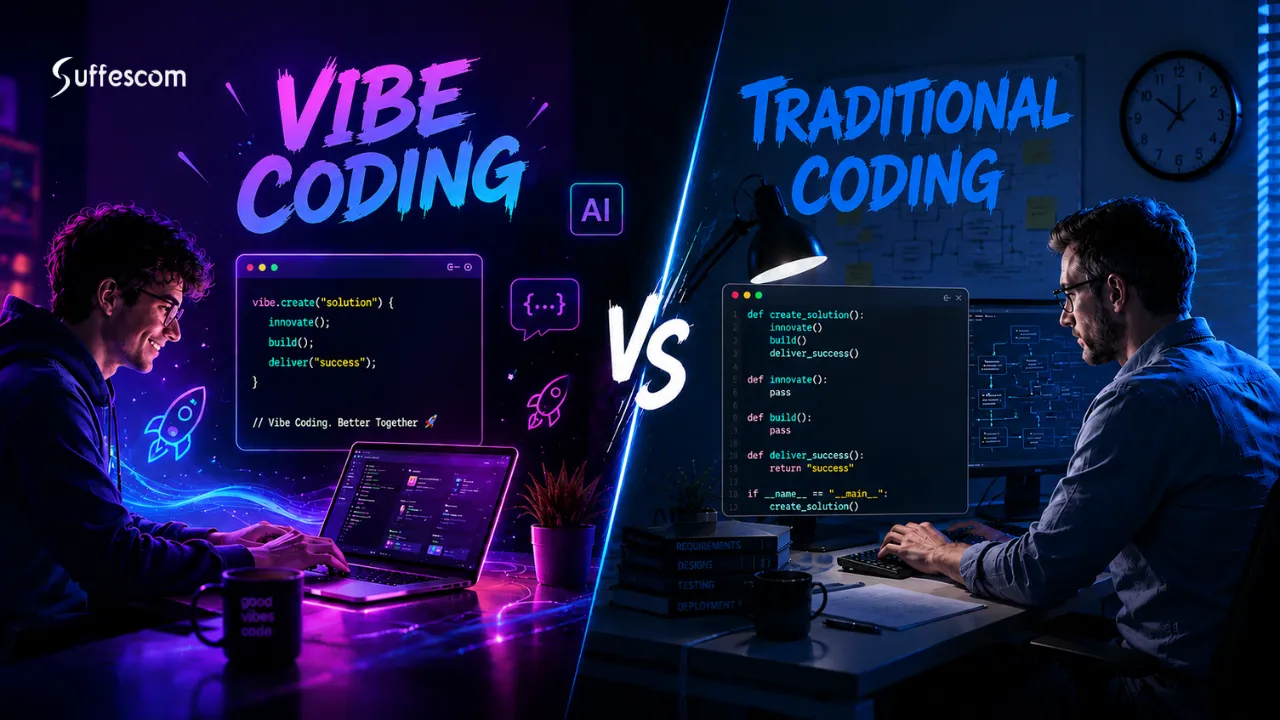
Software development is constantly changing with the advent of vibe coding. The global vibe coding market is expected to grow significantly, increasing from USD 5.85 billion in 2025 to USD 7.06 billion in 2026, and reaching an estimated USD 15.52 billion by 2031. It can support, augment, or even replace conventional software development methods. While today’s AIs are capable of building apps’ code, UIs, and features from the most basic prompts, this opens up possibilities for startups and SMEs to reduce upfront development costs and speed up time-to-market.
At the same time, there are a few requirements such as a solid architecture, enterprise-grade security and regulation, as well as a high degree of scalability, which cannot be met with standard AI-based coding. So which approach is best to take? Vibe coding, traditional development, or both?
In this article, we will examine both approaches regarding their respective costs, speed, security, compliance, scalability, maintenance, and business suitability so that by the end of the article, you can tell what development model is right for you and your needs for your software in 2026.
Key Takeaways
- Vibe coding development costs typically range from £3,000 to £100,000+ depending on project scope. MVPs can cost £3,000-£15,000, SaaS platforms £10,000-£50,000, mobile apps £5,000–£30,000, and enterprise software £20,000-£100,000+.
- Traditional development is better suited for complex software projects. It provides stronger security, better GDPR compliance, and greater scalability for fintech, healthcare, enterprise SaaS, and government applications.
- Lower upfront costs do not always lead to lower long-term costs. Businesses must also consider maintenance, technical debt, security testing, compliance reviews, and future scaling requirements.
- AI-generated code still needs human review. Security checks, code testing, compliance validation, and performance optimization are essential before software goes live.
- Hybrid development is becoming the preferred approach in 2026. It combines AI-powered speed with human expertise to deliver software faster while maintaining quality, security, and compliance.
What Is Vibe Coding?
Vibe coding is an approach to application development that uses AI assistance to help users create an application with natural language rather than writing code for the whole application. Rather than developing features from scratch, developers explain what they want the application to do, and AI will create the code, interfaces, workflows, and documentation. It has become very popular over the past few years thanks to improvements in large language models and AI development platforms. Companies now utilise the available AI tools to develop web applications, mobile applications, prototypes, internal business systems, and SaaS applications far more quickly.
Definition of Vibe Coding
The term “vibe coding” refers to users providing instructions to the AI in natural language form to create software. Software developers provide details on their intended business logic, functionality, and output, without focusing on appearance. For example, in case a user tells an AI application to “Create a customer portal that has features for account creation, registration, profile management, and subscriptions,” the application will be able to create much of the front-end, backend, and database code.
How AI Generates Code from Natural Language Prompts
AI code assistants today can analyse a user prompt and translate it to actual code. These systems are trained on enormous bodies of code for various programming languages, frameworks, and software development patterns.
The process generally involves:
- Enter a prompt describing the requirements of the application
- AI generates a working piece of code or UI, or an overall workflow
- Refine and edit outputs
- Test the functionality of outputs
- Deploy to the production environment with human monitoring
Developers are then free to concentrate on higher-level issues and problems.
Popular Vibe Coding Platforms Used in the UK
Several AI-powered development tools allow you to build an app with little coding knowledge. For example, with you, you can develop an app in Replit with just a simple text prompt. Similarly, through Bubble, you can create a marketplace MVP. Here are some more examples:
- GitHub Copilot
- Claude Code
- Windsurf
- Bolt.new
- Cursor
- Lovable
These platforms assist with code generation, debugging, testing, documentation, and application development across multiple programming languages.
Why Vibe Coding Is Growing Among UK Startups
For startups, speed means success, and vibe coding empowers the entrepreneur and the small development team to experiment on an idea, develop an MVP, and product launch far more quickly than traditional development approaches. Its advantages lie in the following points:
- Faster time-to-market
- Reduced upfront development costs
- Small team sizes
- Faster iterations
- Ease of experimenting & prototyping
These qualities may be appealing to early-stage startups who are seeking product-market fit.
Common Use Cases for AI-Powered Software Development
Though vibe coding isn’t right for all applications, it excels in cases where velocity and experimentation are key.
Common use cases are:
- MVP development
- Startup SaaS platforms
- Internal business tools
- Customer portals
- Marketing technology applications
- Workflow automation Solutions
- Proof-of-concept projects
- Data dashboards and reporting tools
As the technology for AI development continues to get more sophisticated, vibe coding will continue to grow into a significant factor in the contemporary software development environment. However, by contrasting vibe coding with traditional software engineering techniques, both the power and constraints of the former are brought more to light.
Turn your app idea into a working prototype in days, not months.
What Is Traditional Software Development?
Software development refers to the engineering process for designing, constructing, testing, deploying, and maintaining software that utilises human intervention and guided engineering processes to produce the software based on given requirements. In contrast, unlike vibe coding, where much of the software is automatically produced by AI from prompt text, software is typically developed using traditional processes by developers, architects, designers, and quality assurance personnel.
The traditional method of developing software has been the standard for enterprise software development for many decades, and it still continues to be the preferred method when high standards of reliability, security, scalability, and compliance are required.
Traditional Development Process Explained
The traditional development lifecycle involves following a structured pattern from initial business requirements to continuous maintenance and support of the software product.
The general development lifecycle includes:
- Business requirements and analysis
- Architecture and system design
- UI and UX design
- Development (backend and front-end)
- Testing and quality control
- Deployment and release
- Maintenance and performance tuning
Each step is thoroughly analysed in order to reduce any possible risks and fulfil the business goals.
Role of Developers, QA Engineers, and Architects
Modern software development involves various roles and individuals contributing at different points throughout the lifecycle.
The developers will be responsible for writing, checking, and refining code, along with fulfilling the required business requirements.
Architects will design and maintain the structure of the system, decide which languages to use, and how the system can be extended efficiently.
QA engineers will run tests to find software bugs, security holes, performance issues, and problems with usability before it reaches the market.
Software Development Life Cycle (SDLC)
SDLC (Software Development Life Cycle) is an approach to organising the software development process from inception to retirement.
Common SDLC stages include:
| SDLC Stage | Purpose |
| Planning | Define goals, scope, and resources |
| Analysis | Gather business and technical requirements |
| Design | Create architecture and system specifications |
| Development | Build application features and functionality |
| Testing | Verify quality, security, and performance |
| Deployment | Release software to users |
| Maintenance | Fix issues and implement updates |
Following an SDLC helps organisations maintain consistency, predictability, and quality throughout the project.
Agile vs Waterfall Development Methodologies
Traditional software can be built using the following project management techniques:
- Waterfall: A phased approach, in which each stage of the project must be finished before the subsequent stage begins. The most successful projects to build in this style are those where requirements will not change and a well-defined end product is evident.
- Agile: Utilises iterations and sprints of development cycles and, through time, builds the product incrementally and gets it to market as and when appropriate to do so, with constant feedback incorporated throughout.
Agile methodology is arguably the most popular methodology today, due to its dynamic nature.
Why Enterprises Still Prefer Traditional Development
Even though AI tools for coding are becoming better, most enterprises use the traditional way for developing mission-critical systems.
Advantages of the traditional way:
- Improved planning on the architecture of a solution
- Control over security mechanisms
- Higher quality code standards
- More readily compliant with regulations
- Scales easily
- Predictable maintenance costs
- Control and accountability, with higher governance
Most businesses in financial, healthcare, and government, and on large-scale SaS, choose these attributes over the faster output of vibe coding. Traditional development continues to be essential in developing reliable software as complexity increases and regulation expands, especially for long-term business benefits.
Vibe Coding vs Traditional Development: Key Differences
Both development methods set out to create useful applications; however, the fundamental approaches in terms of application design, development, security, and support vary widely. Having an understanding of the variation between them allows businesses in the UK to ascertain which method is most suited to their own objectives, budgets, legal obligations, and long-term future plans.
Development Approach
Vibe coding means building software using natural language and AI-supported processes. A developer will explain what they want the software to do, and the AI will build most of the code for it. Traditional development depends on coding, software engineering principles, and a formal development cycle; developers painstakingly design, develop, test, and optimise the different parts of the software. Therefore, vibe coding favours speed, and traditional development favours control and accuracy.
Team Structure
In vibe coding, teams often get more work done with fewer people than with traditional development. Startups and entrepreneurs can produce an early prototype much more quickly without building large development teams. Traditional development processes require more people, such as:
- Software developers
- Solution architects
- UI/UX designers
- QA engineers
- DevOps engineers
- Security specialists
Coding Quality
AI-generated code quality is influenced by prompt quality, tool feature sets, and human review.
Vibe coding, in spite of generating usable code very quickly, often produces buggy code with redundant logic, inconsistent patterns, poor performance, or security concerns, without quality assurance.
Coding is usually more consistent in terms of quality because developers follow coding standards, peer review, and architectural considerations.
Security Standards
The most distinct contrast between these two processes is security.
AI may generate code that inadvertently contains a vulnerability if security considerations are not specified as a component of its generation and review. Traditional development includes secure coding, code reviews, vulnerability scanning, and testing throughout the entire development lifecycle, and often critically so for regulated industries like finance, healthcare, and government.
Scalability Potential
Prototyping and mini-projects are viable for an application developed using Vibe coding. But problems in scaling might occur when the user base, the size of the data, and the business logic increase.
Software architecture, database optimisation, planning for the infrastructure, and system performance are more emphasised in traditional development than vibe coding, and thus it will be better for building applications that scale.
Compliance Readiness
Nearly all UK companies are now bound by regulations like GDPR and various industry-specific ones, along with various cybersecurity aspects of business. While Vibe coding tools certainly speed up development, they are not usually compliance-ready without significant add-on review, documentation, testing, governance, etc. Traditional development methodologies lend themselves more easily to meeting compliance demands.
Long-Term Maintenance
In most cases, software maintenance takes the largest part of the lifetime costs.
AI-coded applications can be very hard to maintain if documentation is missing or if design choices aren’t obvious.
Normally, the traditional development produces code that is easier to maintain: bugfixing, addition of features, and introduction of new team members will be much easier.
Vibe Coding vs Traditional Development Comparison
| Factor | Vibe Coding | Traditional Development |
| Development Speed | Very Fast | Moderate |
| Cost | Lower Initially | Higher Initially |
| Code Quality | Variable | Consistent |
| Security | Requires Validation | Built-In Processes |
| Scalability | Limited for Complex Systems | High |
| Compliance | Challenging | Easier |
| Technical Debt | Higher Risk | Lower Risk |
| Maintenance | Difficult at Scale | Easier |
| Team Requirement | Smaller | Larger |
| Enterprise Readiness | Moderate | High |
This brings home what most UK organisations will experience in the real world: vibe coding is fast and flexible in the sense that it supports experimenting, but at the expense of security, scalability, governance, and long-term maintenance when compared with traditional development. The right path to follow is determined by the scope of the project and how much risk the business wants to take.
Our AI-powered development can accelerate your next project.
How Vibe Coding Works in Modern Software Development
Vibe coding integrates artificial intelligence into software development work processes, speeding up the creation of applications. Rather than write every line of code, developers employ the help of AI-powered applications to develop features, generate user interfaces, detect defects, and handle mundane development processes.
The seemingly straightforward concept of vibe coding consists of many different AI-driven procedures working hand in hand throughout the entire process of developing applications. However, human intervention is still involved to ensure quality and correctness, while AI takes over the heavy manual labour of creating an application and maintaining it.
AI Prompting and Code Generation
Prompt-driven development is the main principle in vibe coding. You write an instruction in natural language on how the feature, business logic, or workflow needs to be built, and then AI converts the prompt into code that builds the required function for you. For example, you need to build a customer dashboard where customers will see subscriptions, change the billing information, download invoices, etc. You prompt the AI like: “Build a customer dashboard where customers are allowed to manage subscriptions, update the billing information, and download the invoice”. An AI could then write frontend components, backend code, data models, make API calls, and also create the authentication mechanisms to allow customers to access the customer dashboard.
AI-Assisted Debugging
Debugging usually takes the most time of development. This new tool for coding, powered by AI, is able to read code, diagnose bugs, suggest, and even explain it. Instead of digging through hundreds of lines of code, a programmer is able to call on the AI:
- Spot syntax mistakes
- Detect performance bottleneck
- Resolve integration issues
- Fix database query errors
- Propose code optimization
This could lead to quick error fixes and help developers be more productive.
Automated UI Generation
A lot of the AI platforms available to develop applications can produce user interfaces from just a prompt, a wireframe, or a description of a design.
Instead of developing each screen or layout, the application needs to be able to look and behave in a certain way, and then AI produces:
- Landing pages
- Dashboards
- Customer portals
- Forms and workflows
- Mobile application screens
This makes for less development time and means that teams can test and iterate on the user experience in a fraction of the time.
AI-Based Testing and Documentation
AI is increasingly finding uses in testing and documentation automation within software engineering. AI tools can help in the creation of:
- Unit tests
- Integration tests
- Code consistency checks
- Technical documentation
- API documentation
- Test case suggestions
Human Oversight Requirements
While vibe coding has impressive capabilities, it cannot replace the role of a human. The generated AI code requires review, testing, securing, and validation prior to implementation.
It is also crucial for human involvement when dealing with:
- Software architecture design
- Security reviews
- Compliance assessment
- Performance tuning
- Scalability decisions
- Production rollout
Without a review system, a variety of problems will result, including technical debt, security loopholes, and code unmaintainability.
As a result of these challenges, most organisations successfully use vibe coding to increase productivity, but to supplement and not replace the software engineer. The best use of AI development is when it is combined with human capability to produce speed while quality, security, and business trust remain intact.
Benefits of Vibe Coding for UK Businesses
The rising trend of vibe coding can primarily be attributed to how it increases development speed and limits the resources required in the production of new product releases. AI-aided development is the perfect technology for startups, SMEs, and innovation-driven businesses as they can use it as a tool to compete with market pace, decrease development lead times, and rapidly test out ideas.
While vibe coding is not a solution for all applications, it offers strong advantages for organisations that aim to release quickly, validate ideas quickly, and be more agile.
Faster MVP Development
A Minimum Viable Product (MVP) normally requires a period of weeks or months to be planned, designed, coded, tested, and iterated. Vibe coding can greatly reduce this timeframe by automating a number of coding and design tasks.
Through the prompt-to-application feature, interfaces, and workflows, businesses can transition from ideation to a working prototype at a much faster rate, enabling founders and product managers to validate their business case prior to committing to substantial development budgets.
Lower Initial Development Costs
A major attraction of vibe coding is its potential to lower upfront development costs. Since a portion of coding, debugging, testing, and documentation can be automated by an AI, a business can work with a much smaller team of developers during the early stages of a project. This can result in lower expenditures of software engineering resources and make development more affordable for startups and small businesses. However, an organisation needs to account for maintenance, security, and scalability costs in the long run.
Rapid Product Validation
For businesses operating in competitive markets, speed to market can often be critical. Vibe coding provides the capability to test your assumptions, acquire user feedback, and improve your products much quicker than the usual length of the development cycle. Organisations can then decide what they want to build next based on the information provided, rather than spending months building a full-featured product and only then finding out there’s not much demand for it. This reduces the risk and enhances product market fit.
Faster Prototyping Cycles
To innovate, one must experiment, and vibe coding significantly simplifies that process. Teams can quickly iterate on multiple iterations of a feature, workflow, or interface, evaluate the best performance of one against others, and move on. The ability to work at an increased pace will enable organisations to capitalise on changes in customer expectations and market conditions, and for organisations undertaking new product initiatives or digital transformation projects, faster prototyping will accelerate innovation.
Increased Small Team Productivity
With the assistance of AI-based development tools, a small team can accomplish more work with a smaller number of engineers. Examples of tasks that are commonly automated with vibe coding are:
- Boilerplate code generation
- UI component generation
- Test generation
- Code defect detection
- Documentation generation
By allowing small teams to delegate some of these activities to AI-based tools, the team can spend more of their valuable time working on business needs, the end user, and product development strategy.
Business Benefits of Vibe Coding
| Business Goal | Impact |
| MVP Launch | Faster |
| Market Testing | Easier |
| Development Budget | Lower |
| Feature Iteration | Faster |
| Startup Agility | Higher |
Limitations and Risks of Vibe Coding
Despite the ability of vibe coding to speed up development and lower initial costs, it does carry risks. Without adequate controls, software created by AI could bring issues of security, maintainability, compliance, and long-term scalability.
For UK companies creating applications that interface directly with customers, handling sensitive data, or working in regulated sectors, it is crucial to be aware of these challenges prior to extensive use.
Security Vulnerabilities in AI-Generated Code
AI coding assistants can produce working code very rapidly. It is not automatic, however, that these tools will produce code securely by default. When given certain prompts or using specific tools, AI-generated code may:
- Have authentication flaws
- Integrate with insecure APIs
- Fail to properly validate input
- Have hard-coded secrets
- Have insecure third-party dependencies
If these vulnerabilities are not found and addressed through diligent code review and testing, they can put applications at risk of cyber attacks.
Technical Debt Accumulation
A frequently cited problem with vibe coding is that technical debt could accumulate:
A priority for the AI will be to write functional code rather than focus on architecture, maintainability, or long-term efficiency. As projects evolve, a business will likely suffer from:
- Code duplication
- Non-standard code
- Insufficient documentation
- Chainy dependencies
- Difficult-to-maintain workflows
All of which are eventually more expensive to fix than they were to create.
Compliance Challenges Under UK Regulations
A number of rules and regulations (UK GDPR, security standards within specific industries, internal governance, etc.) have to be adhered to by organisations. AI alone can produce the functions of an application, but cannot automatically be relied upon to meet:
- Data protection obligations
- Privacy-by-design principles
- Data retention policies
- Audit trail requirements
- Specific sector-based legislation
The responsibility of ensuring that software is legally and regulatorily sound rests with the business itself, irrespective of the way the software was written.
Code Ownership and Intellectual Property Concerns
The increase in AI-generated software raises a variety of concerns about intellectual property and ownership of the code that is created.
It is crucial that any organisation considering using an AI development platform understands:
- Ownership of the generated code
- The associated license
- Use of third-party code
- Protection of intellectual property
- The right to commercial use of the output
Failing to understand these points can result in a legal headache during a product’s life cycle.
Dependency on AI Platforms
Excessive reliance on a specific AI development tool poses risks to business operations. For example, shifts in pricing models, platform access, capabilities of models, or usage constraints can affect development and subsequent maintenance processes. It is important for organisations to determine how their applications can be maintained and improved if their AI platform is discontinued or experiences major revisions.
Challenges in Large-Scale Software Projects
Vibe coding works well for prototypes, MVP’s, and simple applications. Complexity goes way up with size. For larger software projects, you’re generally going to need:
- Intricate system architecture
- Advanced security measures
- Multi-system integration
- High-performance hardware/systems
- Complex data management
- Regulatory compliance frameworks
All of these tend to require more substantial human intervention and engineering than can be relied upon by AI at this time.
Key Risks of Vibe Coding
| Risk Area | Potential Impact |
| Security Vulnerabilities | Increased cyber risk |
| Technical Debt | Higher future development costs |
| Compliance Issues | Regulatory penalties and legal exposure |
| Intellectual Property Concerns | Ownership and licensing uncertainty |
| Platform Dependency | Vendor lock-in risks |
| Scalability Limitations | Performance and growth challenges |
| Maintenance Complexity | Difficult long-term support |
Need a scalable app beyond the MVP stage?
Start with the right architecture.
Benefits of Traditional Development for Complex Software Projects
The use of AI-assisted development tools is expanding, yet for complex, business-critical applications, traditional software development will remain the chosen strategy for many companies. While the initial investment might be larger, the rigour, governance, and engineering disciplines necessary to support long-term business goals will justify it. This is why the benefits that traditional development offers will almost certainly outweigh the speed benefits of vibe coding for the enterprise, regulated industries, and large-scale applications.
Better Architecture Planning
The success of a software project depends heavily on a good architecture. In traditional approaches, there is much focus put on planning the design prior to starting the development. Software architects consider things like:
- System scalability
- Performance needs
- Security architecture
- Data management
- Integration needs
- Future business growth
By pre-planning, costly redesigns are avoided, and the application will grow along with the business.
Enterprise-Grade Security
Security is always a major concern, especially when customer details, financial data, or sensitive records are being maintained by a business organisation.
- The development methodology followed traditionally incorporates security within the life cycle of software through :
- Secure coding procedures
- Code reviews
- Vulnerability tests
- Penetration testing
- Implementation of access control
- Security monitoring.
Such a well-structured method minimises the risk of vulnerability being present in the production build.
Scalability for Growing Businesses
Some applications may begin small and grow to have many thousands, or millions, of users. Conventional development practices emphasise developing scalable architectures that can handle:
- Higher levels of traffic
- More data to process
- Expanded functionality
- Higher numbers of transactions
- Multi-regional support
As such, it’s the ideal choice for SaaS products, e-commerce solutions, enterprise software, high-growth products, and many other digital systems.
Easier Regulatory Compliance
Regulatory needs are becoming more prevalent and are expected to appear across many industries, from finance, insurance, health, and even within government departments.
The processes within a traditional software development lifecycle that meet these needs include:
- A document trail
- An audit trail
- Risk assessments
- Data governance
- Testing results
- A change management process
Long-Term Maintainability
In most cases, software is not a one-off cost. Software will usually need upgrading, enhancements, and to be added to and patches will need applying to keep it secure.
A Traditional development style will encourage maintainability by:
- Standard code base
- Documented systems
- System structure
- Use of version control
- Code review
This then allows a developer in the future to be more easily able to access and manipulate the code without adding additional risk.
Stronger Quality Assurance
QA testing is part of the traditional development life cycle. QA procedures find out bugs and defects prior to end-users’ use of it, minimising production disturbances and enhancing user satisfaction. The following tests are typically performed as part of a QA process:
- Functional testing
- Integration testing
- Performance testing
- Security testing
- User acceptance testing (UAT)
- Regression testing
Why Traditional Development Remains Relevant
| Business Requirement | Traditional Development Advantage |
| Security | Comprehensive security controls |
| Scalability | Built for long-term growth |
| Compliance | Easier regulatory alignment |
| Quality Assurance | Structured testing processes |
| Maintainability | Easier long-term support |
| Enterprise Readiness | Suitable for mission-critical systems |
While the traditional approach may consume more time and money up front, it offers better results for an organisation that needs to build robust software. For any company whose software needs to be highly secure, compliant, scalable, and utterly reliable, traditional software engineering is a safer and long-term solution.
Vibe Coding vs Traditional Development Cost Comparison in the UK
Cost is usually one of the most significant factors influencing the decision of the right software development methodology. Initially, vibe coding seems much cheaper as tools based on AI can help in writing code, testing it, generating documentation, and assisting in other phases of development. Though development costs include much more than the initial creation phase.
UK companies should assess not just initial but also maintenance, security, compliance, scaling, and long-term operating costs before deciding on their development method.
Development Team Costs
Vibe coding allows for fewer developers in the initial phase of a project. A small team utilising an AI development environment should develop prototypes and MVPs much faster than traditional teams. The traditional development team is typically comprised of various specialists, including developers, QA engineers, architects, designers, and DevOps engineers. While this incurs an upfront cost, it also ensures quality assurance and risk mitigation. For businesses seeking quick validation, vibe coding might present an easy first step. For substantial software projects, the quality assured by a traditional development team may warrant the extra cost.
Infrastructure and Tooling Costs
In terms of required resources and tooling, both methods need infrastructure, hosting, and software tools, but have varying price tags.
Vibe coding costs may include:
- AI development tools
- Subscription to advanced AI models
- Cloud hosting
- Development IDE’s
- Third-party integrations
Traditional coding costs would typically need:
- Frameworks
- Test suites
- CI/CD tools
- Monitoring services
- Cloud infrastructure
- Collaboration tools
AI models can potentially minimise labour costs, but businesses must also consider recurrent usage and subscription costs.
Maintenance Costs
Many organisations are obsessed with development cost but do not account for the ongoing maintenance costs of the software.
An application developed with Vibe coding needs more effort to maintain it in the following areas:
- Refactor the AI code
- Fix architecture concerns
- Improve documentation
- Optimise the performance issues
- Fix the security vulnerabilities
The traditional development has a higher initial cost but results in a simpler maintenance effort over time, because of engineering practices and architectural planning.
Security and Compliance Costs
Security and compliance activities may have a notable impact on the total project cost. Business could invest in:
- Security audits
- Penetration testing
- Vulnerability assessments
- GDPR compliance check
- Data protection controls
- Security monitoring
When projects are developed through vibe coding in particular, it is likely that more validation and testing will be required to make sure the generated code is secure and compliant.
Hidden Costs Businesses Often Miss
Software projects often go over budget because several hidden costs are not taken into consideration when plans are being drawn up. The expenses include:
- Correction of technical debt
- Performance tuning
- Costs for third-party API calls
- Responses to security events
- Compliance assessments
- Scalability costs
- Staff training
- Future migration costs
These can all add a significant proportion to the total cost of ownership over the life cycle of an application.
Estimated UK Development Costs (2026)
Here is an overview of the standard software development cost in the UK:
| Project Type | Vibe Coding Range | Traditional Development Range |
| MVP | £3,000–£15,000 | £15,000–£50,000 |
| SaaS platform | £10,000–£50,000 | £50,000–£250,000 |
| Mobile app development | £5,000–£30,000 | £25,000–£150,000 |
| Enterprise software | £20,000–£100,000 | £100,000–£1M+ |
Cost Comparison: Beyond the Initial Build
Vibe coding provides a better starting cost and speed, while a traditional approach can often give better value over a longer term for more advanced applications, as architecture, maintenance, and security standards are more robust.
- Which option would give better value would be totally dependent upon the goals of the application development:
- Vibe Coding is best suited for MVPs, prototypes, internal applications, or rapid concept testing.
- Traditional Development is the approach for long-term software investment, such as enterprise-level applications or applications in regulated industries.
- Hybrid Development gives you what could possibly be the best of both.
Companies should look at the total cost of ownership rather than solely the cost of the development phase.
Security Comparison: Is Vibe Coding Safe for UK Businesses?
One of the biggest factors in a comparison between vibe coding and traditional development is security. Whilst using AI tools speeds up development, speed cannot come before security. One flaw could cause data breaches, fines, financial loss, and damage to reputation.
For UK-based businesses, security has to be taken seriously. If dealing with customer details, payment details, or confidential business information, the security aspects of software need to be thought about during every phase of the development process, not just at the pre-deployment stage.
The question, therefore, is not whether code can create secure software, but whether the produced code receives the same type of in-depth security checks as software created by traditional methods.
Common Security Issues in AI-Generated Code
AI coding tools generate code that works; however, they aren’t always trained with security best practices in mind. Weaknesses frequently seen in AI-generated code consist of:
- Weak authentication measures
- Poor input validation
- Insecure API integration
- Hard-coded credentials
- Lack of secure session management
- Out-of-date or vulnerable dependencies
- Overprivileged users
These weaknesses aren’t always visible and may go unnoticed without security reviews.
OWASP risks and AI development
OWASP Top 10 is still one of the best-known lists of risks for web application security.
Potential vulnerabilities in an AI-generated application could include:
- Broken access control
- Cryptographic failures
- Injection
- Security misconfiguration
- Vulnerable and outdated components
- Authentication failures
As AI aims for maximum functionality rather than risk, generated code should be tested against recognised security frameworks.
GDPR Compliance Issues
There is a close relationship between security and compliance under the UK GDPR. Software applications processing personal data must have adequate security (technical and organisational measures) in place. AI-generated code might not fulfil requirements relating to;
- Data Minimisation
- Access control
- Encryption level
- Auditing
- Consent management
- Data retention periods
Companies are still legally accountable for compliance, whether software is handwritten or AI-generated.
Secure Software Development Methods
Regardless of using vibe coding or not, secure coding practices should be implemented throughout the entire SDLC. This could involve:
- Code reviews from a security standpoint
- Automated vulnerability detection
- Dependency management
- Security testing within the development cycle
- Multi-factor authentication
- Encryption of sensitive data
- Ongoing monitoring of systems
By augmenting AI-generated code with secure processes, a business significantly mitigates risk.
Where Human Code Review is Absolutely Necessary
Human intervention is a must for any critical applications. The code review is a necessity where software:
- Processes personal data
- Handles financial transactions
- Interfaces with external services/parties
- Supports the healthcare industry
- Is within a regulated industry
- Supports business-critical operations
These risks can only be detected by experienced developers and security professionals.
Security Assessment Comparison
| Security Area | Vibe Coding | Traditional Development |
| Vulnerability Detection | Medium | High |
| Secure Architecture | Medium | High |
| Penetration Testing | Required | Required |
| Compliance Readiness | Medium | High |
| Data Protection | Medium | High |
Which Approach Is More Secure?
The typical development model normally provides enhanced security, as the best practices, code reviews, testing, and governance processes are inherently part of it.
Vibe coding could be used to create secure applications if it’s backed up with intensive human reviews, testing, and validation. The organisation can introduce holes in the application, and they only appear after deployment.
A security trade-off could be justified for startups developing MVPs, but not for fintech products, health applications, enterprise SaaS, and personal data-driven applications.
Vibe Coding and GDPR Compliance in the UK
UK organisations will also want to be confident about compliance with government regulations, as well as cost and speed of development. The UK GDPR and Data Protection Act 2018 require any organisation that holds or processes personal data to meet stringent regulations regarding this data.
Despite AI helping to speed up the development of software, it cannot automate compliance. Businesses have to maintain the responsibility for the security of personal data in the application and adhere to all required regulations, no matter the means of development of the application.
Before utilising vibe coding on customer-facing applications or applications that store a lot of personal data, it is necessary to consider its relationship with GDPR compliance.
GDPR Requirements for Software Projects
UK GDPR dictates that an organisation must ensure that it has in place appropriate technical and organisational measures to safeguard personal data, and that it is protected during the full life cycle. Software projects must be built and designed in such a way that they uphold the relevant data protection principles. Such principles include:
- Lawfulness, fairness, and transparency
- Data minimisation
- Purpose limitation
- Accuracy of personal data
- Storage limitation
- Integrity and confidentiality
- Accountability
Developers must be responsible for taking these principles into consideration in both the design and technical execution of an application.
Data Privacy Risks in AI-Assisted Development
AI-generated code can present privacy concerns if developers blindly trust the outputs and don’t apply appropriate reviews and fixes. Concerns may include:
- Over-collection of data
- Poor access controls
- Poor encryption implementation
- Poor data retention methods
- Lack of audit logging
- Poor third-party integrations
Since AI’s focus is predominantly on function, privacy aspects may not be fully included without a specific request and verification.
AI Model Data Handling Concerns
Organisations also need to look at how the AI development tool processes data while they are building with it. The questions to ask and consider here are:
- Is the prompt stored by the AI provider?
- Is the information that I submit used to train the AI model?
- Where will my data be stored? Where is my data processed?
- What type of security controls are there to protect the development data?
- Does the vendor provide enterprise-grade privacy guarantees?
When using the AI tools in a development workflow in any organisation that processes highly sensitive customer data, it is important to understand what vendor controls are in place and study the policies carefully.
Compliance Best Practices for UK Companies
To minimise the compliance risk, companies should integrate GDPR requirements throughout the SDLC. Practices that help ensure a compliant software product:
- Carrying out DPIA
- Implementing role-based access control
- Encrypting sensitive personal data
- Maintaining audit logs
- Running regular security tests
- Reviewing AI-generated code before deployment
- Documenting the compliance decisions.
Building Privacy by Design Applications
Privacy by Design is one of the key concepts behind GDPR, emphasising the need for the integration of privacy controls into systems and applications at the initial design stage, instead of trying to incorporate them retrospectively. The approach, regardless of whether you adopt a vibe coding or conventional development method, must ensure that applications:
- Only gather data that they need
- Control access to authorised parties only
- Secure data through the use of encryption
- Offer functionality that manages user consent
- Meet requests for data deletion and portability
- Use transparent processing
GDPR Compliance: Vibe Coding vs Traditional Development
| Compliance Area | Vibe Coding | Traditional Development |
| Privacy by Design | Requires Careful Validation | Easier to Implement |
| Documentation | Often Limited | More Structured |
| Audit Readiness | Medium | High |
| Data Governance | Medium | High |
| Regulatory Compliance | Requires Additional Oversight | Stronger Built-In Processes |
Can Vibe Coding Be GDPR Compliant?
Yes, the software generated using Vibe coding can be GDPR compliant, but just because a piece of software was generated using an AI tool does not automatically mean that it complies with GDPR rules. Companies need to do a security check, a compliance assessment, a privacy assessment, and test it before deployment.
In fact, most organisations take a hybrid approach: AI is used to speed up development, but developers, security experts, and compliance officers ensure final code validation. For British companies operating in highly regulated fields or processing great quantities of personal data, this hybrid model is probably the safest one for ensuring compliance.
Which Industries Can Benefit Most from Vibe Coding?
Not every industry or company would benefit equally from vibe coding. AI-powered software development can speed delivery greatly, but the right solution will hinge on your company’s security concerns, regulatory obligations, required scalability, and business risk appetite. Industries in which speed, experimentation, and quickly validating a product were valued the most would reap the greatest rewards from vibe coding, whereas industries regulated by stringent compliance rules would likely be better served by more traditional engineering and human intervention.
SaaS Startups
Startups in Software-as-a-Service (SaaS) will benefit the most from vibe coding.
Startups, especially those at an early stage, will require validating an idea quickly with limited budgets and a limited number of resources in terms of developers. Using AI-assisted development will allow founders to:
- Develop MVPs in the earliest stage possible
- Test market demand for a product or feature
- Launch with fewer developers
- Iterate according to customer feedback
- Minimise initial development costs
In most of these startups, speed-to-market will often be the key differentiator and far outweigh the negatives that AI-generated code may pose during this initial growth phase.
Ecommerce Businesses
For ecommerce development, Vibe Coding can be used to build customer-facing apps, internal dashboards, inventory management systems, and marketing automation solutions. The most frequently used applications:
- Product management systems
- Customer portals
- Order tracking solutions
- Marketing automation solutions
- Inventory monitoring Dashboards
When your business needs to manage payment transactions and sensitive client data, appropriate security and compliance review measures need to be implemented.
Internal Business Applications
Internal software is frequently an excellent candidate for vibe coding due to its usually lower risk compared to products delivered to customers.
Companies can quickly build:
- Employee portal
- Automation system
- Reporting dashboard
- CRM functionality
- Project management tool
- Operation monitoring app
These projects can have quick delivery cycles and do not necessarily need to scale at the enterprise level.
Marketing Technology Platforms
Often, the Marketing team requires the rapid deployment and ease of modification as the campaign grows.
Vibe coding can speed up the generation of:
- Lead Management
- Campaign Dashboards
- Analytics Tools
- Customer Segmentation Tools
- Content Management Systems
The iterative nature of the marketing requirement lends significant business value in the ease of rapid deployment.
Proof-of-Concept Projects
One of the most powerful use cases for vibe coding is the Proof-of-Concept (PoC) project. Instead of pouring significant resources into large development efforts, organisations can use AI-assisted development to confirm technical feasibility, receive stakeholder feedback, and establish market interest before proceeding further. This effectively allows for rapid innovation while minimising risk.
Industry Suitability Matrix
| Industry | Vibe Coding Suitability | Traditional Development Suitability |
| SaaS Startup | High | High |
| Ecommerce | Medium | High |
| Healthcare | Low | High |
| Fintech | Low | High |
| Government | Low | High |
| Education | Medium | High |
Choosing the Right Industry Fit
Ultimately, the best fit for vibe coding comes down to a trade-off between speed and risk.
Industries where time to market is paramount and rapid iteration, experimentation, and cost are important value considerations are likely to see significant value added from the integration of AI into their development process. Conversely, finance sectors dealing with sensitive financial transactions or businesses managing large quantities of sensitive data under regulated environments will likely benefit from governance, security, and compliance frameworks associated with traditional SDLC.
Knowing the differences enables organisations to identify where vibe coding adds value and where traditional SDLC must continue.
When Traditional Development Is the Better Choice
Although vibe coding can speed development and save costs initially, there are numerous situations where it simply doesn’t make sense and traditional development is the more suitable, or the only real, solution. Those dealing with sensitive data, high logic, compliance, high throughput, and others will need the planning, governance, and engineering required, which AI-generated code simply is not mature enough for. In these situations, the benefits of long-term traditional development will usually outweigh the short-term benefits of vibe coding.
Banking and Fintech Applications
The financial industry is the most highly regulated sector in the UK, and whether it is a digital banking platform, a payment gateway, an investment application, or a lending application, the business must consider the following:
- Data Security
- Prevention of fraud
- Regulatory Compliance
- Auditability
- Transaction reliability
There are a few things that cause more damage to a financial application than the discovery of a security vulnerability; the potential loss both financially and reputationally can be immense. The structured security controls and governance structures that support these types of systems can be more easily addressed with traditional development methods.
Healthcare Software Solutions
Applications in the health care sector usually have to process very sensitive patient data and are often integrated with various existing healthcare systems, such as:
- EHR systems
- Telemedicine systems
- Patient portals
- Clinical workflow systems
- Healthcare analytics systems
Since these applications have significant privacy, security, and regulatory needs, they are still a good choice for traditional development models.
Enterprise Resource Planning Systems
ERPs are among the most complicated business applications used by an organisation.
Typically, there are:
- Finance
- Procurement
- Inventory
- Human Resources
- Operations
- Supply Chain
As these systems support business processes, they have to be architected, integrated, and maintained over the long term. These goals can typically be delivered through traditional development.
High-Traffic SaaS Platforms
As a SaaS application grows, it needs to accommodate more users, handle a higher number of transactions, and include more features.
Most large-scale SaaS applications will need to have:
- High-availability infrastructure
- Performance optimization
- Multi-tenant architecture
- Sophisticated monitoring
- Scalability management
- Disaster recovery capabilities
The “classic” software engineering disciplines help to keep the applications in service and robust.
Mission-Critical Software Projects
Certain applications cannot be allowed to fail.
Critical business services such as:
- Business activities
- Financial operations
- Health services
- Public services
- Industrial processes
- Customer-oriented services
In such environments, a crash, security fault, or even slow performance could lead to major issues. The extra consideration, testing, and quality assurance associated with a conventional methodology decrease these risks considerably.
Scenarios Where Traditional Development Is Recommended
| Project Type | Recommended Approach |
| Banking & Fintech Applications | Traditional Development |
| Healthcare Platforms | Traditional Development |
| ERP Systems | Traditional Development |
| High-Traffic SaaS Products | Traditional Development |
| Government Applications | Traditional Development |
| Mission-Critical Software | Traditional Development |
| Compliance-Heavy Solutions | Traditional Development |
Why Many Businesses Still Choose Traditional Development
The range of AI-powered development tools continues to grow; however, good development has always been more than just writing the code. Issues such as architecture, security, compliance, maintainability, and scalability cannot be overlooked in critical, enterprise-level development.
For organisations functioning within strict regulatory environments or building the infrastructure of their business long-term, a traditional development approach is still the most robust and controllable way to proceed.
However, not all developments fit neatly into these two categories. Businesses are starting to bridge the divide, using the speed of AI to facilitate development and the control offered by software engineers to monitor and guide.
Hybrid Development: The Future of Software Engineering in 2026
It is easy to view the argument around vibe coding and traditional development as a fight to the death between the two technologies, but that is far from the case, as many businesses throughout the UK are realising that it is the combination of both that is the way forward.
Hybrid development merges the increased pace of development and the higher productivity offered by AI coding tools with traditional software engineering practices in terms of know-how, governance, and quality assurance. It isn’t about AI replacing developers, but about amplifying their capacity so that software can be delivered at increased speed whilst retaining control over aspects like security, architecture, and compliance.
Combining AI Coding with Human Expertise
AI can assist with:
- Code generation
- Bug fixing
- Documentation
- Test creation
- UI development
- Refactoring suggestions
Meanwhile, human developers remain responsible for:
- Software architecture
- Security decisions
- Business logic
- Performance optimisation
- Compliance requirements
- Final code reviews
This allocation of roles allows teams to work efficiently without sacrificing standards.
AI-Assisted Development Workflows
Most software development teams are now looking to use AI throughout the entire lifecycle, not just for code generation.
A typical workflow in such a hybrid approach:
- Defining business requirements
- Designing system architecture
- Generating code with AI tools
- Reviewing and refining outputs
- Conducting security assessments
- Performing automated and manual testing
- Deploying through established DevOps pipelines
- Monitoring and maintaining the application
This approach combines rapid development with structured engineering practices.
Human-Led Architecture and Security Reviews
AI’s speed in producing code is undeniable, but it cannot entirely substitute the strategic thinking necessary for creating large, secure applications.
Human oversight remains essential for:
- System architecture decisions
- Infrastructure planning
- Data governance
- Security controls
- Compliance validation
- Performance engineering
By keeping human hands in these key areas, it significantly reduces the amount of risk associated with the generated code.
Best Practices for Hybrid Development Teams
If organisations are to utilise a hybrid development model, they must be sure they have the appropriate processes and governance in place.
Recommended best practices include:
- Defining coding standards
- Conducting mandatory code reviews
- Performing security testing on AI-generated code
- Maintaining comprehensive documentation
- Implementing automated testing pipelines
- Using AI as a productivity tool rather than an autonomous developer
- Establishing compliance review procedures
These safeguards help ensure software quality while still benefiting from AI-driven efficiencies.
Why Most UK Software Companies Use a Hybrid Model
Many software development companies have already moved beyond the question of whether AI should be used. The focus is now on how AI can be integrated responsibly into existing development workflows.
A hybrid model offers several advantages:
- Faster development cycles
- Improved developer productivity
- Reduced repetitive work
- Stronger security oversight
- Better compliance management
- Greater scalability
- Lower long-term risk
As AI development tools continue to mature, hybrid development is likely to become the standard approach for software projects across industries.
Hybrid Development at a Glance
| Area | AI Contribution | Human Contribution |
| Code Generation | High | Review & Refinement |
| Software Architecture | Limited | High |
| Security Reviews | Assistance | Critical Oversight |
| Testing | Automation | Validation |
| Compliance | Support | Decision-Making |
| Maintenance | Assistance | Strategic Management |
Why Hybrid Development Is Gaining Momentum
Even for the firms, it has ceased to be a decision of whether to develop a software product using people or an AI, but the real advantage in development lies in combining the two for high productivity levels, perfect control, and efficiency.
This is a way in which companies could reduce cost and time during the development phase of a software, ensuring at the same time, high levels of security, safety, scalability, and standards.
How UK Businesses Should Choose Between Vibe Coding and Traditional Development
There is no absolute right or wrong, either using vibe coding or using traditional development method-the optimal solution really varies with business requirements, business constraints, business objectives, and business strategy. Some businesses require the speed of development that vibe coding brings in order to test the ideas or the application in the market, while other businesses are using traditional methods for their critical applications in order to have control, security, and governance over them. In most cases, the organisations may consider a hybrid method that combines the advantages of both. They need to take the following things into account when deciding:
Evaluate Project Complexity
Software complexity should be among the first things you consider.
Vibe coding works well with:
- MVPs
- Internal business tools
- Proof-of-concept tools
- Simple customer portals
- Workflow automation
Traditional engineering is better suited to:
- Enterprise-scale applications
- Multi-system integrations
- Complicated SaaS applications
- Financial applications
- Health care applications
Assess Security Requirements
Applications that process sensitive information require robust security controls.
Businesses should consider:
- What data will be stored?
- Will financial transactions be processed?
- Are there cybersecurity obligations?
- What would be the impact of a data breach?
Any job involving the processing of customer information, payment details, or confidential corporate data would require more scrutiny for security measures than is afforded through the use of AI-written code alone.
Consider Compliance Obligations
Regulatory requirements can significantly influence development decisions.
Businesses operating in regulated sectors should evaluate:
- UK GDPR requirements
- Industry-specific regulations
- Audit requirements
- Data retention obligations
- Security standards
In situations when there are strong needs for compliance, a classic development or a hybrid approach gives more assurance and responsibility.
Review Long-Term Maintenance Needs
Many organisations focus on launching software but underestimate the importance of maintaining it.
Questions to consider include:
- How frequently will the application change?
- Will additional developers work on the project?
- How long is the expected lifespan of the software?
- Will the application require ongoing integrations?
Businesses that have applications built for future expansion can gain an advantage from having their architectures easily maintained and their code bases well-documented.
Calculate Total Cost of Ownership
Development costs extend beyond the initial build phase.
Businesses should assess:
- Development costs
- Infrastructure costs
- Security costs
- Maintenance expenses
- Compliance costs
- Future enhancement costs
Another possibility is that the initially seeming cheaper option turns out to be more expensive in the long run because of technical debt, security concerns, or scalability issues.
Determine Time-to-Market Priorities
Speed is almost always one of the biggest competitive advantages for new start-ups and businesses launching a new product.
If speed of validation is key, vibe coding will probably get you there the fastest, but if accuracy, compliance, and long-term scaleability are a higher priority, then traditional methods may yield the best results. It all comes down to the urgency of need versus the risk involved.
Decision Matrix: Which Approach Is Right for Your Project?
| Requirement | Recommended Approach |
| Fast MVP | Vibe Coding |
| Startup Validation | Vibe Coding |
| Enterprise SaaS | Hybrid |
| Healthcare Platform | Traditional |
| Fintech App | Traditional |
| Internal Tools | Hybrid |
| Ecommerce MVP | Hybrid |
Future Trends in AI-Powered Software Development
AI is already being used to change the way software is built, tested, and maintained, and over the next five years, we can expect AI capabilities to become even more embedded in development processes, helping organisations deliver software at a quicker pace by automating some of the engineering routine tasks. However, unlike eliminating software engineers, we expect AI to redefine software development teams. It is organisations that can take full advantage of AI technology and the human experience that will most benefit from boosted productivity, rapid innovation, and maintain competitiveness in the economy.
AI Agents for Full Stack Development
Beyond the single function of coding, new categories of AI development tools are emerging. The capacity for AI agents to carry out many or all of the phases of software development:
- Requirement specification
- Frontend development
- Backend development
- Database design
- API Integration
- Bug fixing
- Deployment automation
These abilities can enable smaller teams to build more sophisticated applications with fewer hand-crafted components.
Automated Testing and QA
QA is often the most labour-intensive and least innovative part of the software development lifecycle, and thus most suited for automation. The future state of AI testing will:
- Automatically generate test cases
- Identify edge cases
- Detect vulnerabilities
- Emulate user behaviour
- Automatically conduct regression testing
- Conduct continuous application quality monitoring
The shift toward automated QA should enable developers to focus more on innovation than rote verification tasks.
AI-Powered DevOps
The field of DevOps also has a growing number of applications for AI. AI-enhanced platforms and tools can assist with:
- Infrastructure management
- Performance monitoring
- Resource optimization
- Fault identification
- Root cause analysis
- Predictive maintenance
Automating operational tasks in a DevOps environment will allow companies to increase application reliability while reducing operational costs.
Low-code and Vibe Coding convergence
The boundary between the two approaches of low-code platforms and vibe coding is expected to diminish in future development platforms. These integrated development environments will offer:
- Visual interface
- Natural language prompts
- Automated coding
- Workflow automation
- AI-powered testing
The convergence between low-code and vibe coding will make it easier for less-technical individuals to develop applications, and for existing developers to be more efficient.
Effect on UK Software Development Companies
The increased use of AI-powered development is changing how companies deliver applications. It’s not displacing developers but, instead, allowing agencies and engineering teams to:
- Speed up delivery times
- Cut back on tedious and repetitive work
- Boost development efficiency
- Increase the team’s output
- Deliver early MVPs
- Delegate higher-value engineering work to skilled workers.
Companies are therefore moving toward hybrid development approaches, using AI-powered workflows to supplement the skills of engineers.
What Will Software Development Look Like by 2030?
Several trends are likely to shape the future of software engineering:
| Trend | Expected Impact |
| AI Development Agents | Increased automation across the SDLC |
| Automated Testing | Faster and more reliable quality assurance |
| AI-Powered DevOps | Improved operational efficiency |
| Hybrid Development Models | Greater productivity and quality balance |
| Natural Language Programming | Reduced technical barriers to development |
| Human-AI Collaboration | Higher developer output and innovation |
The Future Is Collaborative, Not Autonomous
Although predictions around fully autonomous software development capture public attention, the majority of people agree that human intervention will remain necessary for many years to come.
Architecture choices, security checks, compliance requirements, business strategy, and the solving of intricate problems will remain the responsibility of humans. Although AI may be developed to take on implementation responsibilities, it will be humans who are ultimately accountable for the quality of software, its governance, and the business outcomes.
For the United Kingdom businesses, it will not be a case of AI or developers for software development in the future, but how organisations effectively harness the capabilities of both to deliver secure, scalable, and innovative digital products.
Ready to move from AI-generated code to a market-ready product?
Conclusion
The use of AI in development tools has started to transform software development processes. The fast application construction capability of Vibe coding enables firms to lower their initial development costs and get a validated product in a short time. Thus, this kind of coding will be more appropriate for startup ventures, internal applications, or even proof-of-concept tasks. Nonetheless, there will be other considerations besides efficiency when choosing the right software development approach. A Vibe coding service provider can help businesses implement these solutions more effectively with proper structure and guidance.
In reality, for most businesses, using purely AI-based software creation processes may not be appropriate, just like using purely human processes. Therefore, the combination of both approaches can result in the adoption of hybrid development. The hybrid approach benefits a company by combining the productivity advantage of AI with human knowledge.
From a long-term perspective, organisations adopting AI in their engineering processes will benefit the most in terms of saving money, productivity, and scalable, quality software delivery. Clearly, the effect of AI in software development is real today; the challenge for businesses in the UK is to use AI efficiently while delivering compliant and secure scalable software.
FAQs
1. What is vibe coding in software development?
Vibe coding is a type of AI-assisted software development in which, instead of a developer manually writing all lines of code, the user gives AI-powered tools a text-based prompt specifying what a software product, application, or service is meant to do. The AI is able to then generate interfaces, workflows, code, and documentation from the user’s request. It is predominantly used as a means to speed up development and increase productivity.
2. Is vibe coding replacing software developers in 2026?
No. Although many coding tasks will be fully automated thanks to AI, developers will continue to play a vital role in architecture, security checks, compliance testing, the resolution of complex issues, and decision-making. In reality, most companies will be looking to implement ‘hybrid development’ methods where AI is implemented to supplement the work of developers rather than engineering teams.
3. Is AI-generated code secure enough for enterprise applications?
AI-generated code can be secure; however, it should not be deployed unless a thorough check and testing phase has been implemented. Enterprise applications will continue to have a set of standard features that must be fulfilled, including reviews of code, vulnerability assessments, penetration tests, and compliance testing, in order to ascertain that the levels of security implemented are acceptable. Human supervision will be central to business-critical software.
4. Can vibe coding be used for GDPR-compliant software development?
It can be, although using AI tools for development does not guarantee GDPR compliance. Organisations should continue to maintain principles of “privacy by design, “secure data handling practices, access controls, audit logging, and necessary security measures to comply with UK GDPR.
5. How much does vibe coding reduce software development costs?
This will vary depending on the complexity of the project; however, it could result in huge savings in terms of costs for MVPs and prototypes due to the automation of coding and testing tasks. Businesses should ensure they consider costs beyond development, too, including those related to maintenance, security, compliance, and scalability when considering the total return on investment.
6. What are the biggest risks of AI-generated code?
The most common risks of AI-generated code would be security vulnerabilities, technical debt, inconsistent code quality, compliance risks, poor documentation, and vendor lock-in. All of these would be addressed with appropriate review processes and testing.
7. Which UK industries should avoid vibe coding?
Industries that are highly regulated and have a high demand for security testing, such as finance, health care, government, and insurance.
8. Is traditional software development still relevant in 2026?
Absolutely, traditional software development remains critical for enterprise applications, mission-critical applications, and areas that require high levels of security, compliance, scalability, and maintainability. The technology and methods used to develop software are constantly changing; however, the underlying principles of engineering will remain.
9. What is the difference between AI-assisted development and vibe coding?
AI-assisted development refers to the wide range of areas that use AI, including code generation, debugging, testing, DevOps, and documentation. Vibe coding focuses specifically on generating software from a textual command or instruction.
10. Can startups build SaaS products using vibe coding?
Certainly, many startups use vibe coding to generate MVPs and test the viability of their business idea and software ideas. As and when products get bigger and become more complex, they may need to incorporate more development work to ensure that the software is up to scratch in terms of security and scalability.
11. Which approach is better for fintech app development in the UK?
For fintech apps, traditional development is safer due to the high level of security and compliance needed; AI can certainly speed up the process, though.
12. Should UK businesses use a hybrid development model?
Hybrid development is the perfect combination of efficiency and quality for the vast majority of organisations. It ensures that businesses can benefit from the time-saving elements of AI-assisted development and yet still have control of their systems from an architectural and security perspective.

Senior Content Strategist
Jonathan Raabe is the Content Strategist at Suffescom Solutions and has more than 7 years of experience in developing data-driven content strategies for technology-centric organizations. He is proficient in the areas of mobile app development, software development, AI, cloud computing, fintech, healthcare, and digital transformation. Jonathan collaborates with industry leaders, developers, and business heads in creating high-value, SEO-optimized content that helps companies in increasing their visibility on the search engines, establishing trust, and driving business inquiries.
Need Help With
Development?