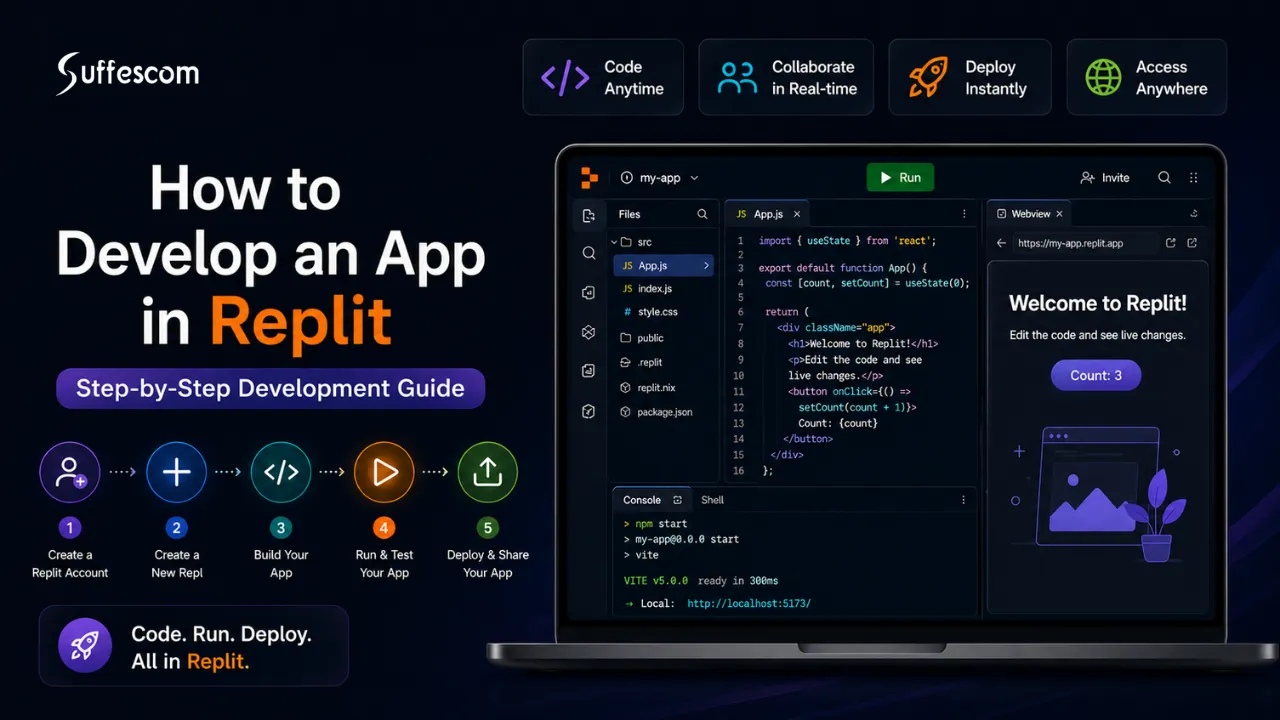
Replit has become one of the most innovative cloud development platforms powered by AI in the world today, forever altering how new age applications are constructed and deployed globally. Rather than using a standard local development environment to build or develop applications, Developers now have the ability to build, test and deploy applications directly from their browser using Cloud technology. This key shift is part of a much larger shift away from Local Development to Cloud based development and AI assisted software development.
In addition to the growth of AI assisted Code completion tools and Cloud based development through Agentic AI powered workflows, Cloud based platforms like Replit provide start up companies, developers, and even non-technical founders the tools to easily construct functional applications in significantly less time than has been possible in the past. Easily construct a simple web application or a complete SaaS Platform, as well as the entire application lifecycle faster and more efficiently.
With the rapidly increasing demand for rapid Application Development as we approach 2026, Companies are concentrating on efficiently validating their concepts as opposed to investing substantial amounts of money into complete products upfront. Replit Caters to this need by providing developers with the ability to have real-time collaboration, instant web hosting, and AI-assisted coding and therefore, minimizing the complexity and cost of developing applications.
With the advancements in the field of cloud computing and artificial intelligence, Replit has evolved beyond being just a coding environment; it is now evolving into a complete software development ecosystem.
Key Takeaways
- One of the quickest-growing AI-driven programming platforms is Replit, which gained popularity so fast that it received a valuation of up to $3 billion while achieving an annualized growth from $2.8 million to $150 million within just about a year due to the rapid AI coding adoption rates around the globe.
- This tool allows you to develop web applications, SaaS solutions, APIs, and various other AI-powered solutions right in your browser without having to set up any local development environments.
- Replit can offer faster software development due to its various AI tools for code generation, bug fixing, deployment, and language to code translation.
- With continued growth in the realm of cloud computing and AI, Replit is not only a platform for coding but has evolved into an ecosystem for the development of software applications in the modern age of software engineering.
- The emergence of agentic AI and ‘vibe coding’ has redefined the process of software application creation, where the generation and deployment of software can be done using conversation-based prompts rather than conventional coding.
- This has made Replit extremely popular with startups, solo founders, educators, and other prototyping groups due to their cost-effectiveness in terms of reducing infrastructure complexity and reducing development time.
- According to reports, the ecosystem of users on the Replit platform now comprises 40+ million users across the globe.
What is Replit?
Replit is a cloud IDE (integrated development environment) for coding, running, and deploying software without requiring any local configuration. The tool allows the use of several programming languages and provides an online space where one can develop programs in a collaborative manner.
In contrast to conventional development systems, which entail a lot of work such as setting up a server and configuring a system before installing the development tools, Replit makes the whole process very easy by merging all these functions on a single platform.
By 2026, Replit will have transformed from being just a web-based code editor to becoming an AI-driven development environment. Thanks to the integration of AI and automation features in its system, it becomes easy to prototype, debug, and code using natural language.
Overview of Replit Platform
Replit removes barriers to creating software by providing an online development platform where you can get started developing code without installing a compiler, IDE or run time. Everything runs in the cloud so you can access the development environment from any device.
Replit is commonly used for prototyping, learning, building SaaS apps and creating AI powered projects. Replit also allows users to collaborate on development projects in real-time, making it especially beneficial for distributed teams and remote development processes.
How Replit Works
Replit runs because it utilizes cloud-based computing, meaning that the code is run on servers rather than local devices. Once a user writes their code, it gets compiled and run in the cloud system and results are instantly returned to the browser window.
Another advantage of using Replit is the possibility of linking databases and other third-party applications to your project. Using Artificial Intelligence, Replit also helps with suggesting codes and debugging issues as well as generating functions from natural language queries.
Key Features of Replit
Replit is a cloud-based development environment that brings together coding, collaborative development, deploying & removing the barrier of managing AI-assistant technology to help streamline application development through one single platform without requiring local resources or installations for building and deploying applications.
Browser-Based Coding Environment
Replit runs entirely in the browser, eliminating the need for installations or system configuration. Developers can start coding instantly from any device with internet access, making development highly flexible and accessible.
AI-Powered Coding Assistant
The use of AI technology in Replit helps generate codes, correct mistakes, and make suggestions. This greatly saves time during the coding process and allows even beginners to develop good software.
Real-Time Collaboration
Multiple developers can be working at once, helping them be more productive than they would by doing so independently, providing opportunities for better team cohesion through less need for communication and therefore N/A to be done for remote developers.
Instant Hosting & Deployment
Instant deployment is made possible through Replit-built applications via one-click. The process eliminates the conventional DevOps process, thus enabling faster MVP launches and test runs.
Multi-Language Support
Replit supports a wide range of programming languages including Python, JavaScript, Node.js, Java, and more. This makes it suitable for both frontend and backend development projects.
Replit Core Features Table
| Feature Category | Feature | Description |
| Development Environment | Browser-Based IDE | Fully cloud-hosted coding environment with no local setup required |
| Multi-Language Support | Supports Python, JavaScript, Node.js, Java, C++, and more | |
| Instant Execution | Run code instantly in the browser with real-time output | |
| AI Capabilities | AI Code Generation | Generates code using natural language prompts |
| AI Debugging Assistant | Identifies errors and suggests fixes automatically | |
| Agentic AI Support | Enables autonomous task-based coding workflows | |
| Collaboration | Real-Time Collaboration | Multiple developers can code together simultaneously |
| Live Editing | Instant sync across all users in a project | |
| Deployment & Hosting | One-Click Deployment | Deploy applications instantly without DevOps setup |
| Cloud Hosting | Built-in cloud infrastructure for running applications | |
| Database & Backend | Integrated Databases | Supports PostgreSQL, SQLite, and external DB connections |
| API Integration | Easy integration with REST APIs and third-party services | |
| Productivity Tools | Package Management | Built-in dependency and package manager support |
| Version Control | Git integration for code tracking and collaboration |
Why Replit is Growing Rapidly in 2026
Replit is experiencing tremendous growth in 2026 due to the world-wide shift from traditional programming methods to AI-assisted development software and modern cloud-based software development processes. Developers and startups are focused on speed, ease of use, automation, and interactivity compared to the slower, cumbersome methods of programming in decades past.
1. Rise of AI-Powered Development
AI coding helpers and Agentic AI type workflows are revolutionizing how developers build out software functions. As AI becomes a better coding assistant with each passing day, Replit has integrated them into the coding environment so programmers can generate code, fix code and create new functions much more efficiently than with traditional software creation methods.
2. Shift Toward Browser-Based IDEs
The trend in programming development is significantly shifting away from local installations to browser (cloud) based tools that allow developers to code directly in a web browser and greatly reduce the complexity involved in establishing/setting up a development environment. Therefore, Replit is more user-friendly for people learning to program, remote workers, and quickly growing startups.
3. Startup Demand for Rapid MVP Development
Startups today are primarily focused on rapidly testing ideas for validation. Replit is perfect for MVP creation because it integrates code-writing; code-hosting; and code-deployment within the Replit web-based programming environment to enable developers to create an MVP in days as opposed to weeks, providing the company with a key competitive advantage over traditional coding processes.
4. Growth of Remote & Distributed Teams
Remote work has become much more commonplace, thus requiring many developers work together on the same project. Replit’s collaboration features allow several software developers located in different geographic locations to work on the same project at the same time. As a result, Replit helps software developers work more productively while reducing communication gaps between its heterogeneously distributed teams of software developers.
5. No-Code + Low-Code + AI Convergence
The merging of no-code tools, low-code platforms, and AI coding systems has provided all developers with greater accessibility in the development process. As the convergence of these technologies takes form, Replit stands at the centre of it all with a combination of true developer flexibility from normal coding and workflow and AI automation.
Build Your AI-Powered App Faster with Expert Developers
Why Developers and Startups Use Replit for App Development
Replit has become a preferred platform for developers and startups because it has dramatically simplified all aspects of the application development lifecycle. Replit provides a fully featured cloud-based environment, removing all traditional setup barriers, allowing teams to efficiently develop features instead of managing infrastructure, making it particularly useful for startups developing MVPs and in fast-paced startup environments.
No Local Development Environment Needed
Replit eliminates the necessity to install software, set up dependencies, and manage environment systems. Developers can begin programming right away using the browser, thus saving a lot of time, changing from hours to seconds.
It’s highly effective for newcomers and distant teams since everyone will have the same development environment without any problems with incompatibility.
Faster MVP Development
Replit enables startups to develop their minimum viable products at a much faster pace than what is possible in conventional software development environments.
Since coding, testing, and deployment occur in a single platform, development timelines are greatly reduced.
AI-Assisted Coding & Automation
Replit provides built-in AI capabilities that facilitate code generation, debugging, and optimization automatically. It saves a lot of manual effort and streamlines the process of software development.
Using agentic AI technology, programmers can describe their requirements in simple language, and the platform will automatically create a code structure accordingly.
Team Collaboration in Real-Time
Many people can be involved in contributing to a single project from different places at once using Replit’s Feature of Real-Time Collaboration, creating a much stronger working relationship and lessening conflicts due to different versions of the same file.
This is especially beneficial for people who work from home and are part of companies with different time zones due to the fact that everyone sees the changes that are made in real time.
Integrated Hosting & Deployment
Replit helps developers to host and deploy applications without the need of external tools (e.g., DevOps) while using their platform; therefore, simplifying the whole process for developers when it comes to deploying applications.
Applications can be deployed with 1 click and therefore makes it easy for developers to quickly test apps, provide demos to potential clients and have a production ready MVP of their application.
Cost-Effective for Startups & Solo Founders
Using traditional development takes a lot of money to build the infrastructure, host the application, and use DevOps skills and knowledge to build applications, increasing the cost of development a substantial amount compared to using Replit’s platform where all of the above are combined into this single platform.
This is what makes using Replit cost-effective for developing applications for small/start-up teams, solo developers and developers on a budget who want to have applications that grow along with them.
Traditional Development vs Replit Workflow Table
| Feature Area | Traditional Development | Replit Development |
| Setup Time | Requires manual installation & configuration | Instant browser-based setup |
| Development Speed | Slower due to environmental management | Faster due to integrated tools |
| Infrastructure | Separate servers & DevOps setup required | Built-in cloud hosting |
| Collaboration | Version control tools required (Git workflows) | Real-time live collaboration |
| Deployment | Manual CI/CD pipelines | One-click deployment |
| Cost | Higher (infra + tools + DevOps) | Lower (all-in-one platform) |
| Accessibility | Requires technical setup knowledge | Beginner-friendly, browser-based |
How Replit AI is Transforming Modern App Development
Modern software development is being transformed by Replit AI through added features of automation, intelligence, and speed to the coding process. Previously developers had to generate each line of code manually; however the advent of AI systems allows them to collaborate with AI systems to assist them with generating data, debugging code, planning architecture, and creating entire applications.
The shift from traditional coding practices towards AI-assisted and Agentic AI-driven development processes has allowed developers to focus more of their efforts on developing product design and logical workflows, while leaving the repetitive, technical aspects of executing a task to the AI system.
AI Code Generation
Using prompts, Replit AI can generate functional code without requiring developers to generate boilerplate logic (i.e., repeated code in programming). Developers can describe the required features needed in natural language; in return the AI will return structured code blocks. This greatly increases the speed of developing an application in the initial stages of development. This is particularly true when building MVP’s, prototypes, and when performing feature testing.
AI Debugging & Optimization
While in conventional debugging, humans are required to manually find the mistakes in their programming codes, Replit AI finds and corrects any error on the fly. Apart from debugging, Replit AI is capable of providing suggestions on how to improve performance and optimize the structure of your codes.
Natural Language to Code
Perhaps one of the most useful applications of Replit AI technology involves the ability to convert natural language instructions into functional programming code. All the user needs to do is describe what he wants in simple terms, and Replit AI will translate them into programming codes.
AI-Assisted Full-Stack Development
Replit AI facilitates front-end and back-end development through the automated generation of your complete application structure. In addition to helping to create APIs, creating UI components, creating database logic, and integrating into other applications, all with an integrated workflow, Replit AI allows you to create full stack applications with very little manual effort.
Agentic AI Development Workflows
Agentic AI allows for even greater levels of development automation by allowing for goal-oriented development. Rather than just executing a single command at a time, AI agents can now plan, take your tasks and break them down into step-by-step tasks, and execute multi-step processes autonomously. This represents a huge paradigm shift in our understanding of self-operating software development systems, where AI is acting as a junior developer in your environment.
AI-Powered Rapid Prototyping
Thanks to Replit AI, developers can prototype products very quickly, since it combines the stages of coding, testing, and deployment of applications within one process. With the help of such an instrument, one can create prototypes in just a few hours.
Real Apps You Can Build with Replit (Examples & Use Cases)
SaaS Applications
Replit is a popular platform for developing SaaS applications, including subscription-based dashboards and productivity applications. Replit makes it easy for developers to add authentication systems, payment gateways, and user management modules to their applications in a single environment.
This allows new companies to easily validate their SaaS idea without investing in large amounts of infrastructure. In addition, Replit’s instant deployment capabilities allow companies to quickly iterate on their products based on user feedback.
AI Chatbots & AI Agents
AI chatbots and intelligent agents are among the many uses for Replit, and allow developers to build conversational assistants, support bots, or automate business processes through the integration of various APIs like OpenAI.
By using Agentic AI workflows automation, developers can take their chatbots and intelligent agents beyond simple responses and create capabilities for their chatbots to perform multi-step actions like scheduling, retrieving data, and automating work processes. These capabilities will prove useful for many modern businesses.
Web Applications
Replit proves to be quite efficient when developing full-stack apps like dashboards, admin panels, portfolios, and portals for businesses. Frameworks that developers can work on in the browser include React, Next.js, and Node.js.
With integrated hosting on Replit, these applications will instantly have their own live URLs for deployment purposes without worrying about DevOps complications.
APIs & Backend Systems
Developers can create scalable backend systems and APIs on Replit that are suitable for use in web and mobile applications. These types of applications can include authentication, processing API data, and using microservice-based architectures to create these types of applications.
Additionally, Replit allows users to connect with external databases and services, so they can create production-ready backend systems with very little effort.
Automation Tools
Automation tools are yet another strong use case for Replit, particularly in regards to startups or small to mid-sized businesses; email automation systems, reporting dashboards, data extraction tools, and Bot-based workflow automation fall into this category. Automation tools help reduce human labour, improve operational efficiency and assist businesses with streamlining by allowing businesses to build and automate tools without requiring a large development team’s support, or having to set up complicated infrastructure.
Marketplace MVPs
MVP’s for the marketplace can also be built on Replit; for example, freelance/consultant marketplace platform, appointment booking system, and ecommerce prototype platforms. By using Replit, a mobile app developer can quickly implement the core functionality of a marketplace platform by building the necessary listings, search features, user profiles, and payment processing.
Internal Business Platforms
Businesses use Replit to create internal tools like CRM systems, HR dashboards, analytics tools, and reporting tools. This allows companies to improve their internal processes and productivity.
Because the development process is fast and flexible, businesses are able to quickly change internal tools based on changes in internal needs without needing an expensive enterprise software product to do so.
Educational & Learning Apps
Replit is also popularly used in the education world to develop interactive learning platforms, coding environments, quizzes, and learning management system (LMS) applications. The browser-based nature of Replit makes it the perfect platform to teach programming and technical skills.
Instructors can create real-time coding environments for their students to easily write, test, and run code immediately. This method enhances student engagement and increases their knowledge base in terms of practical application of what they have learned.
Productivity & Utility Applications
Lastly, Replit is also great for building productivity and utility applications such as task management, note taking, calculators, dashboards, and workflow assistant applications. These types of applications are often lightweight; however, they can be very helpful in everyday operations.
Developers are able to quickly develop these types of solutions on Replit because of the low barriers to entry, and as a result Replit has emerged as an excellent solution for developing internal productivity applications or niche utility applications that help solve problems efficiently for a targeted user group.
Real App Examples & Use Cases Table
| App Category | Example Use Case | Business Value |
| SaaS Applications | Subscription-based dashboards, productivity tools, analytics platforms | Helps startups quickly validate SaaS ideas with minimal infrastructure cost and faster go-to-market execution |
| AI Chatbots & AI Agents | Customer support bots, AI assistants, workflow automation agents | Automates customer interactions and business processes using AI and Agentic workflows, improving efficiency |
| Web Applications | Dashboards, admin panels, portfolios, business portals | Enables rapid full-stack development with instant deployment and reduced DevOps complexity |
| APIs & Backend Systems | Authentication APIs, data processing systems, microservices | Provides scalable backend infrastructure with easy integration of databases and external services |
| Automation Tools | Email automation, reporting systems, workflow bots | Reduces manual work and operational costs by automating repetitive business processes |
| Marketplace MVPs | Freelance platforms, booking systems, ecommerce websites | Allows fast validation of marketplace ideas before investing in full-scale development |
| Internal Business Platforms | CRM systems, HR dashboards, analytics tools | Improves internal operations and productivity with customizable business tools |
| Educational & Learning Apps | Coding platforms, LMS systems, interactive quizzes | Enhances learning experiences through real-time coding and interactive educational environments |
| Productivity & Utility Apps | Task managers, note apps, calculators, workflow assistants | Helps individuals and teams improve daily productivity with lightweight custom tools |
Turn Your Startup Idea Into a Live App in Weeks
Step-by-Step Process to Develop an App in Replit
Replit is unique in that it combines coding, testing, and deployment into one browser-based application, vaporizing traditional development environments and eliminating the need for complicated exasperation with complicated setup processes. Developers will be able to produce applications immediately without any pre-established configurations to burden the path to application creation.
Step-by-step instructions are included as part of the overall product offering, and are designed to aid new users, startup companies and experienced developers in constructing highly scalable applications through the utilization of Replit’s AI-enhanced ecosystem.
Step 1: Create a Replit Account
Registering for an account on Replit is the first thing that needs to be done in order to use its online development environment. Signing up for an account can be done in no time by using either email, Google, or GitHub authentication.
After signing up, users will be taken to their dashboard where they can begin creating projects and coding right away. This saves time by avoiding setup hassles and lets developers get straight down to work.
Step 2: Choose Programming Language or Framework
Developers are required to choose the programming language or framework for their projects after creating an account based on the type of application that they wish to develop. Replit allows developers to work with numerous different programming languages and frameworks which include Python, JavaScript, Node.js, React, etc.
The decision on which language and/or framework to use is fundamental to the structure of the application (front end, back end and database integration) and choosing an appropriate stack will make it easier to scale and develop a project at a later date.
Step 3: Set Up Project Workspace
The project workspace is where you as the developer will be able to manage all the coding, file types, and configuration settings relating to your project (application). After you create your project, Replit will automatically create all required environments, dependencies and runtime configurations so that there is no need for you as the developer to have to manually set them up; as a result, you can immediately begin coding. The project workspace will also allow you to have the ability to save in real-time and sync with the cloud.
Step 4: Build Frontend Interface
In this stage, developers design the user interface of the application using HTML, CSS, JavaScript, or modern frameworks like React or Vue.js. The focus is on creating a clean, responsive, and user-friendly experience.
The frontend determines how users interact with the application. A well-designed interface improves usability, engagement, and overall product experience.
Step 5: Develop Backend Logic
This involves the development of the server-side functionality of the application which includes authentication and database management.
Some of the programming languages supported by Replit to develop the back end include Node.js, Flask, and Django among others.
Step 6: Integrate Database & APIs
In this phase, developers incorporate databases such as PostgreSQL, MongoDB, or Firebase for storing application data. Additionally, APIs are incorporated in order to add functionalities and integrate other external applications.
This phase is important in developing applications that need dynamic content such as real-time data handling, user authentication, or even integration with third-party payment solutions.
Step 7: Use Replit AI for Faster Development
Replit’s AI is able to improve the speed of development by coding automatically, making suggestions, and correcting errors. The developer does not need to code manually since the developer will just have to use plain language to describe what they want to do. The developer can use agentic AI that allows for automation of some of the development processes.
Step 8: Test & Debug the Application
After developing the application, testing takes place in order to find any bugs and logical errors. Real-time execution offered by Replit makes debugging simpler and faster.
The use of AI technology in debugging also makes this stage more effective since it helps in suggesting some possible solutions.
Step 9: Deploy Your App
The deployment process on Replit is extremely easy because of the one-click hosting service offered by the platform. There is no need for setting up server infrastructure and managing DevOps processes as the apps can be immediately published. Once the app is hosted, it gets a URL link that can be shared publicly.
Step 10: Scale & Maintain the Platform
Once deployed, applications may continue to be enhanced through adding functionality, performance tuning, and bug fixing. The process is done smoothly using Replit.
Scalability is a way of ensuring the sustainability of an application. This can be done by scaling up the infrastructure, backend improvements, and improvements in user experience.
Best Tech Stack for Building Apps in Replit
The choice of technology stack is critical because it will greatly influence the performance of the application, the ability to scale the application, as well as the time to develop the application. The use of AI-assisted components in Replit’s integrated platform allows developers to take advantage of AI-driven automation; Automation can help you develop smart applications faster by using an agentic AI (an AI system to help developers build better apps).
Frontend Technologies
The term `Frontend tech` describes the user interface/user experience of an application. Replit supports all the major frontend frameworks that allow you to easily build responsive and interactive applications.
- React
React is a widely used JavaScript library for building dynamic and component-based user interfaces. It is ideal for SaaS dashboards, interactive platforms, and scalable web applications. - Next.js
Next.js is a React-based framework that supports server-side rendering and SEO optimization. It is perfect for production-grade applications that require fast loading and better search visibility. - Vue.js
Vue.js is a lightweight and flexible frontend framework used for building modern UI components. It is especially popular among startups due to its simplicity and ease of integration. - HTML/CSS/JavaScript
These are the core web technologies used for building simple websites, MVPs, and static web applications. They provide full control over structure, styling, and interactivity.
Backend Technologies
Backend technologies handle server-side logic, authentication, and data processing. Replit supports multiple backend frameworks that allow developers to build secure and scalable systems.
- Node.js
Node.js is a fast and scalable JavaScript runtime used for building APIs and real-time applications. It is widely used for modern full-stack development. - Express.js
Express.js is a lightweight backend framework built on Node.js. It simplifies API development and is commonly used for creating RESTful services. - Python
Python is a versatile language widely used for backend development, AI integration, and data processing. It is highly preferred for automation and machine learning projects. - Flask
Flask is a minimal Python framework used for building lightweight backend systems and MVPs. It offers flexibility and quick setup. - Django
Django is a full-featured Python framework used for building secure and scalable enterprise-level applications. It comes with built-in authentication and admin tools.
Database Technologies
Databases are essential for storing, managing, and retrieving application data. Replit supports both SQL and NoSQL databases, allowing flexibility based on project requirements.
- PostgreSQL
PostgreSQL is a powerful relational database used for structured data and complex queries. It is ideal for SaaS and enterprise applications. - MongoDB
MongoDB is a NoSQL database designed for flexible, unstructured data storage. It is commonly used in modern web and mobile applications. - Firebase
Firebase is a real-time database platform by Google that supports authentication, storage, and backend services. It is widely used for mobile and real-time apps. - Supabase
Supabase is an open-source alternative to Firebase that provides real-time databases, authentication, and APIs. It is popular for scalable SaaS applications.
AI & Automation Stack
AI and automation tools are becoming a core part of modern Replit applications. They help developers build intelligent, self-operating systems and advanced digital products.
- OpenAI APIs
OpenAI APIs enable developers to build AI-powered applications such as chatbots, content generators, and intelligent assistants. - LangChain
LangChain is a framework used for building AI workflows and Agentic AI applications. It helps connect large language models with external data sources. - Vector Databases
Vector databases store embeddings for semantic search and AI retrieval systems. They are essential for advanced AI applications. - AI Agents
AI agents enable autonomous task execution where systems can plan, decide, and complete multi-step workflows without manual intervention.
Tech Stack Summary Table for Replit
| Layer | Technology | Purpose | Best Use Case |
| Frontend | React | Dynamic UI development | SaaS dashboards & web apps |
| Frontend | Next.js | SEO-optimized applications | Production-ready websites |
| Frontend | Vue.js | Lightweight UI framework | Startup MVPs |
| Frontend | HTML/CSS/JS | Core web development | Simple apps & prototypes |
| Backend | Node.js | Server-side runtime | APIs & real-time apps |
| Backend | Express.js | API framework | RESTful services |
| Backend | Python | General backend & AI | Automation & ML apps |
| Backend | Flask | Lightweight backend | MVP development |
| Backend | Django | Full-stack framework | Enterprise applications |
| Database | PostgreSQL | Relational data storage | SaaS & business apps |
| Database | MongoDB | Flexible NoSQL storage | Scalable web apps |
| Database | Firebase | Real-time backend | Mobile & chat apps |
| Database | Supabase | Open-source backend | Modern SaaS platforms |
| AI Layer | OpenAI APIs | AI integration | Chatbots & AI tools |
| AI Layer | LangChain | AI workflow orchestration | Agentic AI systems |
| AI Layer | Vector DBs | Semantic search storage | AI search & RAG apps |
| AI Layer | AI Agents | Autonomous workflows | Multi-step automation |
How to Build AI Apps & AI Agents in Replit
Replit allows developers to create AI applications that can not only respond to users but also perform autonomous multi-step tasks and therefore fits well with startups that are creating the next wave of AI driven products.
Building AI Chatbots
The most common type of application created in Replit is the AI Chatbot, particularly for customer support, sales automation and user engagement. Developers can easily develop conversational interfaces with JavaScript or Python and AI API’s.
The chatbots created can be trained and/or configured to interact with the user based on data unique to the business developing the chatbot and will work across websites, applications and internal tools. Beginners can build functional bots using Replit AI without needing a solid knowledge of machine learning.
Integrating OpenAI APIs
Developers can integrate OpenAI APIs into their Replit applications to add advanced AI functionality to their application. The main capabilities available through OpenAI APIs include text generation, summarization, translation and intelligent conversation.
By integrating GPT model APIs developers can build many potentially powerful AI based applications including content generation engines, virtual assistants and smart recommendation systems. Replit enables developers to quickly and efficiently test and deploy AI applications in the cloud.
Building AI Agents
Unlike typical chatbot systems, AI-based agents operate on their own according to the input given by a user. With Replit, a developer can create an agent that can create plans, reason and carry out a series of steps to accomplish various tasks.
These agents are able to accomplish many things, such as collecting data, creating reports, automating emails, etc. While this trend continues, we see many applications of this type of software independently completing tasks and achieving complex objectives with very little human involvement.
AI Workflow Automation
AI workflow automation utilizes artificial intelligence (AI) technologies to automate many repetitive business processes. Developers using Replit can create a series of workflows which connect multiple API endpoints, databases and AI to automate activities.
For instance, in the case of a specific workflow, an agent could take the user’s data, use AI to analyze the data, make actionable suggestions or recommendations and send a report to the user without any necessary input from the user. Automation of all these activities will help businesses tremendously with productivity and efficiency, but at the same time it also helps to free up employees’ time so that they can focus on higher value projects and tasks.
Multi-Agent Systems in Replit
Multi-agent systems refer to the use of numerous autonomous AI agents working together in order to accomplish highly complex tasks. Developers can create multi-agent systems that allow for the use of different types of agents that manage different responsibilities (e.g., planning, execution, validation) on Replit.
The implementation of multi-agent systems is ideal for cutting-edge applications such as research assistants, business automation platforms, and intelligent decision-making systems. This method represents the next generation of distributed AI architectures.
Deploying AI Applications
After creating an AI application, Replit enables developers to deploy their AI applications with one-click deployment to quickly publish their AI toolset online. Developers can create a live URL for their AI application, and they can quickly provide access to the AI application to their users and customers. This significantly lessens traditional DevOps complexity and enables rapid iteration. In addition to updating their AI applications frequently based on user feedback, Replit is an excellent option for fast-moving AI startups.
Vibe Coding with Replit AI: The Future of App Development
Vibe coding is the next big evolution in creating software. Instead of requiring developers to use a specific syntax to tell the computer how to do something, it allows them to provide an outline or description of their intentions and then use AI technology to create the application from that description. Where traditional programming focuses on syntax-based coding, vibe coding focuses on the concepts behind it: ideation, logic, and product development.
What is Vibe Coding?
Vibe coding defines a new way to develop software by using an AI-assisted approach to building out the solution based on what you want (“intent”) expressed in natural language and logic, rather than being dependent on traditional coding language where every action is broken down and coded line-by-line. In the vibe coding process, developers can focus on developing the “features” they want to build instead of how they will program them, and AI tools such as Replit AI will take that outline and create the code needed to create those features.
Vibe coding is quickly gaining in popularity with the increasing amount of AI-driven development environments available for use, enabling developers to create and launch applications much faster than they could before by practically eliminating technical barriers that existed due to having to learn syntax, create boilerplate, and set up frameworks before developing their applications.
Essentially, to sum this up, vibe coding has shifted the way developers will create software from a focus on writing code to a focus on expressing outcomes — making them more aligned with product development methodologies and facilitating rapid prototyping.
One possible instance of vibe coding in Replit could be:
- “Create a task management application with login capability and a dashboard analytics section.”
- And the AI system then develops the frontend interface, backend functionality, and database schema for you.
It becomes particularly useful for startups, minimal viable product (MVP) development, and single entrepreneurs that require rapid validation without needing dedicated engineering teams.
On a more profound level, vibe coding is also reshaping the role of developers themselves from programmers who manually write code into architects who instruct AI systems on how to design programs.
Natural Language-Based Development
Using natural language for the development process means that natural language describes the function of the software rather than programming syntax. The result is that software development is now vastly simplified and much more accessible.
The benefits of this method are that it can be used for:
- Quick creation of minimum viable product (MVP) prototypes
- Creating prototypes by non-technical founders
- Speeding up experimentation during the testing process
This new method of building software has created a streamlined process between idea and execution, thereby significantly reducing the amount of effort needed to develop any software product.
AI Pair Programming
Replit AI Pair Programming makes Replit a smart coding tool by working side-by-side with programmers to provide suggestions, correct mistakes, and improve the logic of the codes.
In case of a function that is either inefficient or erroneous, for instance, Replit instantly suggests better-performing alternative codes.
Conversational App Building
Chatbot App Development involves building apps through conversations with AI, without having to write lines of code.
For instance, a developer can just talk to AI saying:
- Add a payment gateway
- Design an analytics dashboard
- Make the UI more responsive
These changes are implemented immediately by the AI.
Autonomous Coding Workflows
Automated coding processes allow the AI to perform mundane programming activities without much human supervision. Within the Replit platform, examples of such automated processes include code generation, bug fixing, and code refactoring.
This allows software engineers to allocate their time more efficiently by concentrating on architectural issues and product planning.
Future of AI-Native Software Engineering
AI-native software engineering will define the next phase in software development whereby AI plays a crucial role in the development process as opposed to being an auxiliary tool.
As Replit heads towards agentic AI architecture, apps will become progressively engineered by means of automated intelligence. Software engineers will move away from coding to controlling systems, signifying a revolution in software engineering.
Replit App Development Cost (2026 Breakdown)
In the UK, creating an app via Replit generally ranges from £0 for simpler MVPs to £8,000 – £40,000+ for complex SaaS or AI-driven apps.
Replit saves UK app development costs greatly by eliminating the need for DevOps, servers, and other traditional hosting-related expenses. Yet the overall cost would depend on the amount of AI, third-party integration, database expansion, and other factors.
UK startups frequently leverage Replit to quickly create MVPs for product validation without committing to engineering staff at this stage.
Replit Free vs Paid Plans
Replit provides a free version and several paid versions that are commonly utilized by software developers in the UK. The free version can be ideal for learning purposes, testing, and building minimal viable product prototypes without the need for any production capabilities.
The paid version is intended for professional use and comes with enhanced computing power, private deployment features, and AI tools.
Table: Replit Free vs Paid Plans (2026 Comparison)
| Feature | Free Plan (£0) | Core Plan (~£16–£20/month) | Pro Plan (~£75–£80/month) |
| Best For | Students, hobby projects | Freelancers, MVP builders | Startups & SaaS companies |
| App Deployment | Limited | Full deployment support | Advanced production hosting |
| AI Features | Basic AI access | Enhanced AI coding support | Advanced AI + model access |
| Privacy | Public projects | Private projects | Enterprise-grade privacy |
| Collaboration | Limited | Up to 5 users | Up to 15 users |
| Compute Power | Basic | Medium performance | High performance |
| Support | Community | Standard | Priority support |
Cost by App Complexity
The cost of developing applications in Replit will vary widely according to three main things: complexity of system, backend architecture and the amount that is used to integrate artificial intelligence (AI). The UK also complicates things because the costs of developers per hour and how much the application uses the cloud will affect the total cost.
- Basic Apps (£0 – £4,000)
A basic application might consist of just a landing page with a calculator or a simple prototype (MVP). They do NOT require a ton of backend logic and usually have all their time spent in either the free or low-cost area of Replit to build. - Medium Complexity Apps (£4,000 – £12,000)
A medium complexity application would likely consist of SaaS dashboards, authing applications or booking applications with some simple integrations through external APIs and databases. - Advanced SaaS & AI Apps (£12,000 – £40,000+)
An advanced application will generally be fully functional (including ai) can process data in realtime, support multiple users and have agentic ai working towards a single goal. The additional costs will occur when using any external API’s, computing resources and the capability to scale.
As the complexity of the application increases, the driving costs for either a backend will become the backend scalability, ai integration and infrastructure optimazition (not the front end).
Table: Cost by App Complexity (2026 Breakdown)
| App Type | Example Use Case | Complexity | Estimated UK Cost (£) | Estimated US Cost ($) | Key Cost Drivers |
| Basic MVP Apps | To-do apps, portfolio websites, simple dashboards | Low | £1,500 – £6,000 | $2,000 – $8,000 | Basic UI/UX, lightweight backend, hosting |
| Starter SaaS Apps | Booking systems, CRM MVPs, subscription platforms | Medium | £6,000 – £15,000 | $8,000 – $20,000 | Authentication, APIs, database setup |
| Business SaaS Platforms | Analytics platforms, workflow management systems | Medium–High | £15,000 – £40,000 | $20,000 – $50,000 | Multi-user architecture, integrations, scalability |
| AI Applications | AI chatbots, AI agents, automation tools | High | £10,000 – £60,000+ | $12,000 – $75,000+ | OpenAI APIs, vector databases, AI workflows |
| Enterprise Systems | Large-scale business software, enterprise dashboards | Enterprise | £80,000 – £250,000+ | $100,000 – $300,000+ | DevOps, compliance, infrastructure, security |
Factors Affecting App Development Cost
There are many factors that can impact the total cost of building an application on Replit. Understanding these factors can help you more accurately budget for your project, making sure you don’t run into scaling costs that are some large surprise in your development process.
- AI API Integration Costs
Integrating AI tools such as OpenAI, LangChain or similar betas creates usage-based pricing. An application with a lot of AI-based features will therefore incur higher operational costs over time. - Hosting & Compute Usage
Replit applications that require continuous processing, real-time updates, or heavy backend computation consume more resources, increasing overall cloud usage costs. - Database Architecture & Storage
When choosing how to architect your database (PostgreSQL, MongoDB, Firebase, Supabase), you’ll have to weigh the performance aspects of the chosen database vs the ongoing costs of maintaining that database. Additionally, larger data sets and real-time data syncing will add considerable infrastructure needs as well. - Third-Party Integrations
Payments gateways, analytics tools, authentication systems, and other external APIs can significantly add to both the upfront and long-term operating costs due to added complexity in development. - Developer Experience Level
Although hiring experienced developers, and/or agencies may result in higher upfront costs, it substantially reduces the long-term technical debt incurred by your project and helps your system become more stable and scalable. - Application Scalability Requirements
Apps designed for thousands or millions of users require better architecture, load balancing, and optimization, which significantly increases development cost.
How to Reduce App Development Costs in Replit
To Reduce development costs on Replit, a strategic plan is necessary for most UK-based start-ups, particularly during their initial phases of funding when they typically have minimal funding available.
Starting with a functioning MVP that consists only of the basic features and then growing from that point as you receive feedback from real users is the most cost-effective strategy.
You can also save costs in other ways:
- Use Replit AI so you do not have to write as much code manually.
- Do not integrate with third-party applications until you have tested your idea and know that your idea will succeed.
- Optimize the way you use APIs to limit your costs for AI.
- Use small frameworks that will allow you to develop faster.
- Gradually scale up your infrastructure instead of building out too much too soon.
Using this methodology allows a UK start-up to rapidly test its idea and maintain a controlled cost for long-term development.
Need Help Building an App on Replit?
We help startups and enterprises transform ideas into fully functional digital products with faster turnaround times and lower development costs.
Replit App Development Timeline (2026)
In Replit, simple applications may be developed within a period of hours up to 1 to 2 days, whereas more complicated SaaS or AI-based applications in the United Kingdom may take between 2 and 8 weeks.
The speed of application development with Replit is faster than traditional software engineering since it takes away the need for setting up the environment and configuring servers and deployment processes. Nevertheless, for production-level applications, there should be planning and optimization involved.
As regards the United Kingdom, startups may develop MVPs incredibly fast, even in minutes with the use of artificial intelligence, although real-life functioning applications require gradual development processes.
Can You Build Apps in Minutes with Replit?
The Replit platform enables developers to create a rudimentary architecture for an app within a few minutes with the help of its artificial intelligence-based code generator.
However, even though building the foundation may take only a few minutes, developing a robust system still needs time for development, debugging, and customization of features.
Average Timeline for Replit App Development
In the UK, the timeline for app development differs according to app complexity, team size and level of integration needed to develop the app.
- Basic MVP Apps (1–3 days)
Simple UI-based applications, prototypes, or validation tools built using Replit AI. - Medium Complexity Apps (1–3 weeks)
SaaS dashboards, authentication services, APIs-driven apps, and business tools that use databases. - Advanced AI / SaaS Platforms (4–8+ weeks)
Applications developed using AI, including real-time features and multiple users’ functionalities and scalability.
Why Replit Speeds Up App Development
With Replit, there is a drastic reduction in the amount of time taken to develop software as all the constraints that usually slow down the process, such as setting up a local environment and manually configuring the deployment, have been eliminated. Everything takes place in a cloud environment and the developer can begin working straight away.
Adding Replit AI to this process increases its efficiency many times over.
1. No Local Setup or Configuration Required
Replit operates solely within the web browser, so engineers won’t need to download SDKs, frameworks, or development environments to their workstation. This saves developers the time that they would usually spend setting up their workstations – for example, usually, a developer would spend a lot of time setting everything ready before they begin creating an application. Since all applications created within Replit are pre-configured out of the box, they can hit the ground running and get coding immediately. This also makes Replit the perfect tool for rapidly prototyping and getting a fully-featured minimum viable product (MVP) ready for launch.
2. Instant Cloud-Based Development Environment
Replit provides a single cloud-based IDE (integrated development environment) to create, execute and even host your applications in. Developers won’t need to set up servers or manage any of the infrastructure manually. Furthermore, because all coding, testing and deploying of applications occur within the same integrated environment (in this case, the Repl webpage), development occurs considerably more rapidly than traditional development.
3. AI-Powered Code Generation & Assistance
Replit has AI capabilities that help developers produce code more quickly, by automatically creating functions, suggesting changes to improve the code they wrote, and debugging errors as they occur during coding. With this type of automation, developers spend much less of their time manually creating code. Startups and solo developers will be able to develop new features more quickly than with a large engineering team.
4. Built-in Deployment System
Unlike conventional implementation processes, Replit enables you to deploy your app with one click by eliminating the delay associated with setting up servers and working through Devops pipelines. This provides the opportunity for continuous testings and rapid iteration cycles essential to validate MVPs and refine products.
5. Pre-Built Integrations and Templates
Replit offers pre-designed templates and integrations for many popular frameworks, databases and APIs; thereby allowing developers to eliminate the majority of the time it takes to develop an app by not having to build everything from scratch (e.g., authentication and database integration and other complex tools).
Factors That Affect Development Speed
There are a number of factors that can also affect how fast an app can be created even with the speed advantages that Replit provides.
- Feature Complexity
The number and complexity of features directly impact development speed. Simple applications with basic functionality can be built quickly, while apps with advanced workflows, user roles, or AI features take more time. - AI & API Integrations
Integrating third-party services into an app takes up development time. The process of integrating APIs or services like OpenAI involves not only coding but also testing, managing access tokens, and setting up endpoints and keys.
- UI/UX Requirements
Products with unique UI/UX design take longer to develop than products based on templates. Creating custom designs usually means spending extra time developing and testing a product. - Team Experience Level
Experienced developers can build applications faster because they understand architecture, debugging, and optimization techniques. Beginners may take longer due to learning curves and trial-and-error coding. - Scalability Needs
Apps designed for large user bases or real-time usage require additional optimization, backend structuring, and performance tuning. These requirements increase development time because developers must ensure the application can handle growth without performance issues or system failures.
Replit App Development Timeline (UK Breakdown Table)
| App Type | Description | Timeline | Key Influencing Factors |
| Basic MVP Apps | Simple tools, landing pages | 1–3 days | Minimal backend, no integrations |
| Starter SaaS Apps | Dashboards, CRUD systems | 1–3 weeks | Auth + database setup |
| Business SaaS Platforms | Multi-user systems | 3–6 weeks | APIs + scaling needs |
| AI Applications | Chatbots, AI agents | 2–6 weeks | AI integration complexity |
| Enterprise Systems | Large-scale platforms | 6–12+ weeks | Security + infrastructure |
Replit vs Cursor vs Bolt vs Lovable vs Windsurf
Selection of an appropriate coding platform for the AI system will be determined by the development objectives, technical capabilities, and the type of projects such as MVPs or software as a service being developed or an AI-first application being designed.
Replit serves as a comprehensive coding environment hosted on the cloud while Cursor and Windsurf are more concerned with AI support in the process of code writing. Bolt and Lovable concentrate on quick development of applications powered by AI.
AI Coding Platform Comparison Table
| Feature | Replit | Cursor | Bolt | Lovable | Windsurf |
| Core Purpose | Full-stack cloud IDE + AI coding | AI-powered code editor | AI app builder | No-code AI app generator | AI-native dev environment |
| Best For | Startups, MVPs, SaaS apps | Developers, coders | Rapid prototyping | Non-technical users | AI-first engineering teams |
| Setup Required | None (browser-based) | Local install required | Minimal setup | No setup | Cloud + local hybrid |
| AI Capability | Strong (Replit AI + Agents) | Very strong code assistance | Moderate AI automation | High no-code AI generation | Advanced agentic AI support |
| Deployment | Built-in instant hosting | External deployment needed | Limited hosting | Built-in simple deployment | Cloud deployment support |
| Learning Curve | Easy–Medium | Medium–High | Very easy | Very easy | Medium |
| Collaboration | Real-time team support | Limited | Limited | Limited | Moderate |
| AI Agent Support | Strong (Agentic AI focus) | Weak–Moderate | Basic | Basic | Very strong |
| Ideal Use Case | SaaS, MVPs, AI apps | Professional coding | Quick prototypes | Non-coders building apps | AI-native systems |
Which Platform is Best for Startups?
For startups, speed of execution and cost efficiency are key. Replit’s complete cloud-based development environment, with AI assistance, instant deployment and full-stack capabilities make it the best platform for building MVPs and SaaS products quickly.
By allowing founders to go from Idea to working product, Replit reduces Time-to-market by not requiring management of infrastructure; thus allowing them to develop products without worrying about setting up backend, frontend, and AI integration separately (which many other services only support code editing or prototyping).
Given that Cursor and Windsurf are better options for experienced developers, they still require separate external setups and deployment processes. Whereas Bolt and Lovable can deliver prototypes faster, they do not scale for larger SaaS products. Accordingly, based on these factors, Replit proves balance out as the most appropriate option for early-stage startup companies.
Which AI Coding Tool is Best for Beginners?
Lovable and Bolt are beginner-friendly AI code-generation tools that help programmers create basic applications with little or no experience in coding. Both provide a user-friendly environment to create apps. These programs help programmers by providing assistance when creating apps via voice or written description without having code the backend or the data structure of an application.
Replit is also a beginner-friendly tool but is a little more technical than bolt and lovable. Cursor and Windsurf require someone who knows how to write code and would not meet the needs of a non-technical person. As a result, both Lovable and Bolt are the fastest way non-technical individuals can create an application.
Best Platform for AI Agent Development
The most suitable platforms for developing AI agents are Windsurf and Replit, because of their well-defined support for agentic AI process and multi-step automated process support.
Agents need reasoning and planning abilities in order to act without any assistance. The Windsurf platform is focused on complex AI native environments, whereas the Replit platform is an easier cloud-based platform with AI support along with APIs such as OpenAI and LangChain.
The Replit platform can be considered as the most appropriate platform for developing AI agents by start-ups, whereas the Windsurf platform would be used for more experienced AI developers. The Cursor, Bolt, and Lovable platforms have weaker performance regarding full agentic processes.
Pros and Cons of Using Replit for App Development
Replit has benefits and drawbacks based on what kind of application you are developing. For startups, developers, and companies that plan to use Replits for production-level application development – particularly scalable SaaS or AI-powered applications – it is essential to clearly understand both the pros and cons of using Replit in production.
Pros of Replit
Replit has many positive attributes making it useful for developing modern applications, especially when creating MVPs, prototypes, or developing apps using AI technology.
1. No Setup Required (Browser-Based Development)
You can create software on Replit without having to install any software locally, create a local environment setup, or configure anything. You can get started on your next project immediately, which greatly shortens the onboarding process for beginners, startups, and users doing rapid prototype workflows.
2. Fast MVP Development
Through Replit’s capabilities, users can complete their projects much quicker than they could otherwise be achieved. Utilizing Replit allows individuals and startups to quickly build on their initial idea and establish a working prototype in hours or days instead of weeks!
3. Built-in AI Coding Assistance
Replit AI helps generate code, debug errors, and optimize logic in real time. This reduces manual effort and speeds up development significantly. It also lowers the barrier for non-experienced developers to build functional applications.
4. Instant Deployment & Hosting
Applications created through Replit can be instantly hosted just by clicking one button. This eliminates the need for external hosting and DevOps operations. This enables the tester to experiment continuously with quick iterations.
5. Real-Time Collaboration
Multiple developers can work on the same project simultaneously, similar to Google Docs for coding. This improves teamwork efficiency. It is especially useful for distributed teams and startup environments.
Cons of Replit
Though Replit is efficient in fast coding, it has some downsides that may affect larger projects or business applications.
1. Limited Scalability for Large Applications
Although Replit is great for small projects and Minimum Viable Products (MVP), as well as for small-to-medium size applications, it has the potential to run into some performance issues when working with a large enterprise wide application. An application with very high traffic volume or complex architectural structure may require migrating to dedicated cloud infrastructure.
2. Dependency on Internet Connection
As the IDE runs through a web browser, it necessitates a constant connection to the Internet. The program does not allow offline coding. This may limit its use among developers operating in poor connectivity zones.
3. Performance Constraints on Heavy Projects
Large-scale programs that demand heavy computing power, extensive data processing, or real-time functionality may encounter performance issues. Classic cloud computing platforms may outperform the platform in such scenarios.
4. Limited Low-Level System Control
Replit hides a lot of the infrastructure management so that developers do not have as much control over the servers, network infrastructure, and low level configuration of the system itself. This may not work for many developer’s who require a more advanced level of backend engineering due to this limitation.
5. Cost Increase at Scale
While Replit provides a cost effective alternative for small projects, it is possible that the costs of using Replit will grow rapidly as you begin to use some of the advanced AI tools and increased amounts of compute resources, as well as additional costs for scaling up your infrastructure. This should be closely monitored if you will be doing any long term planning for a SaaS or large enterprise.
Replit Pros vs Cons Table
| Category | Pros | Cons |
| Setup | No installation required, browser-based | Requires stable internet connection |
| Development Speed | Extremely fast MVP development | May slow down for large systems |
| AI Capabilities | Strong AI coding assistance | Limited advanced AI customization |
| Deployment | Instant deployment & hosting | Limited infrastructure control |
| Scalability | Good for startups & MVPs | Not ideal for enterprise-scale apps |
| Collaboration | Real-time team coding | Limited offline collaboration |
| Cost Efficiency | Low initial cost | Can increase at scale |
| Flexibility | Easy to use for beginners | Less control over system architecture |
Security, Hosting & Scalability in Replit
When evaluating Replit as a viable option for creating apps in the real world, you want to consider security, hosting and scalability of the Replit platform. Replit has created an easy to use cloud-based platform that allows for app development and deployment, but it’s really important that you research their current security measures and scaling capabilities before using the platform.
Environment Variables & API Security
The Replit platform provides developers with the ability to save sensitive information like API keys, database connection strings, and authentication tokens in their codebase using environment variables.
Nevertheless, developers need to implement some best practices like key rotation and limiting permissions to avoid any possible issues with API access and protect their applications from vulnerabilities.
Secure Hosting Infrastructure
Replit comes with integrated cloud hosting capabilities which enable applications to be deployed immediately without configuring servers manually. This makes deployment easy while ensuring the baseline level of security.
The architecture supports efficient handling of small to moderate loads, but for enterprise-level applications, there is a need for extra levels of security like cloud hosting or reverse proxies.
Database Security
Replit also allows for integration with third-party databases, which include PostgreSQL, Firebase, and Supabase, that deal with storage and data security independently of Replit.
Data security will be greatly affected by how the databases are configured, and how authentication methods are set up for them, among other factors. Correct database implementation is essential when it comes to securing users’ data.
Authentication & User Management
Replit apps usually use external authentication mechanisms like OAuth services, Firebase authentication, or a custom-built back-end authentication service. This enables developers to implement robust user authentication and login functionality.
Best practices for authentication include multi-factor authentication (MFA), token-based sessions, and role-based access control (RBAC).
Scalability Considerations for Production Apps
Though Replit can be used to develop minimum viable products, scalability issues might occur when trying to scale applications to support many users.
The use of external cloud platforms such as Amazon Web Services, Google Cloud Platform, and Microsoft Azure can solve scaling problems in conjunction with Replit.
Replit for Beginners vs Professional Developers
Replit is one of those development environments that work efficiently for both beginners and professionals; however, the usage approach for these two user types is drastically different. While for beginners Replit works as an efficient educational platform to learn and experiment, for professionals it turns into a productive environment for building applications.
The main distinction between these two approaches to working with Replit is in how much the use of Artificial Intelligence matters for users of each type.
Why Beginners Prefer Replit
The main advantage Replit provides for first-time users is that it streamlines the programming process by removing all the complexities associated with the traditional programming development environment. Replit allows users to run their programs from the web browser without requiring any compiler installation or system dependency configuration. As a result, first-time users can focus exclusively on acquiring knowledge regarding programming logic and programming theory rather than using time to acquire experience with other components of a program.
Replit offers AI-assistance when writing code, allowing first-time users to learn proper code structure through function creation and error identification/correction.
While beginners use Replit as an integrated development environment or IDE for learning to code, they also have access to a full-fledged programming ecosystem in which they can gradually learn to go from creating a very simple, small script to creating a fully functioning application.
Best Use Cases (for beginners):
- Learning programming fundamentals (Python, JavaScript, etc.)
- Building simple apps like calculators, to-do lists, or games
- Practicing coding challenges and algorithms
- Experimenting with AI-generated code and understanding logic flow
- Creating small portfolio projects for education or internships
Why Startups Use Replit for MVPs
Startups use Replit to build MVPs (minimum viable product) and deploy them in a matter of days, while spending little on the infrastructure, DevOps and back-end application setup, etc. A founder can use Replit to create and deploy an MVP directly through a web browser and go from concept to product in a very short time frame.
Using Replit’s AI code creation technology, the need to manually write code will be greatly reduced, enabling the startup to quickly validate their product idea, confirm there’s a demand for it, and make appropriate changes based on user feedback, all with minimal engineering effort at the outset.
This is especially useful for companies following the lean startup methodology, which emphasizes speed to market in lieu of architectural excellence.
Best Use Cases (for startups):
- Building MVPs for SaaS products
- Creating proof-of-concept applications/prototypes to present to prospective investors
- Developing early versions of AI chatbots or automation apps
- Validating marketplaces or booking platforms
- Attempting rapid product experimentation and A/B testing
How Professional Developers Use Replit
Replit is typically used by professional developers as an environment to create rapid iterations of prototypes; it is not usually considered to be a production deployment. Developers use Replit to conduct quick tests of ideas, develop APIs and test new frameworks without having to implement the full capability of a local deployment.
For more experienced engineers, Replit is particularly effective for experimentation with AI and prototyping concepts for microservices, as they can integrate APIs such as OpenAI and LangChain, or use external data sources to evaluate how a system will behave once it is deployed to a production environment on a cloud provider such as AWS or Google Cloud.
In the enterprise, Replit is often used as an experimental space in which ideas can be validated very quickly before the processes are implemented into a scalable architecture.
Best Use Cases (for professional developers):
- APIs and back end development
- AI agent and automation process development
- Internal developer tools and administrative processes
- Rapid debugging and code verification
- Proof of concept development prior to deploying to the cloud
Common Mistakes to Avoid When Building Apps in Replit
Replit simplifies app dev but many develop (mostly beginning) make fatal errors that will affect how scalable and secure the app will be long term/ability to maintain the app over time. Recognizing these errors early prevents spending money to rebuild the app or deal with performance issues down the road.
Ignoring Application Scalability
One of the biggest mistakes that developers make when creating an application is that they build the application without thinking about how scalable the app will be in the future(for example, although Replit is really great for creating a prototype or an MVP, most apps will eventually become very large and due to a lack of forward thinking in the first place- therefore, you will have a nasty performance bottleneck during the time you need to scale your application, etc.)
Poor API Security Practices
A lot of developers don’t secure their API keys/authentication tokens and/or their connections to third-party services correctly. As such, there are numerous security risks; especially if sensitive data is being leaked either through your client-side code or through a public repo.
Over-Reliance on AI Without Code Validation
Replit’s powerful AI capabilities are great for quickly generating code; however, just because it’s generated from AI, doesn’t mean that the actual code will be secure, efficient, or even be well written. AI-generated code usually does not adhere to any of the standard best practices used by traditional programmers.
Weak Database Architecture
Inadequate database structures are not only a huge source of issues from missed relationships to index/designing benchmarks for scaling but also are seen as common pitfalls that many developers fall into through a lack of foresight and planning.
Improper Dependency Management
Another pitfall that developers experience is not taking into account the use of dependent libraries and frameworks for their application development. Instead of reviewing how library use plays into the long-term stability of your code and application, many developers simply install the library without intention or thought; the result is nothing less than bloated and insecure programs that tend to fail at some point due to the incompatibilities associated with the use of these libraries.
Challenges of Developing Apps in Replit (And Solutions)
There are many challenges that developers will encounter when building their applications on the Replit platform and these challenges will become more visible as you progress from the initial MVP phase of your application to the large, production-scale version of your application. Fortunately, most limitations associated with building an application using Replit can be addressed through proper architecture and through out-of-the-box integration with external services.
Performance Limitations
Replit is optimized for rapid development and small to medium-scale applications, but performance can become a challenge for compute-heavy or high-traffic systems. Applications with real-time processing or large datasets may experience delays or resource constraints.
As a result, many developers have turned to cloud services or APIs to offload the bulk of their processing to those external providers, while keeping Replit as front-end and orchestration logic.
Infrastructure Control Constraints
One issue with Replit is that you don’t have the same level of transparency and control as you would with a traditional cloud provider such as AWS or Azure, meaning that you cannot configure the physical servers, the underlying networking layers, or the system-level resources.
While this abstraction improves the speed of development, it also limits the way developers are able to create more complex backend engineering use cases. In fact, in most production setups today, developers are using hybrid setups and combining the power of Replit with other cloud service provider’s (CSPs) physical infrastructure.
Third-Party Integration Challenges
Despite the capabilities of Replit for incorporating various APIs, it might be challenging at times to incorporate too many third-party tools because of issues related to authentication, rate limiting, and dependencies.
Effective management of APIs is necessary to avoid interfering with the process flows of the application.
Scaling Enterprise Applications
Replit works well when developing MVPs or early-stage products, but when looking to scale to enterprise-level applications, more infrastructure is needed, such as high concurrency, databases, and traffic distribution across the globe that might be beyond the capabilities of Replit.
In these instances, enterprises usually move their backend to cloud providers such as AWS or Google Cloud, but keep Replit for development purposes.
Cloud Resource Management
Resource efficiency plays an important role in Replit development, particularly when using AI APIs and background jobs. Failure to manage resources effectively could lead to higher expenses or performance throttling.
It is imperative for developers to observe resource consumption behavior and optimize the use of API services and workflow.
Best Practices for Developing Apps in Replit
Application development on Replit can be done very quickly, but creating scalable applications that work well in production requires discipline. Failures of using Replit to create an application often aren’t due to any problem with the technology itself, but rather bad architecture decisions taken when starting out.
The most successful groups look at Replit as a quick way to develop applications and then gradually scale up into something else. This is what distinguishes serious software-as-a-service projects from mere hobbies.
Start with MVP-First Architecture Thinking
Rather than planning for the entire system from day one, successful developers first build an MVP architecture that concentrates solely on essential functions. In particular, Replit helps with this approach since it eliminates all infrastructure concerns.
However, even MVPs should be structured with future scalability in mind. This means keeping modules separated, avoiding tightly coupled logic, and ensuring that backend and frontend responsibilities are clearly defined from the beginning.
- Focus only on essential features for proving the concept
- Do not over-engineer the early stage architecture
- Ensure your code is modular for moving it to the cloud
- Plan API architecture with scaling in mind
Use AI as a Coding Partner, Not a Replacement
However, Replit AI is very powerful in helping accelerate the development process; however, depending on AI too much may create some weaknesses from a structural perspective in your application.
The best software developers employ AI to generate codes, debug codes, and optimize codes, but they do all other activities manually.
- Never depend on AI in making final architectural decisions.
- Always make sure that you review and refactor the code generated by AI.
- Make sure that your logic validates with real-life scenarios.
Keep Codebase Modular and Scalable
Modularity is one of the most crucial aspects of coding best practices. Many Replit codes do not work effectively when deployed in a production environment because of a lack of modularity. Modular design guarantees that every module in your project grows independently from the others.
- Frontend logic must be separated from the backend logic
- Components should be reusable rather than copied
- APIs should be organized as modules
- Prepare your code to be migrated to a cloud environment
Optimize API Usage and External Integrations
Replit-based applications often depend heavily on external APIs, like OpenAI, payment gateways, or analytics platforms. Improper use of APIs leads to a rapid rise in both costs and inefficiency.
API efficiency includes batch processing of requests, caching responses, and avoiding unnecessary requests. It is particularly crucial for AI-powered apps because the cost of API usage depends on tokens consumed.
- Avoid making unnecessary API requests
- Cache data whenever possible
- Keep an eye on the costs and performance of your API
- Include a backup plan in case of external services’ failure
Treat Security as a First-Class Priority
Never add security as an afterthought during development. Security becomes an issue in Replit-based applications very often since developers fail to properly configure their environment variables or set up proper authentication flows.
A secure-by-design approach ensures that all aspects of authentication and data protection are incorporated into the product right away.
- Store secrets using environment variables
- Set up RBAC wherever possible
- Encrypt data
- Conduct regular audits
When Replit is NOT the Right Choice
While Replit provides an awesome platform to develop the MVP, do fast prototyping, experiment with AI, and support start-up operations, this platform is not an ideal fit for all kinds of applications. In situations where increased infrastructure and security compliance are required, more conventional cloud engineering strategies will come into play.
Enterprise-Scale Infrastructure Requirements
It is common practice for large enterprise-level systems to need complex infrastructural setup, distributed computing capabilities, load balancing, networking, and highly customized backend systems. The simplicity provided by Replit comes with its own set of restrictions when designing enterprise-level systems.
A business that deals with millions of users, high transaction volumes, or critical systems usually goes for cloud ecosystems like AWS, Azure, or Google Cloud because it needs more control over its infrastructure than Replit can provide.
Where Replit struggles: Distributed systems, high availability systems, enterprise networks.
Highly Customized DevOps Needs
Businesses with advanced DevOps pipelines need more precise control over their CI/CD pipeline integration, containerization, Kubernetes, infrastructure-as-code frameworks, and other advanced deployment tools. Replit abstracts many aspects of deployment, which limits the ability of developers to customize their DevOps processes.
Teams with extensive infrastructure pipelines and advanced environment setup requirements may find better deployment solutions through conventional engineering stacks.
Where Replit struggles: Advanced CI/CD workflows, container orchestration, infrastructure automation.
Complex Compliance-Based Applications
Applications in highly regulated industries (healthcare, banking, insurance, and government) often function under strict compliance regulations (GDPR, HIPAA, SOC 2, ISO and others) and require advanced audit controls for their systems to comply with their respective governing bodies.
Replit provides secure development tools; however, organizations with complex compliance regulations may require dedicated cloud infrastructures, private hosting, and/or advanced governance systems beyond the default capabilities of Replit.
Where Replit struggles: All organizations requiring strict regulation enforcement or enterprise-level governance will have to look elsewhere for development tools and services outside of Replit’s platform.
Extremely High-Traffic Applications
Applications with extremely high traffic (real-time volume, large-scale video streaming, enormous analytical calculations, etc.) may not perform effectively within a browser-based development environment such as Replit.
At scale, most companies must purchase a range of advanced technologies (caching systems, distributed databases, edge computing, performance enhancements, etc.) to operate their applications at the level necessary to provide their products and/or services.
Where Replit struggles: Any organization requiring high levels of concurrency processing, real-time processing, or the ability to manage large volumes of traffic will need to seek alternative methods to operate its businesses (i.e., not on Replit).
Large Distributed Engineering Teams
Replit works excellently when it comes to facilitating collaboration for startups and small teams, but huge engineering companies have complex needs in terms of workflows, repository management, branches, and other advanced development operations.
Teams operating within a microservice architecture or handling massive codebases usually require engineering ecosystems with features such as GitHub Enterprise, Jira, Kubernetes, etc.
Where Replit struggles: Engineering governance at scale, advanced workflows, repository management.
Future of AI-Powered App Development with Replit (2026 & Beyond)
The future of app development is moving to an environment of AI-native, browser-based development, with platforms such as Replit becoming central players. This approach does not involve the usual practice of writing code but is rather involving people developing alongside AI, who create, debug, and even deploy apps without much human effort.
Replit is transforming itself from a mere cloud-based integrated development environment into an AI-native development environment where all elements involved in developing and deploying apps can work seamlessly together.
AI-First Software Engineering
Software development is trending towards an AI-first strategy, whereby software developers outline the intentions and architectural design while leaving the heavy lifting to AI-powered systems. This trend is apparent within Replit in the form of AI-assisted coding and automated code generation.
Agentic AI Coding Systems
Agentic AI is characterized by autonomous planning, execution, and refinement of multiple-step development processes. Within Replit, agentic AI is becoming prevalent in the form of agents that can construct application features, fix bugs, and optimize code workflows.
Autonomous Application Development
Replit-like platforms’ next step would be to enable development with minimal human intervention, with applications being created entirely via prompt-based instructions.
Browser-Based Engineering Teams
Teams working on developing applications are trending toward full reliance on the browser to work together, code, test, and deploy applications seamlessly within the same cloud-based environment. This trend is facilitated by Replit, which enables collaboration capabilities.
No-Code + AI Hybrid Development
The distinction between no-code and coding is blurring. Replit sits in the sweet spot of this trend, bridging visual simplicity with advanced coding capabilities fueled by AI.
AI-Native Startup Ecosystems
The startup ecosystems of 2026 and beyond will feature many products built using AI-native workflows that are fully automated in regards to development, testing, and scaling of the product offering. Replit will serve as the foundational layer for such ecosystems.
Ready to Build Your Next AI-Powered Application?
Partnering with an experienced development company can help you launch faster and scale confidently.
Conclusion
Replit is changing the way of mobile app development by providing users with access to a toolset that allows for cloud-based development, AI-supported coding, and instantaneous application deployment through one interface. Whether it is used by novices learning to code or professionals developing MVPs with the help of AI agents, Replit helps make software development easier and more efficient in 2026.
Replit’s reduction of friction during traditional software development is one of its primary strengths. Developers now have no longer had to spend countless hours on setting up environments, managing infrastructure and maintaining complex deployment processes. Through AI-powered tools, in-browser collaboration, and quick prototyping possibilities, Replit provides both businesses and creators with the tools needed to transform an idea into a working application much more quickly than traditional software development techniques.
On the other hand, despite the effectiveness of Replit when it comes to MVPs, AI projects, automation apps, and SaaS platforms in the initial phases, scalability over the long term demands proper architecture and cloud considerations. Entrepreneurs and startups who adopt an intelligent approach toward using Replit for quick validations and agile development have a lot to benefit in the emerging AI-first software landscape. As agentic AI and self-coding technology keep advancing, platforms like Replit are bound to take center stage in the coming years.
FAQs
1. What is Replit used for?
Replit is a cloud-based development platform used for building web apps, SaaS platforms, APIs, AI tools, automation systems, and educational coding projects. It allows developers to write, run, and deploy code directly from the browser without local setup. It is widely used for MVP development, rapid prototyping, AI-assisted coding, and collaborative software engineering workflows.
2. Can beginners build apps in Replit?
Yes, Replit is highly beginner-friendly because it removes complex setup requirements and provides AI-assisted coding support. Beginners can start building applications directly in the browser without installing compilers or configuring environments. Its templates, real-time execution, and AI guidance make learning programming much easier for new developers.
3. Is Replit good for startups?
Replit is very helpful when developing mobile app and validating product ideas. It reduces the number of issues related to setting up an infrastructure and increases productivity. Thus, many startups use Replit when trying to find investors and developing a first product.
4. Can Replit build AI apps?
Yes, Developers throughout the globe utilize Replit when developing applications that incorporate artificial intelligence capabilities. Developers can build chatbot applications, automated and intelligent application(s) using multiple API(s)—including, but not limited to, OpenAI, LangChain, vector databases and Machine Learning tools.
5. Is Replit good for production apps?
Replit can support production applications for startups, small businesses, and moderate-scale SaaS platforms. However, highly complex enterprise systems may eventually require migration to dedicated cloud infrastructure like AWS or Google Cloud. It works best as a rapid development and deployment platform for MVPs and scalable early-stage products.
6. Can non-developers build apps with Replit AI?
Yes! Replit AI makes application development more accessible by allowing non-developers to use natural language instructions to generate code. Developers can create low-complexity applications (e.g., basic mobile apps, websites, automated application(s) for business purposes) using minimal coding experience. However, non-developer built applications with higher complexities can still benefit from a developer’s professional experience and architectural guidance/planning.
7. What programming languages does Replit support?
Replit offers a multitude of the most widely-used programming languages including, but not limited to: python, JavaScript, Node.js, Java, C++, Go, Ruby, PHP, etc. This makes Replit an extremely versatile and flexible environment for developing building virtually any application type on one platform. In addition to traditional programming languages, Replit supports a number of modern web-development frameworks (such as: React, next.js, Flask, Django, and Express), which are being adopted by an increasing number of developers today in order to create business solutions.
8. Is Replit free?
Replit offers a free plan that allows users to build and run basic projects. However, advanced features such as private projects, enhanced AI capabilities, increased compute resources, and production hosting require paid plans. The platform is cost-effective for students, indie developers, startups, and early-stage MVP development.
9. Can Replit host production apps?
Yes! Replit has a built-in hosting & deployment mechanism allowing developers to deploy applications directly from within the web browser. This significantly reduces deployment time compared to the traditional deployment workflow. However, if you anticipate an extremely high volume of enterprise traffic or have significant custom infrastructure requirements, you will need to utilize an external cloud provider for hosting.
10. What are Replit AI features?
Replit AI offers many features, including AI code generation, help with debugged code, auto-completion of your code, converting natural language into a programming language, and automation of workflow. These tools allow developers to build their applications quickly while doing a lot of repetitive coding less frequently. Replit is also focusing more on AI-native and agent-based development workflows.
11. How secure is Replit?
Replit offers features like environment variables for keeping your secret information safe, cloud-hosted services, and connections to third-party authentications. Developers can even use secure databases and third-party identity providers. Nevertheless, the final level of security will always be application-level security, which depends on developers’ implementation of their applications.
12. Can Replit build SaaS applications?
Yes! Replit can be used to create SaaS applications and/or quickly develop MVPs and/or early stage SaaS products. Using Replit, developers can create an authentication service, an API, an admin dashboard, and a billing service, as well as deploy the app directly to Replit. Many startups utilize Replit for rapid validation of their SaaS application before they move to enterprise-class infrastructure.
13. What databases work with Replit?
Replit supports integration with databases such as PostgreSQL, MongoDB, Firebase, Supabase, SQLite, and external cloud databases. Developers can connect both SQL and NoSQL systems depending on application requirements. This flexibility makes Replit suitable for web apps, AI tools, APIs, and scalable SaaS platforms.
14. Can I build AI agents in Replit?
Yes, Replit has become a great source for developers who want to build AI agents and agent-like systems through a number of integrations with OpenAI APIs, LangChain, Vector databases and Automation Frameworks to create things like multi-step intelligent workflows. Examples of tasks that AI agents can complete include: Customer support, Workflow Automation, Scheduling and Data Analyses.
15. Replit vs Cursor: Which is better?
It can be said that Replit is better for a full stack of cloud development, quick deployments and startup MVP builds when compared to Cursor which focuses on providing professional developers with AI-assisted code editing capabilities. Beginners and Startups prefer Replit as it is an all-in-one tool with hosting, collaboration and browser-based workflow (Development) built into one platform.
16. What is the future of AI-powered coding?
The future of AI-Powered Coding will move to a new paradigm of software development. This new paradigm will include autonomous and agent-based software development in which AI systems will assist developers through Architecture, Code Generation, Debugging, Testing and Deployment. Replit will play a prominent role in shaping this future by delivering AI + Development together with Online Development and Rapid Application Deployment as an all-inclusive solution.

Senior Content Strategist
Jonathan Raabe is the Content Strategist at Suffescom Solutions and has more than 7 years of experience in developing data-driven content strategies for technology-centric organizations. He is proficient in the areas of mobile app development, software development, AI, cloud computing, fintech, healthcare, and digital transformation. Jonathan collaborates with industry leaders, developers, and business heads in creating high-value, SEO-optimized content that helps companies in increasing their visibility on the search engines, establishing trust, and driving business inquiries.
Need Help With
Development?