Key Takeaways
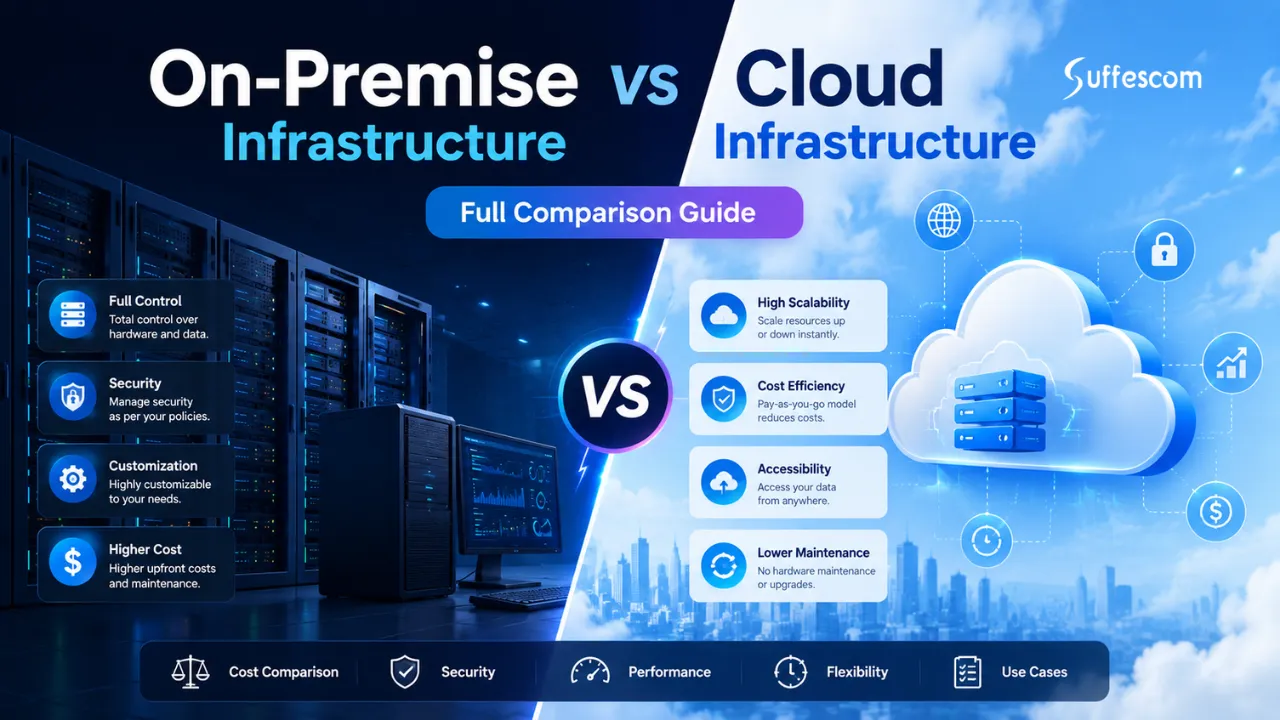
- On-premise provides more control and governance, but is often more expensive, and less scalable and operationally complex.
- Cloud has much greater scalability and flexibility, rapid deployment, and a lower investment for initiating digital transformation.
- Hybrid is very popular today, because it enables organisations to strike the right balance for compliance needs, legacy infrastructure and cloud usage.
- When making infrastructure choices, the total long-term cost (security, operation costs, scalability, performance needed and migration complexity) must be taken into consideration rather than just the initial purchase cost.
- Successful transformation of infrastructure relies not only on technology, but also on how ready an organisation is to migrate, on governance, assessment of workloads, and on business goals.
Businesses in the UK are reviewing how their infrastructure can enhance their organisation’s growth, security, compliance, and digital transformation strategy. As adoption of cloud infrastructure has ramped up across UK businesses in the healthcare, financial, governmental, retail, and large enterprise sectors, these companies are analysing whether legacy on-premise infrastructure fits the flexible demands of the business.
The decision between on-premise and the cloud transcends just technology; it’s about impacting all areas of your organisation, from the operational costs to your organisation’s long-term competitiveness, from security levels to scalability, to the day-to-day operations.
Although many businesses have retained on-premises solutions due to greater perceived security or strict compliance measures, other companies are transitioning to the cloud or even combining on-premises and cloud infrastructure to gain maximum flexibility and ease.
In this complete comparison between on-premise and cloud infrastructure from the perspective of UK businesses, we will explore the financial impact of both solutions, security considerations, performance attributes, scalability capabilities, levels of compliance, maintenance aspects, and the complexities involved in migration, so you are empowered to make the correct infrastructure decisions for your organisation.
What is On-Premise Infrastructure?
On-premise infrastructure comprises IT systems, software, servers, storage, and network facilities that are located, installed, and maintained in an organisation’s private data centre or office location. In contrast to cloud deployments, where the provider takes responsibility for the complete infrastructure stack and is therefore responsible for the buying, maintenance, security, and operation, a company will internally acquire, run, and manage all infrastructure systems.
Common scenarios to run on-premise systems are when an organisation needs more system control and strict governing processes, or to run legacy applications or compliance-sensitive workloads.
Core Components of On-Premise Infrastructure
Infrastructure components in an on-premise infrastructure include the following:
- Physical Servers: These are hardware units utilised to run applications, databases and workloads.
- Networking equipment: Routers, switches, firewalls and network infrastructure are utilised for systems and traffic connections.
- Storage Systems: Local storage infrastructure to store data (database, application, file, backups).
- Internal IT Operations team: Internal teams are to operate and maintain the IT infrastructure operation (security, patching, updates, and monitoring).
Strengths of On-Premise Infrastructure
- Total Data Ownership and Control: Companies own and have full control over their infrastructure, systems, and data.
- Guaranteed Performance: Hardware environments that are used exclusively for a particular workload offer predictable performance.
- Robust governance: Companies have their own security and operational controls and infrastructure management procedures.
Limitations of On-Premise Infrastructure
- High CapEx: Investment needed upfront can be huge to acquire hardware, facility, licenses, etc. And set them up.
- Poor scalability: Additional infrastructure may mean investing on more hardware and resources to run it.
- Long innovation cycles: It takes a long time to roll out new infrastructure, applications and services.
Discuss the right infrastructure strategy for your business.
What is Cloud Infrastructure?
The cloud infrastructure can best be described as the provision of computing resources over the Internet on demand, instead of having computing resources located in on-premises infrastructure. Rather than acquiring and maintaining computing infrastructure within the organisation’s private IT department, customers can rent access to computing power, storage, networks, databases, etc., from cloud service providers.
Today’s cloud infrastructure enables organisations to run and scale workloads quickly and efficiently without the need to develop massive in-house teams required and the huge expenditure for procuring hardware infrastructure; and hence many organisations adopt platforms like AWS and Azure to run their digital transformations, applications, analytics, and to modernise their IT infrastructure.
Core Components of Cloud Infrastructure
Infrastructure in the cloud is made of several different building blocks that collectively provide you with scalable computing power.
Virtual Machines
These are on-demand instances of computers for running applications, workloads, and enterprise systems.
Managed Databases
Databases hosted in the cloud, where you don’t need to manage the infrastructure and do the administration of the database yourself.
Serverless Computing
Execution environments for applications to run without you having to manage any underlying servers.
Object Storage
These are storage systems, allowing files, backups, applications, media, and enterprise data to be stored at scale.
Key Benefits of Cloud Infrastructure
Elastic Scalability: Infrastructure resources scale up or down according to business requirements.
Pay As You Go Pricing: Organisations pay for the amount of infrastructure resources that they use.
Faster deployment cycles: Applications and infrastructure can usually be provisioned and deployed in much shorter timescales than in an on-premises environment.
On-Premise vs Cloud Infrastructure
It’s quite probable the choice between on-premise and cloud is based on which of the following you hold important: decreased operational costs, necessity to be scalable, and the level of control, ownership and responsibility you wish to exert over the infrastructure. There is a much larger degree of control with an on-premises infrastructure; however, it is usually easier to scale with a cloud infrastructure.
The table below summarises the differences between on-premises and cloud infrastructure:
| Factor | On-Premise Infrastructure | Cloud Infrastructure |
| Cost Model | High upfront capital expenditure (CapEx) | Flexible operational expenditure (OpEx) |
| Scalability | Limited by physical infrastructure capacity | Elastic scaling based on demand |
| Maintenance | Requires internal IT teams for management | Infrastructure management is handled by the provider |
| Deployment Speed | Slower due to procurement and setup requirements | Faster deployment and provisioning |
| Disaster Recovery | Typically manual and resource-intensive | Often automated with built-in redundancy |
Cost Comparison: On-Premise vs Cloud
Cost is often a critical consideration in technology adoption decision-making for an enterprise. Whilst on-premise is capital-intensive to set up, cloud moves spending towards an operational consumption-based spend. However, the cost of both will vary according to your workload, size of infrastructure, level of governance and efficiency. Alongside, there will be hidden costs of cloud migration and on-premises as well. Let’s discuss this in detail:
On-Premise Cost Structure
On-premises infrastructure typically involves a substantial capital expenditure, followed by an ongoing operational spend.
- Hardware Acquisition: Servers, networking and storage will all need to be bought and installed.
- Data Centre Maintenance: A power, cooling and physical environment, backup, security, upgrade and general infrastructure maintenance.
- IT Staffing Costs: An internal team to manage, monitor, patch, troubleshoot and maintain infrastructure.
Cloud Cost Model
In a cloud infrastructure, costs work differently as companies make use of the infrastructure as and when required.
- Usage-Based: Businesses generally are charged on the basis of the usage of computing resources, storage, network and other services.
- Lower Infrastructure Cost: Companies do not need to invest heavily in physical infrastructure, premises and purchase of hardware.
- Automation-Enabled Optimisation: Wasted resources are saved, and infrastructure efficiency can be increased using automation technologies.
Cost Comparison Table
Here are some real factors that impact your migration budget:
| Cost Factor | On-Premise Infrastructure | Cloud Infrastructure |
| Initial Investment | Very high upfront investment | Lower initial investment |
| Operational Cost | Typically high | Medium to low, depending on usage |
| Scaling Cost | Expensive due to hardware expansion | Flexible based on consumption |
| Maintenance Cost | High ongoing operational costs | Lower infrastructure management costs |
Security & Compliance
Security and compliance are generally two of the largest influences behind infrastructure decisions in the UK and across organisations. Whether an organisation opts for an on-premises or cloud setup, the infrastructure issue has moved on from just where the infrastructure is to how that infrastructure protects, governs, monitors, and manages data.
On-Premise Security Model
The on-premise infrastructure gives organisations total control over both security and the operational mechanisms involved.
- Total Internal control over data: Businesses have complete control over infrastructure hardware, systems, security settings, access control mechanisms, and infrastructural policy.
- Responsibility for physical security: Businesses must secure servers, network equipment, data centres, and physical infrastructure.
Although this model allows more control, the responsibilities the organisation has to uphold security and defend against attacks are much higher.
Cloud Security Model
The paradigm shifts again when you adopt the cloud as infrastructure. Cloud deployments rely on a Shared Responsibility Model, in which the provider and the customer have different security obligations.
- Shared responsibility model: Cloud providers will be accountable for securing the infrastructure and facilities, organisations will be accountable for workloads, applications protection and managing user access to data.
- State-of-the-art security automation tools: Automated monitoring, threat detection, access control, data encryption and access management are all built into the cloud platform.
- UK Compliance Legislation: There are a variety of UK compliance regulations and sector-specific governance rules organizations will want to bear in mind before choosing an infrastructure provider.
UK GDPR Data Governance Requirements
Personal data must be subject to effective security controls in relation to its storage, processing, and management.
- Financial Services Compliance Requirements: Regulated environments typically require a greater degree of governance, control, resilience, and auditability.
- Healthcare Data Governance Requirements: Specific data governance standards will be inherent to any health sector deployment.
It’s not the infrastructure itself that matters (cloud vs on-premise), as the actual security, governance and operational controls will have a far greater impact on compliance.
Performance & Scalability Comparison
The performance and scaling requirements of an organisation will most likely be the drivers behind whether an organisation will continue to use its on-premise environment, or if it will move its workloads into the cloud. Typically, the response is dependent on the specific workload, how its traffic will move, how its traffic is expected to grow and its operational needs.
On-Premise Performance
A predictable environment can lead to a stable performance from a physical infrastructure when you know the expected workloads and can scale the physical infrastructure accordingly.
Predictable latency
In the right scenarios, you may be able to achieve consistent performance due to dedicated local infrastructure resources.
Constrained scalability
As the need grows to scale, the organisation would be forced to purchase new hardware, deploy new resources, and potentially add new operational staff.
Performance Comparison Table
| Factor | On-Premise Infrastructure | Cloud Infrastructure |
| Scalability | Limited by infrastructure capacity | Very high and demand-driven |
| Availability | Medium, depending on the architecture | High with built-in redundancy |
| Elasticity | Limited or none | Full elastic scaling |
| Global Reach | Typically limited | Global infrastructure availability |
Maintenance & Operational Complexity
Beyond hardware and the overall expense, a company’s infrastructure has the most significant implications in time, resources, staff and day-to-day operational effort. In turn, the day-to-day operational complexity of solutions frequently becomes the dominant reason for evaluating on-premise vs. Cloud.
On-premise operations
An on-premise deployment generally places the burden of most operational duties squarely on the organisation itself:
- Manual updates and patching: Updating infrastructure, applying operating system and security patches, upgrading hardware, or applying software maintenance often falls to internal IT staff.
- Intensive IT Workload: Internal resources must handle monitoring and troubleshooting of infrastructure, managing data backups, capacity planning, system availability and so on. As an organisation’s infrastructure grows, the operational complexity associated with its maintenance often grows with it.
Cloud Operations
Cloud services can offload some operational burden to infrastructure providers, allowing IT to concentrate on application development and business results:
- Automated maintenance: many underlying infrastructure duties like patching, monitoring, backup, scaling, and provisioning can be largely automated.
- Managed Services: The ability to use cloud provider-provided services for databases, networks, storage, etc. Alleviates the need for an extensive in-house administration staff.
Many organisations view adopting cloud services not just as a modernisation initiative, but as an opportunity to simplify their own IT operations.
Migration Pathways from On-Premise to Cloud
Migrating from on-premise to cloud is seldom a one-step approach. Different organisations utilise migration strategies which are driven by workload complexity, compliance and security needs, current infrastructure, business objectives and appetite for operational risk.
A suitable approach to the migration of different applications and systems needs to be chosen, as not all of them may adopt a similar migration approach.
Common Migration Strategies
Rehost (Lift and Shift)
Rehost means the transfer of applications and workloads to the cloud as-is or with very few changes to them. It is typically performed when organisations require quicker migration timeframes and less complexity at the outset.
Replatform
Replatform means migrating applications to the cloud by making a few amendments/optimum changes to them instead of entirely rewriting them. It is aimed at better performance without excessive change.
Refactor
Refactoring involves completely rewriting or redesigning applications to take advantage of native cloud functionality and to maximise their extensibility and automation features. It is much more complex to implement.
Hybrid Cloud Strategy
Most organisations will not be able to make one large decision that says all companies will switch to the cloud or all companies will stay on-premises. This is exactly why a hybrid strategy is catching on in the business world.
What is a Hybrid Cloud?
A hybrid cloud infrastructure solution is where a traditional on-premise computing environment is combined with a cloud computing environment, and applications are run on both environments. Organisations can distribute the workloads between on-premise and cloud-based infrastructures according to performance requirements, security policies and regulatory and operational objectives, without having to move applications at once.
Reasons for Enterprises to Use Hybrid Cloud
- Gradual migration approach: A hybrid cloud enables gradual infrastructure modernisation rather than performing a large migration at once.
- Regulatory compliance: The companies dealing with strict regulations in a specific industry can move only non-sensitive systems and applications to the cloud while continuing the sensitive ones on controlled infrastructure.
- Legacy Applications: Applications that are not suitable for hosting on the cloud will be supported via a Hybrid cloud infrastructure, in parallel to new applications ready to be cloud-enabled.
A hybrid cloud acts as the bridge to the cloud for the majority of organisations, due to the minimal risk and increased agility for the infrastructure.
Get clarity before making infrastructure decisions.
Industry Use Cases
Different industries may utilise different approaches to infrastructure based on regulatory requirements, workload demands, security posture and operational objectives. Therefore, they typically have a different approach to cloud adoption patterns.
Banking and Financial Services
Organisations in the BFSI space operate in highly regulated environments that require significant levels of control and a strong audit trail, along with high operational resilience. Many organisations may use a hybrid infrastructure to retain control over some sensitive workloads while modernising some selected systems and achieving better elasticity and scalability.
NHS and Healthcare
Organisations in this space are dealing with sensitive patient data and operate in a highly complex legacy system environment. Critical systems may be maintained in controlled environments where the cloud may be used to deliver analytic services, collaboration, or digital services.
Government sector
This space is driven by stringent security, governance and sovereignty requirements. This strategy can allow organisations to modernise while maintaining strong control over certain applications.
Retail and E-commerce
This space typically experiences varied workload demand due to seasonal patterns, peak loads and changing consumer behaviours. Cloud delivers scale, flexibility and helps in accommodating rapid changes in business demand, availability, as well as supporting various digital initiatives more efficiently. Ultimately, the decisions to use one form of infrastructure over another are likely to be less driven by industry and more by the nature of workload, regulation and business.
AWS vs Azure Role in Infrastructure Transformation
With organisations moving away from traditional infrastructures, cloud platform selection becomes a critical part of the transformation process. AWS and Azure both offer a comprehensive cloud experience, and organisations evaluate cloud platform choice against scalability needs, investment in existing technology, desired business outcomes, and approach to migration.
AWS Strengths
Organisations that need extensible infrastructure services and a full array of cloud capabilities tend to use AWS.
Global Scalability
AWS provides its infrastructure services across many regions and availability zones, which permit organisations to scale workloads across environments.
Sophisticated computing and storage services
AWS possesses a huge set of compute, storage, networking, analytics, and infrastructure services which serve different workload needs.
Azure Strengths
When organisations already run services on a Microsoft platform, they will often choose Azure.
Excellent Hybridity
There are functions that Azure allows businesses that have both on-premises and cloud elements to run.
Microsoft Ecosystem for the Enterprise
If the business relies heavily on Microsoft productivity and enterprise software, then an extra close tie with the ecosystem can be attractive.
When considering whether to opt for AWS or Azure, it is not usually about finding the platform that does more. Organisations will be asking which cloud will integrate best with infrastructure requirements, technical demands, current systems and future transformation.
Find the most cost-effective path for infrastructure modernisation.
Total Cost of Ownership
Evaluating infrastructure on a purely upfront basis is a short-sighted approach for many organisations. In reality, operating costs, staff allocation, risks associated with uptime, and scalability costs can outweigh initial outlay more in the long run. This is the rationale behind the utilisation of the TCO concept in infrastructure decisions.
What really is TCO?
TCO analysis considers the total cost of ownership of infrastructure over the complete lifecycle, not just the acquisition costs.
Common TCO Calculations include:
– Infrastructure costs
– Licensing costs
– Operating costs
– Maintenance & Support costs
– Staffing costs
– Downtime & Business Continuity costs
– Scale & upgrade costs
On-Premises TCO drivers
Several sources increase the total cost of ownership in the traditional infrastructure space.
- Hardware Depreciation: Servers, network gear, and infrastructure lose value and have replacement schedules.
- Power and Cooling: Power and cooling are costs of running physical infrastructure facilities and operations.
- IT staffing overhead: Infrastructure increases operational staffing.
- Cloud TCO drivers: While cloud shifts the expenses, costs can still spiral out of control without proper control over cloud spending.
- Usage Optimisation: Infra spending is dictated by how efficiently you run workloads and what resources are required.
- Reserved Pricing: You get incentives and pricing that become more favourable for usage commitments to lower your infra expenses.
- FinOps governance: Practices to control cloud costs and drive efficiency.
TCO Comparison Table
| Factor | On-Premise Infrastructure | Cloud Infrastructure |
| 5-Year Cost | Typically high | Medium to lower, depending on governance |
| Scalability Cost | Expensive hardware expansion | More optimised and flexible |
| Maintenance Cost | High operational overhead | Lower infrastructure management costs |
| ROI Speed | Slower due to upfront investment | Faster due to lower initial costs |
Cloud Migration Readiness Assessment Framework
Lack of proper infrastructure readiness is a major factor for failures in many cloud migration projects, rather than picking the wrong technology. Applications, infrastructure, processes and the internal team should be migration-ready before the workload goes live on the cloud.
Well-planned readiness assessment helps to minimise the migration risk, enables efficient and effective planning and allows organisations to prioritise workload appropriately.
Why Readiness Assessment Matters
An infrastructure modernizations are not simply a lift and shift of servers from one environment to the next. In the absence of an assessment organizations will frequently encounter overruns, unexpected cost increases, disruption of business operations and failed migrations.
Avoids failed migrations
The analysis of technical interdependencies, application complexity and the limitations of the current infrastructure will lower the risk of migrating to new infrastructure and will help organisations avoid costly mistakes.
Decreases the risk of overspending
Infrastructure assessments enable a more precise calculation of required resources, migration complexity and operating costs prior to implementation.
Uncovers opportunities for modernisations
Readiness assessment will not only identify potential problems, it will also highlight opportunities to optimise existing infrastructure, decommission legacy systems or redesign workloads.
Key areas of assessment
Before proceeding to plan the migration strategy, most enterprise cloud assessments concentrate on the following key areas:
Application Dependency Mapping
This area allows organisations to identify what other databases, services, internal or third-party applications interact with. Highly complex interdependencies can make the application difficult to migrate.
Security and Compliance Readiness
It includes evaluating security controls, governance, identity management, compliance requirements, and risk management capabilities within an organisation prior to starting a cloud migration.
Infrastructure utilisation assessment
This examines how the infrastructure is being utilised in order to evaluate potential over/under-utilized resources, migration priorities and any potential areas of optimisation.
Cloud skill maturity
This involves understanding whether your team members possess the adequate operational and technical skills to maintain the infrastructure post-migration and have the necessary cloud governance capabilities to perform and enforce.
Readiness Scoring Model
The following framework can also act as a practical cloud readiness assessment checklist for businesses, helping organisations evaluate infrastructure maturity.
| Category | Low Readiness | Medium Readiness | High Readiness |
| Infrastructure | Legacy-heavy infrastructure with outdated systems | Mixed infrastructure with partial cloud adoption | Modern infrastructure with cloud-ready architecture |
| Security | Manual controls with limited governance processes | Partial automation with defined security controls | Mature security practices with automated governance |
| Skills | Traditional IT operations with limited cloud expertise | Teams with mixed infrastructure and cloud capabilities | Strong cloud-native expertise and automation skills |
| Applications | Monolithic applications with complex dependencies | Hybrid application environments with some modernisation | Cloud-ready applications with modern architectures |
On-Premise vs Cloud vs Hybrid
There is no one-size-fits-all infrastructure solution that organisations should deploy. The choice is dictated by their own business needs, the nature of their workload, legislative requirements, existing infrastructure, and their long-term transformation aspirations.
The framework below can guide the decision as to which of these infrastructure strategies is more appropriate.
Opt for On-Premises if
On-premises infrastructure may be a better fit where organisations want to maintain a high level of control and have a strong reliance on existing infrastructure investments.
You have strict control needs regarding data
Organisations dealing with extremely sensitive workloads and greater levels of governance over infrastructure might be better off owning the systems.
You have large existing investments
Enterprises that have made considerable investments in existing hardware infrastructure will likely continue to build on current infrastructure instead of looking for replacements.
You require offline/local operations
Applications requiring minimal latency, local processing, or reduced dependence on an internet connection might operate better on the premises.
Choose Cloud if
Cloud infrastructure is often a priority for organisations that demand high degrees of agility, scale, and a quick infrastructure refresh.
Business priority is Scale
Organisations with increasing or unpredictable demand benefit from an infrastructure that grows or contracts in accordance with the needs of the business.
Cost efficiency is a concern
Businesses trying to reduce their cloud migration costs for enterprises while improving operational efficiency will examine cloud models.
Digital transformation has begun
Businesses aiming for accelerated development and deployment cycles, increased automation, and modern application paradigms are likely to pursue cloud infrastructure.
Choose Hybrid if
Hybrid infrastructure models are increasingly common as companies seek flexibility instead of a complete rip and replace.
A phased approach is desired
Businesses moving from on-premise to cloud can take this phased approach and move workloads iteratively, not all at once.
The organisation is heavily regulated
Sensitive data and regulated processes will likely remain on-premises or be moved to a highly regulated cloud, as less regulated components move to the cloud.
A mix of workloads is in operation
The vast majority of businesses today have a mixed portfolio of legacy applications and modern workloads that would benefit from different infrastructure deployment paradigms.
For a number of enterprises, the question is not which form factor, Cloud or On-Premise. The answer to this business challenge is which infrastructure best fits the business objective, operational, and growth needs of the enterprise.
Build a future-ready infrastructure strategy for long-term growth.
Conclusion
The decision about on-premise versus cloud infrastructure is no longer a matter of which infrastructure model is better overall. It is now up to businesses to select the infrastructure which is most suitable in relation to business goals, operational needs, legal compliance requirements, and long-term development requirements.
Infrastructure located on-premises continues to have benefits for those businesses which require tight security, old, legacy systems, and specific governance. Cloud-based infrastructure benefits organisations due to scalability, speed of deployment, operational agility, and minimal need for infrastructure management tasks. For a lot of enterprises, hybrid environments are the answer to provide a way forward in both approaches.
Infrastructure selection is down to a combination of: the needs of the workload; security, the models used in relation to cost; operational issues, and business development in the future. As businesses are all looking to update their current infrastructures, attention is focusing less on how many infrastructure models there are going to be in the future and more on building environments that remain flexible, resilient, and are of business benefit in the long term.
FAQs
What is on-premises infrastructure?
On-premises infrastructure refers to all of the hardware, servers, storage systems, networking devices, and applications located and operated on the premises of an organisation or within an on-premises data centre rather than relying on a third-party cloud service.
What is cloud infrastructure?
Cloud infrastructure is a form of IT infrastructure, which means it could be compute, networks or databases, made accessible for immediate provisioning over the internet through a third party as opposed to on-premises infrastructure.
What is a hybrid cloud?
Hybrid cloud is a strategy involving the provision and maintenance of infrastructure in both a third-party cloud environment and an on-premises data centre, allowing IT workload resources to function across each of them.
Is cloud cheaper or is on-premises?
While cloud infrastructure generally features less CAPEX and low initial costs relative to on-premises IT infrastructure, the TCO can vary depending on workload requirements, consumption and operational efficiency in the long term.
Is the cloud more secure than on-premises?
Neither form of infrastructure provision, either on-premises or on the cloud, is more or less secure than the other. Security is largely influenced by access control configurations, monitoring procedures, governance and the actual state of the provisioned infrastructure resources.
What are the disadvantages of on-premises?
The disadvantages usually most frequently discussed are CAPEX, on-premises system scaling difficulties, the operational management of on-premises equipment, the complexity and lengthy deployment timeline, as well as relatively high operational expenses.
Why is companies migrating to the cloud?
Companies often choose to migrate their IT operations and workloads to cloud infrastructure to achieve scalability, reduce operational overheads, accelerate development processes, boost operational agility and support their ongoing digital transformation.
What is UK GDPR on the cloud?
UK GDPR rules place obligations on the data controller, or any entity that processes personal data, to put adequate security and operational controls in place, whether the organisation’s infrastructure is situated on premises or in a third-party cloud service.
What is a cloud migration strategy?
A cloud migration strategy outlines the steps a company will take to migrate its IT workload and data to a third-party cloud service. Some of the typical migration strategies are replatforming, rehosting, refactoring or a hybrid migration approach.
What industries are still using on-premises systems?
Some businesses, such as those in regulated industries, which utilise legacy infrastructure or possess sensitive data, are likely to retain on-premises systems.
What is the total cost of ownership on the cloud?
The total cost of ownership (TCO) is a methodology used to identify and quantify the overall expenses connected with the full lifecycle of an IT infrastructure system (including hardware, software, operations and maintenance costs, staffing, and more).
How long is cloud migration?
Cloud migration, depending on the complexity of existing infrastructure, the number and scale of workloads, the existence of dependencies and the strategy implemented, can range between several weeks to many months.
What can a hybrid cloud be used for?
A hybrid cloud strategy can support gradual cloud migration efforts, regulatory compliance issues, the elasticity and flexbility of workloads, data disaster recovery and combining existing enterprise applications with cloud native services.
What is the comparison between AWS and Azure infrastructure?
AWS and Azure are prominent, leading third-party cloud service providers which deliver a vast range of infrastructure solutions, which are on-demand, similar to what you’d find from any dedicated, internal data centre (e.g., computing power, networking, storage, and database functionality) to allow businesses to deploy cloud-native applications and upgrade their existing IT infrastructure.
What is cloud scalability?
Scalability refers to the ability of the cloud infrastructure to expand or contract resources (servers, processing power, storage capacity, etc) depending on the volume and demands placed upon them.
What is a data centre versus cloud?
A data centre is a on-premise facility or portion of a third-party building owned and operated by a company; cloud infrastructure comprises the readily available IT resources (computing, networking, storage, etc) provided over the internet by a third-party supplier.
What is FinOps on cloud computing?
FinOps is a financial cloud management discipline aimed at ensuring that businesses manage their variable cloud spending effectively and efficiently.
What is the future of on-premises?
Although the trend is towards cloud and hybrid cloud services for IT infrastructure management long term, it is likely that many companies will continue to use on-premises infrastructure for specific tasks and workloads.

Senior Content Strategist
Jonathan Raabe is the Content Strategist at Suffescom Solutions and has more than 7 years of experience in developing data-driven content strategies for technology-centric organizations. He is proficient in the areas of mobile app development, software development, AI, cloud computing, fintech, healthcare, and digital transformation. Jonathan collaborates with industry leaders, developers, and business heads in creating high-value, SEO-optimized content that helps companies in increasing their visibility on the search engines, establishing trust, and driving business inquiries.
Need Help With
Development?