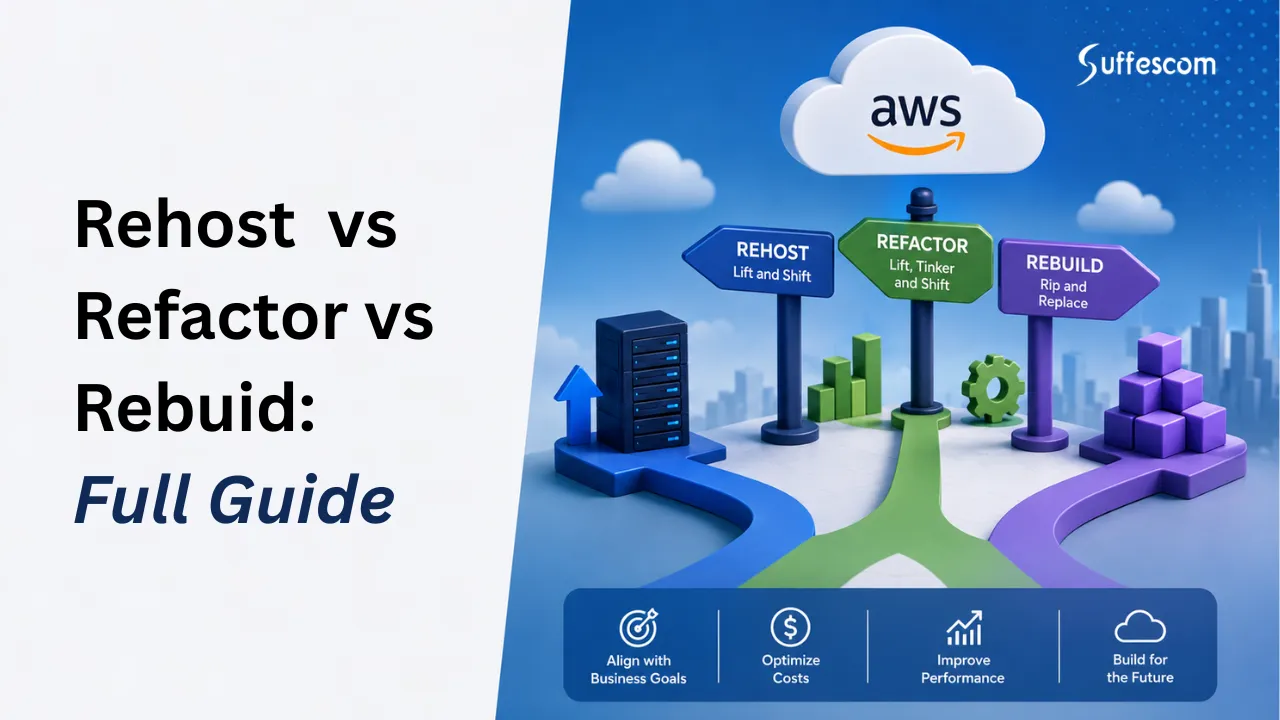
In the process of cloud migration planning, most companies tend to focus on the choice of the cloud service provider and pay little attention to the selection of migration strategies. However, choosing the right approach is vital because cloud migration with the wrong solutions may lead to high costs, inefficiency, scalability issues, and a further need for application modernisation.
Choosing rehost, refactor, or rebuild as your cloud migration approach affects key factors such as implementation period, migration complexity, failure probability, cloud efficiency, and costs.
Since different strategies solve particular business problems, a wrong choice will make the entire migration process much more complex and expensive than expected.
This guide aims to compare rehost, refactor, and rebuild migration strategies in terms of their features, criteria of assessment, working principles, advantages and disadvantages, implementation conditions, and selection process.
Key Takeaways
- Rehosting emphasises quick cloud migration with a reduced initial cost, but provides minimal modernisation advantages.
- Refactoring enhances scalability, efficiency, and the ability to perform better in the cloud; however, it demands more engineering and money.
- Rebuilding achieves the best outcomes in terms of modernisation, but also entails increased time, expense, and complexity.
- Different types of migrations suit different purposes, depending on various factors such as business objectives, budget limitations, and risk aversion.
- Selecting a migration approach can be just as important as choosing a cloud platform.
What is Rehost (Lift and Shift)?
Rehosting, which is referred to as lift and shift migration, is a type of cloud migration where organisations transition their applications to the cloud without having to make any major alterations to the code or functionality of the applications.
Speed is the main motive behind rehosting applications. The idea is to migrate applications faster by moving them to the cloud without changing anything other than the location of their existence.
As applications are not changed much during rehosting, it is among the easiest cloud migration strategies.
How Rehost Works
With regard to rehost migration, organisations migrate applications directly to cloud infrastructure, either from on-premise servers or from any other infrastructure being used for that matter.
Generally speaking, this type of migration includes:
- The identification of workloads to be migrated
- Migrating servers, databases, virtual machines, and applications into cloud infrastructure
- Implementing these applications in the cloud without changing their current architecture in any significant way
- Relying on applications in the cloud without making too many changes to them
To put this in perspective, let’s take the case of an organisation that runs legacy applications on physical servers. The said organisation may migrate those applications directly to cloud infrastructure offered by Amazon Web Services or Microsoft Azure rather than having to develop them.
Key Characteristics of Rehost
The features associated with rehosting include:
- A faster migration process due to fewer changes needed
- Minimal development effort, as the same codebase can be used
- Lower initial costs than other types of migrations
- Less disruption to the business through migration processes
- A fast cloud adoption strategy for companies seeking to quickly leave legacy architecture
However, because applications have not been rearchitected for cloud use, the full cloud benefits have not been realised.
Rehost Pros and Cons Table
| Pros | Cons |
| Fast migration timelines | Limited performance optimization |
| Lower upfront migration cost | Higher long-term cloud operating costs |
| Minimal business disruption | Existing legacy limitations remain |
| Requires less engineering effort | Limited scalability improvements |
Need help understanding whether rehost, refactor, or rebuild makes sense?
What is Refactor (Re-Architecting Applications)?
Refactoring cloud migration refers to changing the application architecture for the applications to be able to leverage the benefits of the cloud, including scalability, flexibility, and performance.
While in rehosting, the applications are migrated without much alteration, refactoring calls for the modification of particular components of the application to perform more efficiently in the cloud.
Companies opt for refactoring when their applications still deliver value to their business operations but have a certain architectural limitation on scalability, performance, or future modernisation efforts.
How Refactor Works
Software refactoring involves changing how the application is designed and deployed, rather than just moving it to a different infrastructure.
It may entail:
- Dividing monolithic applications into microservices
- Adding APIs to make the applications more communicative
- Containerization for portability and ease of deployment
- Making workloads more scalable and resource-efficient on the cloud
- Designing application components to be used better in the cloud
For instance, organisations will not replace the old software but instead modify parts of it to make its workload scalable and efficient on cloud-based resources.
Key Characteristics of Refactor
Key features of refactor migration include:
- Increased emphasis on cloud-native architecture and modernisation
- Complexity of medium to high levels relative to rehosting
- Enhanced scalability and performance of applications
- Increased engineering effort owing to changes in architecture
- Increased efficiency and flexibility for clouds in the long run
Despite being a relatively costly process, refactor migration is preferred by companies that value long-term scalability and modernisation over quick migration processes.
What is Rebuild (Full Application Redesign)?
The approach of rebuilding involves changing an organisation’s application by redesigning and redeveloping it rather than simply migrating it. An organization rebuilds its system from scratch instead of making changes to legacy software.
When an application becomes obsolete, hard to manage, or does not meet the needs of the business in the long term, then rebuilding becomes necessary.
How Rebuild Works
The difference between rebuilding and rehosting or refactoring is that rebuilding entails replacing existing architectures rather than migrating them.
This approach may involve the following:
- Abandonment of legacy architectures and outdated systems
- Creation of modern applications using contemporary architectures
- Creation of cloud-based applications to benefit from their flexibility and scalability features
- Reworking of the application workflow, database, and integration components
- Installation of newly created applications in cloud environments
One example of rebuilding is creating a completely new application rather than migrating an old enterprise application burdened with decades of technical debt.
Rebuilding results in the highest degree of modernisation, although it comes at the highest cost.
Key Characteristics of Rebuild
Features that distinguish rebuild migration include:
- A total redesign and modernisation of applications
- The highest degree of optimisation for cloud computing
- More flexible for development and scalability
- Longer migration times than in any other migration type
- Increased costs and complexity
Firms may opt for a rebuild migration when the benefits of modernisation supersede its cost and complexity.
Rebuild Pros and Cons Table
| Pros | Cons |
| Maximum performance optimization | Very high implementation cost |
| Fully cloud-native architecture | Long development timelines |
| Greater scalability and flexibility | Higher migration risk |
| Reduced legacy technical debt | Requires significant engineering resources |
Rehost vs Refactor vs Rebuild: Core Comparison
Although the terms rehost, refactor, and rebuild can be applied in a similar manner, they solve distinct business problems and involve differing levels of costs incurred and complexities.
Although rehosting, refactoring, and rebuilding might appear to be equal in definition, they serve unique purposes in solving various business challenges and incur distinct levels of costs and complexities.
Rehosting is characterised by rapid workload migration with minimal application alteration. Refactoring is associated with the optimisation of applications for improved functioning in the cloud environment. And finally, the rebuilding process refers to the development of brand-new applications.
The choice of an appropriate technique will rely on the aims set by businesses.
High-Level Strategy Overview
| Factor | Rehost | Refactor | Rebuild |
| Migration Speed | Fast | Medium | Slow |
| Upfront Cost | Low | Medium to High | Very High |
| Migration Risk | Low | Medium | High |
| Implementation Complexity | Low | High | Very High |
| Cloud Optimization | Limited | High | Maximum |
| Engineering Effort | Minimal | Moderate to High | Very High |
| Scalability Improvements | Limited | Strong | Maximum |
| Best For | Fast migration projects | Application modernization | Full transformation initiatives |
In simple terms, rehosting prioritises speed, refactoring prioritises optimisation, and rebuilding prioritises long-term modernisation.
Cost Impact Comparison
The cost of migration is one of the major criteria that impacts cloud strategy. Organisations tend to overlook the comparison of operating expenses and return on investment and opt for estimating only initial migration costs instead.
Despite the low initial cost of rehosting, overall infrastructure cost may become higher if applications are not efficient enough. Although refactoring will demand additional investments due to higher engineering costs, cloud efficiency might be improved over time.
Rehost Cost Model
Rehosting is typically the most economical method since there is minimal cost involved in transferring the application to the cloud without any major engineering effort.
The main costs involve:
- Migration of infrastructure
- Transfer of workload
- Deployment of workload
- Basic testing and validation
In spite of the low initial cost, the overall cost could be higher in the long run due to inefficient applications deployed to the cloud.
Refactor Cost Model
Refactoring entails increased investment since firms will redesign the application architecture before or while migrating to the cloud.
Fees are generally determined by:
- Engineer and developer efforts
- Redesigning the application architecture
- Development and integration of API
- Increased testing and deployment effort
Even if the initial investment is higher, firms can save on operational costs in the long run.
Rebuild Cost Model
Rebuilding involves the highest cost due to application redevelopment.
Typical costs associated with it may include the following:
- Development of the entire application
- Creation of the architecture of the system
- Migration and integration of data
- Testing period and deployment process
- Engineering resources required
Since rebuilding entails creating brand-new systems, it takes more time to achieve ROI, yet it produces bigger returns in the long run.
Understanding these nuances can help reduce cloud migration costs for enterprises in the UK.
Cost Comparison Table
| Cost Factor | Rehost | Refactor | Rebuild |
| Upfront Investment | Low | Medium | High |
| Engineering Cost | Low | Medium to High | Very High |
| Operational Cost | High | Medium | Lower |
| Migration Timeline Cost | Lower | Medium | High |
| ROI Timeline | Short | Medium | Long |
| Long-Term Efficiency | Lower | Higher | Highest |
Performance & Scalability Comparison
Better performance and scalability are some of the major motivating factors for moving an application into the cloud. Moving applications into the cloud does not guarantee improved application performance. Improvement in performance will greatly depend on the extent of rehosting, refactoring, and rebuilding of the applications.
While rehosting mainly concerns moving workloads, refactoring and rebuilding of applications concern the optimisation of applications for the cloud environment.
Rehost Performance Profile
Performance gains are minimal with rehosting since applications operate with a similar architecture.
Potential benefits include:
- Infrastructure performance is better than that of traditional systems
- Greater availability of infrastructure offered by cloud services
- Minor improvements in application performance
- Persistence of existing inefficiencies within applications
With applications not optimised for the cloud, scalability gains are minimal.
Refactoring Performance Profile
Refactoring enhances performance through changes to the application’s architecture to allow it to operate more effectively within the cloud environment.
Some of the advantages of refactoring may include:
- More effective distribution of workloads among services
- Optimal resource use
- Enhanced scalability
- Effective implementation of updates and deployment
- Performance enhancement when workloads peak
Most of the time, applications created with modern architectures tend to scale more effectively.
Rebuilding Performance Profile
The rebuild approach yields the highest performance gains as the applications are created specifically for the cloud environment right from the start.
When organisations rebuild their applications, they enjoy:
- Maximum scalable capacity
- Optimal scaling of workloads
- Improved responsiveness
- Maximum scalability flexibility
- Efficient use of resources
This is due to the fact that they design their systems from scratch.
Performance Comparison Table
| Factor | Rehost | Refactor | Rebuild |
| Scalability | Limited | High | Very High |
| Performance Optimization | Low | Medium to High | Maximum |
| Cloud Efficiency | Lower | Higher | Highest |
| Flexibility | Limited | High | Maximum |
| Ability to Handle Growth | Lower | Higher | Highest |
Security & Compliance Considerations
Security and compliance needs may affect migration to cloud services just as much as cost and performance do. When it comes to organisations based in the UK, not only should their infrastructure be optimised through migration, but compliance with regulations, data protection obligations, and risk management should also be ensured.
The extent to which security will be improved upon migration to the cloud largely relies on how applications are hosted, refactored, or reconstructed. Migration alone does not eliminate security risks. So, before starting the migration, it’s very important to discuss common cloud migration risks with your expert and how to avoid them.
Still deciding whether to migrate quickly or modernise applications first?
Security Risks Associated with Rehosting
While rehosting improves the infrastructure, little is done in terms of the application itself. Organisations may experience difficulties, including:
- Vulnerabilities that continue post-migration
- Unaltered legacy authentication and access management
- Transferring security weaknesses to cloud-based infrastructure
- Little possibility of changing security controls
While cloud infrastructure provides its own set of security measures, companies implementing rehosting could very well transfer all risks associated with legacy architectures to the cloud.
Security Opportunities Associated with Refactoring
Refactoring provides an opportunity to enhance application security through architectural modernisation.
Improvements in security include:
- Enhanced identity and access management
- Strengthened API and authentication
- Workload isolation improvements
- Permissions improvements
- Easier application of modern security measures
Since changes to the architecture take place during the process of refactoring, security improvements are possible without a complete rebuild of applications.
When to Use Each Strategy
The decision to either go for rehosting, refactoring, or rebuilding is more dependent upon the objectives of an organisation than on the technology itself.
In summary, there is no such thing as the right approach to migration. This will depend on what organisations are trying to achieve and the level of changes needed from their existing applications.
When to Choose Rehost
Generally, rehosting becomes an appropriate option if rapid migration with minimal impact is needed by organisations.
Some common situations are as follows:
- Requirement for rapid migration to the cloud
- Insufficient budget for comprehensive modernisation efforts
- Exit from data centres or infrastructure refresh programs
- Applications that do not need many changes during modernisation
- Non-essential applications that require migration in a shorter time frame
When to Choose Refactor
The concept of refactoring becomes increasingly applicable where companies desire to enhance the performance and scalability of their applications without a complete system overhaul.
Some typical situations include:
- Scalability issues with applications
- Digital transformation efforts that need modernisation
- Systems create additional cloud operating expenses through their inefficiencies
- Companies looking to adopt cloud technology in the long term
- Application upgrades need greater flexibility and integration
Refactoring becomes the preferred option for modernising applications without replacement.
When to Choose Rebuild
Rebuilding is mainly done when the existing application fails to meet business needs or lacks capabilities for modernisation.
Common reasons are:
- Application nearing its end of life
- Application containing considerable amounts of technical debt
- An application that needs fundamental architectural redesigns
- Long-term digital transformation projects
- Need for the highest levels of cloud-native capability
Rebuilding demands the biggest financial commitment but remains a popular choice in situations where flexibility over time is paramount.
AWS vs Azure Support for Migration Strategies
Cloud migration approaches do not only rely on the business needs but also on the abilities provided by the selected cloud platform. In this regard, both AWS and Azure offer migration services that help with rehosting, refactoring, and modernising tasks, despite the differences in the advantages of each of them depending on organisational needs.
AWS Migration Services
There are various services provided by AWS cloud infrastructure that facilitate the identification of the workload, migration, modernisation of applications, and conversion of them into cloud-native applications.
In general, AWS can be termed as one of the best services that facilitate rehosting and refactoring because there are various services that ensure quick migration and modernisation of applications. However, rather than migrating workloads immediately, enterprises should first evaluate their readiness using an AWS cloud migration checklist for enterprises.
Commonly used AWS services are:
- AWS Application Migration Service (MGN) for lift-and-shift migrations
- AWS Lambda for serverless application modernisation
- Amazon ECS and EKS for containerised workloads
- Database migration tools for moving legacy databases
Azure Migration Support
The reason for choosing Azure among other cloud computing providers is the need for hybrid integration in such enterprises that require higher capabilities.
Typically supported by Azure migration capabilities:
- Hybrid cloud environment
- Migration of enterprise applications
- Discovery and assessment of infrastructure
- Containerised applications migration
Azure services for:
- Workload assessment and migration with Azure Migrate
- Container orchestration with Azure Kubernetes Service (AKS)
- Hybrid infrastructure services to migrate gradually and modernise
Enterprise customers and those with high-level dependency on Microsoft utilise Azure services during migration.
Which Platform Works Better?
No platform will be a universal winner, as platform choice depends on the migration objective.
- Rehost migrations have been successful on both platforms
- Refactoring migration can rely more on architectural and engineering considerations
- Hybrid migration is often more compatible with Azure
- Cloud-native migrations have often considered the capabilities of both the cloud providers
Neither platform is a deciding factor in migration success. More important than the platform selection is the choice of the migration strategy.
Choosing the Right Strategy
Selection of rehosting, refactoring, or rebuilding depends on business factors alone and not solely on technical aspects. It is essential for the business to look into the time factor, monetary factor, aims for modernisation, and requirements before opting for any of these options.
What may be good for one application might not be good for the next. Many enterprises even choose more than one strategy in their migration process.
Business Requirement Matrix
| Business Requirement | Best Strategy | Why |
| Fast migration timelines | Rehost | Requires fewer application changes and reduces migration time |
| Lower upfront investment | Rehost | Lower engineering effort and migration complexity |
| Better performance and scalability | Refactor | Improves architecture for cloud environments |
| Long-term modernization | Refactor/ Rebuild | Enables greater optimisation and flexibility |
| Legacy application replacement | Rebuild | Replaces outdated architecture completely |
| Maximum cloud-native capabilities | Rebuild | Allows full optimisation for cloud environments |
| Lower migration risk | Rehost | Fewer changes reduce implementation risk |
| Long-term ROI optimization | Rebuild | Higher upfront cost but potentially greater long-term benefits |
Questions to Ask Before Choosing
It is vital to pick the right migration strategy by knowing what is relevant in the business beyond just the technology. By asking the right questions, one would be able to figure out whether time, optimisation, cost effectiveness, or even modernisation is key.
How Quickly Does Migration Need to Happen?
The timeframe within which migration must be accomplished defines the migration strategy that one should adopt. A business that is pressed for time in completing migration or even has to vacate its data centre premises, among other reasons, could opt for fast migration strategies.
Why this matters:
- Faster timelines generally favour simpler migration approaches
- Longer timelines create more opportunities for optimisation
- Migration deadlines directly affect project complexity and cost
What insight this provides:
This question helps determine whether speed or optimisation should become the primary decision factor.
What Budget Constraints Exist?
There are major differences among migration strategies in terms of the engineering effort and the development and operational costs involved.
Considering the budget available to a firm helps prevent the selection of migration strategies that are hard to sustain.
Why this matters:
- Higher modernisation usually requires higher upfront investment
- Engineering costs increase as migration complexity increases
- Budget limitations can restrict the modernisation scope
Are Applications Experiencing Performance or Scalability Problems?
In most cases, the existing limitations of the applications under consideration usually point to either the need for a mere transfer or deeper modernisation.
The applications that have been facing some limitations, like scalability or performance, will continue to face such challenges even after being transferred.
Why this matters:
- Existing bottlenecks rarely disappear automatically after migration
- Scalability challenges often indicate modernisation requirements
- Performance limitations may increase cloud costs later
What insight this provides:
This question helps determine whether migration alone is sufficient or architectural improvements are necessary.
How Much Technical Debt Exists in Current Systems?
Technical debt affects both migration effort and operational efficiency.
Outdated architectures, legacy systems, or applications with high-maintenance costs can become more expensive to maintain after migration.
Why this matters:
- Legacy complexity increases migration risk
- Older architectures can reduce cloud efficiency
- Technical debt affects long-term operational costs
What insight this provides:
This question helps determine whether organisations should preserve existing systems or replace them.
Is the Goal Migration, Modernisation, or Transformation?
Not all cloud projects have the same objectives.
Some organisations simply want workloads moved quickly, while others want better scalability, modernisation, or complete digital transformation.
Why this matters:
- Different objectives require different migration approaches
- Misaligned strategies often create higher costs later
- Business outcomes should drive technical decisions
What insight this provides:
This question clarifies whether organisations need relocation, optimisation, or complete redesign.
What Level of Operational Risk Is Acceptable?
Every migration approach entails a balance among elements such as risks, pace, and gains.
For example, organisations with low risk tolerance will opt for less risky methods, whereas others will assume more risks in pursuit of greater gains.
Why this matters:
- Greater architectural change generally increases risk
- Risk tolerance influences migration complexity
- Operational disruption can affect business continuity
Conclusion
Making a choice among rehost, refactor, and rebuild involves much more than just technical migrations. Migration choices affect costs, scalability, operations, security, and cloud success at an organisational level.
Rehosting supports fast migration and relatively low initial investment. Refactoring aims at making application improvements, focusing on scalability and cloud performance optimisation. Rebuild gives maximum application modernisation, yet at the cost of increased expenses and efforts.
Which migration type will be the most advantageous depends on the organisation’s goals. If speed matters the most, rehosting seems to be the best option; if modernisation and improvement of long-term efficiency are the priorities, refactoring or rebuilding can be preferable.
First of all, before choosing the migration strategy, it is necessary to assess the company’s needs, its goals and capabilities, including financial considerations, risks, etc. Although the platform selection does matter too, the migration strategy is even more critical.
Need a clearer migration path before starting cloud transformation?
FAQs
1. What is rehosting in cloud migration?
Rehost migration is sometimes referred to as lift-and-shift migration. This cloud migration method involves transferring applications to a cloud-based infrastructure with no change to the application code. Organisations tend to prefer rehost migration since it provides them with fast migration at an affordable cost.
2. What is refactoring in cloud migration?
Refactoring is a migration technique whereby the scalability, performance, and cloud-readiness of applications are enhanced. This is distinct from rehosting in that refactoring refers to architectural modifications of applications in order to exploit cloud-based attributes.
3. What is rebuilding in cloud computing?
Rebuilding means the development of new applications from scratch rather than the migration of existing applications. Rebuilding is done by organisations when their old applications do not meet the business requirements.
4. Which is better: Rehost, Refactor, or Rebuild?
There is no universal choice to be made since both approaches address different challenges. The first one concentrates on speed while the second one addresses optimisation issues.
5. What is lift and shift migration?
Lift and Shift Migration may also be termed rehosting. It involves moving applications from their current infrastructure to cloud environments without changing their application architecture.
6. Is refactoring expensive?
Refactoring usually costs more than rehosting because of the need for changes in architecture and engineering. Organisations can, however, recoup their losses due to increased scalability and cloud efficiency.
7. When should you rebuild an application?
When applications have too much technical debt, are outdated, not scalable, and fail to meet the future needs of the organisation, then rebuilding becomes an option.
8. What are cloud migration strategies?
Cloud migration strategy is a methodology that an organisation uses to migrate its workload from an existing infrastructure to a cloud environment. Some of the typical migration strategies include rehosting, refactoring, rebuilding, replatforming, and retirement of the workload.
9. What is the difference between refactor and replatform?
The process of replatforming includes performing smaller optimisations without affecting the application’s architecture significantly. On the other hand, refactoring entails changing the architecture on a larger scale.
10. Which strategy is fastest for cloud migration?
Rehosting is normally seen as the fastest form of migration since organisations migrate workloads with few modifications to applications.
11. What is the cost difference between rehost and rebuild?
Lower costs can be expected when rehosting because the modifications that would need to be made will be minimal. However, rebuilding would definitely mean greater expenses due to the fact that the development process would be repeated entirely.
12. Is rehost a good long-term strategy?
Rehosting is effective for quick migrations; however, rehosting will never offer optimisation benefits in the long run since the legacy architecture stays the same.
13. What industries use refactoring?
Refactoring is commonly adopted by sectors such as finance, healthcare, retail, software-as-a-service, and enterprise technology, where scalability and modernisation are necessary.
14. What is cloud modernisation?
Cloud environment modernisation refers to the improvement in applications and systems that will enable better utilisation of cloud-based benefits such as scalability, automation, and flexibility.
15. How does AWS support migration strategies?
The migration services of AWS facilitate rehosting, refactoring, and modernisation using application migration, containerization, databases, and cloud-native development tools.
16. How does Azure support refactoring?
The process of refactoring is possible with Azure services related to container orchestration, APIs, hybrid cloud infrastructure, and application modernisation tools.
17. What is the risk of rehost migration?
One of the main problems with rehosting is that the organisation might just transfer all of its technical debt and limitations to the cloud without actually fixing them.
18. What is the best cloud migration strategy for enterprises?
The right enterprise cloud migration strategy depends on the goals of the business, the budget, the requirement for upgrading, and the risk tolerance of the company. It should be noted that most companies tend to combine several methods rather than use only one method.

Senior Content Strategist
Jonathan Raabe is the Content Strategist at Suffescom Solutions and has more than 7 years of experience in developing data-driven content strategies for technology-centric organizations. He is proficient in the areas of mobile app development, software development, AI, cloud computing, fintech, healthcare, and digital transformation. Jonathan collaborates with industry leaders, developers, and business heads in creating high-value, SEO-optimized content that helps companies in increasing their visibility on the search engines, establishing trust, and driving business inquiries.
Need Help With
Development?