Mobile app/web app development has seen some great transformations over the years. By 2026, companies won’t have to employ extensive engineering talent to build applications. Platforms like Bubble are already helping entrepreneurs design diverse products ranging from SaaS apps, marketplaces, and artificial intelligence-driven applications with minimal coding.
Given this scenario, most entrepreneurs who plan on building something new start with a common question: whether to go for tool based development like Bubble development or choose custom development.
While Bubble enables entrepreneurs to deploy their products faster and cheaper, custom application development provides more scalability, security, flexibility, and control of their products over the long run. Making the right choice about applications using AI technology, SaaS products, fintech, healthcare, and enterprise software solutions is crucial.
This article aims at analysing both processes in terms of cost, scalability, functionality, security, artificial intelligence capabilities, development timeline, and business advantages.
Key Takeaways
|
What is a Bubble?
Bubble is an easy-to-use, no-code platform for creating apps without extensive programming knowledge since Bubble provides an app development tool with a visual editor interface instead of long code lines.
The main tools on which this platform operates consist of the following three elements:
- Visual UI builder
It enables the creation of app pages via dragging and dropping buttons, forms, dashboards, tables, pop-ups, and other elements.
- Workflow engine
This is where users can create app logic, automation, user interactions, and workflows without any coding.
- Database
Bubble comes with a built-in database that stores all the user-generated content as well as app data and workflows.
Also, Bubble can be integrated with other services such as OpenAI, Stripe, Twilio, Google Maps, and Firebase.
What You Can Build with Bubble
One of Bubble’s biggest strengths is flexibility. Businesses can build a wide range of web applications using the platform.
Common Bubble app use cases include:
- Startup MVPs
- Saas Platforms
- Ai Chatbots
- Marketplaces
- Healthcare Portals
- CRM Software
- Learning Management Systems
- Project Management Tools
- Booking Applications
- Internal Dashboards
- Community Platforms
- Fintech Dashboards
- Workflow Automation Tools
Many startups use Bubble for rapid product validation before investing in full custom app development.
Core Features of Bubble
- Drag-and-Drop Builder: App building through visual editor of Bubble, page creation, dashboard making, form creation, and workflow building with the help of visuals on responsive pages.
- Workflow Automation: Workflows like notifications triggers, scheduled workflows, and backend operations can be automated.
- Database Management System: A database module is incorporated into Bubble platform where all sorts of data including user data, app data, workflows, and dynamic data are stored.
- Application Programming Interface: The Bubble platform provides an option to integrate with API, artificial intelligence, payments, analytics, and automation.
- Responsive Design: There exists a responsive engine on the Bubble platform which helps in smooth operation on desktops, tablets, and mobiles.
Why Bubble Became Popular in 2026
Bubble’s growth trend has been substantial because of the increasing need for brands to bring their digital products to market. Traditional development typically comes with constraints, like requiring a team of developers, handling different teams, long development timelines, and more. All of this can hinder product validation at an early stage.
But with Bubble, app founders get the following benefits:
- Time to market on a minimal viable product
- Reduced cost for product development
- Ability to quickly test ideas
- The capacity for rapid iterate
- The capability to build an application without the need for all of the resources a traditional development team would require
Many startups are currently building AI based platforms by leveraging Bubble. In conjunction with APIs, it allows founders to create powered chatbots, automation tools and intelligent workflow systems without much dedicated engineering resources.
The growing acceptance of no code development in traditional investor communities and startup ecosystems has also contributed to the growth of Bubble as an acceptable digital development tool. As a result, in 2026 no code will become a widely accepted form of developing rapidly scalable digital products.
Examples of Successful Apps Built with Bubble
There have been many successful startups/digital platforms that have used Bubble to help them develop and expand their apps more rapidly than traditional methods allow, such as the Dividend Finance Portal, Qoins, Comet, and Teal. There are also many AI startups, internal business platforms, marketplaces and SaaS MVPs doing the same; using Bubble helps founders decrease development cost, speed up time to market and receive real data from actual users sooner in the life of the product.
What is Custom App Development?
Building a custom application from scratch is the process of developing your own software app using a dedicated engineering team, programming languages, and frameworks. Unlike no-code tools like Bubble, custom development allows businesses full control over their application architecture, back-end systems, databases, infrastructure, integrations, security, and scalability. Custom app development is frequently used for SaaS products, enterprise software, fintech apps, health care applications, AI apps, and highly-performing digital products.
In a traditional app development environment, developers create a fully custom-coded front-end and back-end solution using the coding language to meet individual customer needs. The technology stack, cloud hosting provider, APIs, database architecture, and security policies are typically up to the client to decide. Although custom application development typically costs more and takes longer than no-code application development, it offers significantly more customisation options, performance improvements, ownership, and long-term scalability than do-no code applications.
Key Components of Custom App Development
Frontend Engineering
The field of frontend engineering refers to the construction of the UI/UX of an app. The technologies that are involved in implementing the frontend design are listed below:
React
- Angular
- Vue.js
- Swift
- Kotlin.
Frontend apps are designed to be fast, interactive, and have great aesthetics when viewed on different web/mobile apps. An application with solid frontend engineering ensures that there is great usability and user engagement on all platforms.
Backend Architecture
Backend architecture refers to how the core logic of an application is built along with managing the APIs, authentication systems, workflows, and all of the server-side processes. Technologies for building backend systems include Node.js; Python; Java; PHP; and .NET. An application that has a well-organized and structured backend design will provide reliability and speed when processing information, as well as better integrations with other systems, thereby allowing the system to scale as the user base grows.
Database Infrastructure
Database infrastructure refers to the storage, retrieval, and management of data within the application. The type of database used generally depends on the requirements of the application. Proper database architecture will allow you to store and retrieve very large amounts of data while maintaining good performance and data security.
DevOps & Cloud Hosting
DevOps and cloud hosting services enable businesses to deploy, manage, monitor, and scale applications effectively. Commonly used services for hosting custom applications include Amazon Web Services (AWS), Google Cloud, and Microsoft Azure. The implementation of DevOps practices will allow organisations to deploy applications faster; provide more reliable systems; automate their infrastructure; and keep the application uptime.
Security Implementation
Having the ability to implement security features such as anti-virus, anti-malware, and authentication into an application is the primary benefit to utilizing custom development for securing your applications. Using custom development allows your business to create and implement many capabilities including role-based access control, encryption of sensitive data, and adherence to industry-specific standards, such as HIPAA, PCI, or GDPR.
Scalability Engineering
Scalability engineering refers to how to develop your application such that it can manage an increasing number of users, transactions, and data without causing any performance degradation. Developers are able to create a robust infrastructure, server architecture, caching systems, and database systems for your application which allows you to design and implement an adaptable system, which provides for the capability to respond to the future growth of your application. If you are an enterprise software as a service product , an artificial intelligence platform, or a high-traffic application, scalability is an essential feature of your application design.
Why Enterprises Prefer Custom Apps
Custom development is preferred by larger organisations when it comes to the development of enterprise applications because custom applications provide complete control over the application’s entire architecture, infrastructure, data hosting, data management, and the ability to integrate with other enterprise solutions. Due to the nature of enterprise applications having complex business processes, security systems, performance-optimised data storage, and integration with dozens of third-party services, it is very difficult for a business to use standard no-code platforms to solve their custom enterprise application needs.
Through custom development efforts, businesses will have the capability to design and implement very specialised enterprise applications to meet their organisations’ needs, as well as ensure the compliance, analytical, and artificial intelligence readiness of their technology. In addition, custom-built applications allow enterprises to enhance the performance of their enterprise application systems, retain their proprietary technology stack, and scale their enterprise applications without significant limitations.
Common Technologies Used in Custom Development
Modern custom app development uses a wide range of frontend, backend, database, and cloud technologies depending on project requirements.
| Development Layer | Common Technologies |
| Frontend Development | React, Angular, Vue.js, Next.js |
| Backend Development | Node.js, Python, Java, PHP, .NET |
| Mobile App Development | Swift, Kotlin, Flutter, React Native |
| Databases | PostgreSQL, MySQL, MongoDB, Firebase |
| Cloud Hosting | AWS, Google Cloud, Microsoft Azure |
| DevOps Tools | Docker, Kubernetes, Jenkins |
| AI development | OpenAI API, TensorFlow, LangChain |
| Authentication | OAuth, Firebase Auth, Auth0 |
| APIs & Integrations | REST APIs, GraphQL, Webhooks |
Bubble vs Custom App Development – Core Difference
Bubble is an API-driven, no-code platform for building web and mobile applications that focuses on speed and efficiency by requiring very little coding. In comparison, custom app development creates a completely new application utilising various programming languages and technology stacks for a high degree of scalability, flexibility, and control.
Both approaches can be used to create modern applications, but they vary broadly in the following areas:
– Development method
– Ownership of infrastructure
– Scalability
– Customisation
– Performance
– Long-term business flexibility.
Bubble is popular among start-up companies as a fast method to deliver MVP, whereas larger companies and established SaaS businesses typically utilize custom application development due to their advanced engineering skill set, as well as their control of the underlying technology stack.
Development Approach
Bubble utilizes a visual, drag & drop editor development environment to create applications within the application, and through a no-code service. This makes it possible for founders and businesses to launch products quickly, without needing a significant number of engineers or coding experience.
Custom application development (CAD) is a standard software engineering approach that involves using developer APIs and coding (using Java script and/or other back end development tools and programming languages) to develop a custom front end and back end for an application. Developers using CAD are typically very knowledgeable and experienced developers, and therefore can develop applications with complete technical control over the entire application.
Technical Flexibility
Bubble’s versatility allows you to create an MVP, SaaS app, marketplace, and automations. However, you are somewhat limited by Bubble as it operates in the world of Bubble only. With that being said, some of the advanced backend management, configuration of infrastructure, and optimisation of performance may not be possible or will be difficult to implement using Bubble.
When developing a custom application, the developer has complete freedom of choice in regard to the technology stack (programming language, framework, database, infrastructure) required to fit the business’s needs. For this reason, custom-built applications are perfect for specialised applications, AI platforms, or enterprise systems.
Scalability Comparison
Bubble applications provide a moderate amount of user growth capabilities. They provide a great solution for many of the SaaS MVPs and most startups will use a Bubble application. However, as applications with heavier usage on large-scale sites and have complex workflows or require real-time processing will encounter limitations in both scalability and performance over time.
Custom build applications are designed to scale using a cloud-based infrastructure, use a cloud-native architecture, use optimised databases, and use a caching mechanism to allow the business to scale its applications as activity demand increases.
Ownership & Infrastructure Control
One of the main differences between developing a Bubble Application versus applications you develop yourself is the level of ownership you have over your application’s infrastructure. Your Bubble application is hosted within the infrastructure and ecosystem of Bubble. This inherently limits your ability to manage and control the underlying infrastructure of your application at the backend.
When you develop a custom application, your business maintains 100% ownership of your application’s source code, hosting environment, server architecture, APIs, and infrastructure configuration. This gives the business greater operational autonomy and greater flexibility for the long term.
Development Speed
Bubble allows for much faster development times for MVPs and launching products quickly. Startups can often develop a fully functional application in only a few weeks, versus multiple months for a custom-built application.
Developing a custom application takes longer because the engineer must build frontend systems, backend architecture, database, APIs, and security layers, and then deploy the final product. However, this time spent developing custom applications will allow the company to have more scalability and provide better performance over time.
Long-Term Maintainability
Because Bubble manages the hosting of the applications, it manages infrastructure upgrades and many of the backend processes automatically, it makes maintenance of Bubble applications simpler to manage. As a result, there is much less operational overhead for small teams and startups.
Developing and deploying a custom-built application requires a level of ongoing maintenance, DevOps management, security upgrades, and server monitoring, along with optimizing the infrastructure. Although these additional efforts increase the operational burden of developing custom applications, it provides the business with total control over the evolution of the product and the technical improvements that are required over time.
Customization Capabilities
Bubble provides a user-friendly way for companies to design and configure their processes, interface, and system connections through visual design, making it a great solution for most of the standard SaaS and business applications. There will be situations where advanced features or complex backend architectures may need alternate solutions or connections outside of Bubble.
On the other hand, custom development can provide an organisation with limitless opportunities for customisation.
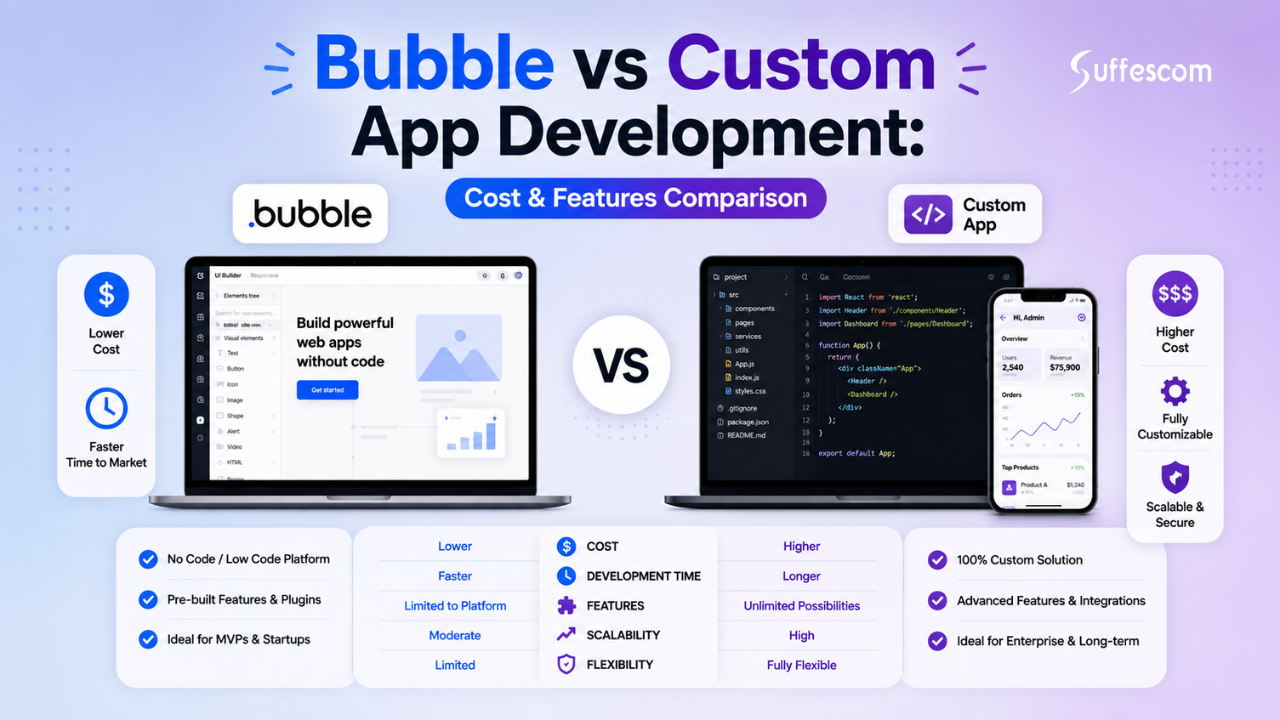
Bubble vs Custom Development Comparison Table
| Feature | Bubble Development | Custom App Development |
| Development Approach | Visual no-code builder | Traditional coding & engineering |
| Coding Requirement | Minimal coding | Full frontend & backend coding |
| Development Speed | Faster MVP launches | Longer development cycles |
| Initial Development Cost | Lower upfront cost | Higher initial investment |
| Technical Flexibility | Limited by platform capabilities | Fully customisation |
| Scalability | Moderate scalability | Enterprise-grade scalability |
| Infrastructure Ownership | Platform-controlled | Fully owned by business |
| Backend Control | Limited backend access | Complete backend control |
| Performance Optimisation | Limited optimisation options | Advanced performance tuning |
| AI Integration Capability | API-based integrations | Fully custom AI systems |
| Security Flexibility | Platform-dependent | Custom security architecture |
| SEO Flexibility | Moderate SEO control | Advanced technical SEO control |
| Maintenance Responsibility | Managed largely by Bubble | Managed by internal/dev teams |
| Best For | MVPs, startups, internal tools | Enterprise apps, scalable SaaS, AI platforms |
Bubble vs Custom App Development Cost Comparison (2026)
The cost of building a bubble app’s MVPs can vary widely and typically fall between £3k and £30k. The cost of a fully developed custom application varies also, typically costing between £15k and £250k, depending on such factors as complexity, scalability, integrations, infrastructure, and engineering needs.
Bubble Development Costs
Generally speaking, Bubble is a lower-cost option for businesses looking for start-up assistance services, MVPs/web applications, internal tools for their companies, and very early SaaS products. Bubble also reduces the backend/frontend engineering costs for businesses. Businesses that develop an MVP using Bubble can expect to pay between £3k and £30k for their MVP using Bubble, depending on the features, workflows, integrations, and UI complexity. The amount spent on smaller internal tools or simple startup MVPs would be even lower than the aforementioned range depending on whether they were created by freelancers or an “in-house” team.
However, custom applications made using Bubble that require a large number of advanced workflows, sophisticated integrations with A.I., the use of custom plugins created by third-party developers, and the development of scalable backend application logic can be very costly over time.
Custom App Development Costs
Building custom apps virtually always requires a higher level of investment as they are being developed entirely from scratch. Custom applications are developed using a combination of front-end application frameworks, back-end application frameworks, cloud infrastructure, various integration techniques using APIs, and engineering teams. Starting prices for basic custom applications usually run from £15k -£40k per application, with more sophisticated SaaS platforms, enterprise-level applications, fintech applications, and/or applications powered by A.I. easily exceeding £100k.
Cost by App Complexity
The total cost of developing Bubble and a custom application largely relies on many factors like app complexity, back-end requirements, integration, scalability, AI capabilities, and the need for infrastructure.
Basic MVP Apps
The choice of Bubble comes in handy due to the fast deployment and lower initial costs involved when starting up an MVP.
- Bubble MVP Cost: £3k –£10k
- Custom MVP Cost: £15k–£40k
It’s usually the go-to option for MVPs since startups can launch much quicker while requiring a smaller initial investment.
SaaS Platforms
SaaS platforms need advanced functionalities like subscription modules, user role management, analytical dashboard, automated processes, API support, and scalable database.
- Bubble SaaS App Cost: £10k–£30k
- Custom SaaS Development Cost: £50k–£150k
Custom development is better suited for later stages when scalability and performance are critical aspects to consider.
AI Applications
AI-based solutions can include chatbots, automation using AI, recommendation algorithms, AI copilots, and AI that generates content via the OpenAI API.
- Bubble AI App Cost: £15k–£40k
- Custom AI Development Cost: £80k–£250k
For custom AI solutions that require building custom machine learning models, implementing vector databases, setting up GPU clusters, and executing AI in real time, custom software development is necessary.
Enterprise Systems
Enterprise applications include workflow systems, compliance systems, secure systems, cloud computing platforms, big data, and high performance architectures.
- Bubble Enterprise App Cost: Limited suitability for large enterprise systems
- Custom Enterprise Development Cost: £100k–£250k
Custom application development is usually preferred by large companies since it gives them full control over the infrastructure, scalability and security features.
| App Type | Bubble Development Cost | Custom Development Cost |
| Basic MVP App | £3k–£8k | £15k–£40k |
| SaaS Platform | £10k–£30k | £50k–£150k |
| AI Application | £15k–£40k | £80k–£250k |
| Marketplace App | £8k–£25k | £40k–£120k |
| Enterprise System | Limited suitability | £100k–£250k |
| Internal Business Tool | £3k–£15k | £20k–£60k |
Building an AI app or SaaS platform in 2026?
Discover whether no-code, custom code, or a hybrid model fits your business best.
Hidden Costs Businesses Often Ignore
While making the comparison of Bubble with other custom software development, it is important to remember that companies tend to prioritize initial development costs while ignoring long-term operational expenditures. The truth is that with time the amount of money needed for maintaining software might be significantly greater due to growing scale, expanding audience, and increased demands to infrastructure. Such expenses as API subscriptions, paying for plugins, renting servers from the cloud, workflow scaling costs, infrastructure updates, security updates, maintenance, optimisation, analytics tools, and tech support might be included into hidden costs.
However, as products mature, companies might incur even more expenses for DevOps, database improvements, compliance, backend integration, developers retention, and tech debt management. Regarding SaaS and startups, these costs could occur very soon once their product hits critical mass or new features are introduced. Therefore, it is essential to consider not only the initial cost of development but also long-term expenses.
Long-Term ROI Comparison
In terms of short-term ROI, Bubble can be more favorable for startups as they will be able to validate ideas quicker with reduced investment costs. In relation to long-term ROI, custom-built software is more effective for scalable products, especially for enterprise-level applications and AI solutions. While there may be higher initial costs required, businesses have complete control over their infrastructure, ensuring superior performance and scalability in the long run.
Which Option is More Cost-Effective?
For startups, MVPs, business applications within organisations, quick product validation, frugal entrepreneurs, and early stage SaaS applications, Bubble is usually more cost-effective.
But custom development tends to be more economical for:
- SaaS platforms that scale rapidly
- Enterprise-level software products
- Products relying heavily on AI
- FinTech systems
- Healthcare platforms
- High-traffic applications
- Infrastructurally complex products
Which Approach Launches Faster?
For startups who want to validate their MVPs and launch quickly rather than later on in life, Bubble would most likely be the better option. With Bubble, businesses can create their products in a few weeks instead of several months, making it ideal for startups, internal use applications, marketplaces, and SaaS MVPs. They are exploring top mobile app ideas to build their startups in the UK using platforms like Bubble.
Applications that need complex backend infrastructure, large-scale enterprise, AI-based custom solutions, or even integration with third-party software would be more effectively built with custom application development. Most modern startups nowadays take the hybrid method where they build their app with Bubble first and then move onto building it custom as they scale up.
Timeline Comparison Table
The timeline to develop your product can range from a few days to several weeks. For example, a marketplace MVP can be built with Bubble in as little as 3 days. However, more complex applications with advanced workflows and integrations may take 3 weeks or more. Ultimately, the development timeline depends on your unique project requirements.
| Development Stage | Bubble Development Timeline | Custom App Development Timeline |
| Basic MVP App | 2 weeks | 3 months |
| SaaS Platform | 1 month | 6 months |
| Marketplace App | 1 month | 5 months |
| AI-Powered App | 2 months | 6 months |
| Enterprise Application | Limited suitability | 9 months |
| UI/UX Design | Faster visual setup | Full custom design process |
| Backend Development | Built-in workflows | Custom backend engineering |
| Infrastructure Setup | Mostly platform-managed | Full DevOps & cloud setup |
| Testing & Deployment | Faster deployment cycles | Longer QA & testing phases |
| Time-to-Market | Very fast | Moderate to long-term |
Features Comparison: Bubble vs Custom Apps
When it comes to deciding between Bubble and custom software development, features and technology are key factors that can help one determine whether either is better for a company. Although Bubble allows you to build apps faster and easily deploy them, custom software allows more engineering flexibility and has more scalability options.
It all comes down to what type of app you are trying to build and its requirements, as well as future considerations.
| Feature | Bubble Development | Custom App Development |
| UI/UX Flexibility | Strong for standard web apps | Fully customisation |
| Frontend Development | Visual drag-and-drop builder | Custom frontend engineering |
| Backend Capabilities | Built-in workflows & database | Advanced custom backend systems |
| API Integrations | REST APIs & plugins supported | Unlimited integration flexibility |
| AI Integration | Supports external AI APIs | Full AI infrastructure control |
| Automation Features | Built-in workflow automation | Custom automation architecture |
| Security Features | Standard platform security | Advanced enterprise security |
| Authentication Systems | Built-in authentication | Fully customisation auth systems |
| Performance Optimisation | Moderate optimisation control | Advanced performance tuning |
| Mobile Responsiveness | Responsive web apps | Native & cross-platform apps |
| Scalability | Moderate scalability | Enterprise-grade scalability |
| Infrastructure Control | Limited platform control | Full server & cloud ownership |
| Third-Party Integrations | Plugin-based integrations | Unlimited integration support |
| Maintenance Management | Mostly platform-managed | Managed by engineering teams |
| Best Use Cases | MVPs, SaaS startups, internal tools | Enterprise apps, AI systems, scalable SaaS |
Bubble vs Custom Development for AI Apps
AI-enabled apps have become some of the fastest-growing sectors in the app development industry. By 2026, startups will be able to create AI chatbots, AI copilots, automation software, AI SaaS software, recommendation engines, and generative AI apps at an unprecedented pace. This has also led to the rise in demand for Bubble as founders do not need to develop complicated backend infrastructures when integrating AI into their projects.
Nevertheless, while Bubble is ideal for creating AI MVPs and automation software, many AI-focused startups will have to transition to custom app development in order to scale.
Building AI Apps with Bubble
Bubble offers startups the ability to rapidly develop AI-based apps via visual workflows, API connections, and automation features. Hence, Bubble is very appealing to entrepreneurs seeking to test their AI-based product concepts without needing to spend huge amounts on hiring engineers and building infrastructure in the initial phase.
Examples of AI apps that have been created using Bubble include:
- AI chatbots
- AI writing software
- AI automation software
- Customer support bots
- AI dashboards
- Workflows automation
- AI software as a service MVPs
- Internal AI software
Speed is the key benefit. Startups can leverage AI APIs and create working solutions in a matter of weeks, not months.
Limitations of No-Code AI Systems
While there are multiple benefits to Bubble’s platform, it also has certain limitations in relation to building complex AI-based systems. There is a need for real-time processing, vector databases, GPU support, streaming capabilities, customised AI pipeline, and backend optimisation in many advanced AI applications, which may be hard to achieve with the help of a no-code environment.
Other performance issues that may arise include:
- Large AI tasks
- Massive API requests
- Real-time AI response
- AI chain automation
- Multi-agent AI system
- Enterprises-level data processing
Most often than not, startups tend to grow beyond no-code limitations.
Why AI Startups Often Move to Custom Development
Most AI start-ups begin by using Bubble for quick MVP creation and validation to save on costs and speed up product launch. Nonetheless, after growth in users and increased workload on their AI products, they end up opting for custom app development to take control of their infrastructure.
Examples of things that custom app development can enable an AI company to build include:
- Scalable backend
- Custom ML pipelines
- Vector searches
- Real-time inference services
- Cloud-based distributed infrastructure
- Enterprise AI products
Other benefits of custom app development include improved control over performance optimisation, data security, API management, scaling infrastructure, and management of AI models.
Therefore, most of the successful AI start-ups today embrace a dual approach in scaling, whereby they initially scale their MVPs using Bubble before adopting custom infrastructure.
Scalability Comparison – Bubble vs Custom Apps
Scalability is among the main considerations that companies have to take into account while deciding between Bubble and custom software development. Even though Bubble is good at developing MVPs and startup products as well as relatively small SaaS services, the demands on scalability usually become more difficult as traffic increases and additional features and technologies come into play.
Bubble Scalability Limitations
Bubble is able to provide support to numerous startups at the early stages of their development, particularly for software as a service applications, marketplaces, internal applications, and minimal viable product applications. Nevertheless, since the application is running on a no-code environment, there will be limitations in terms of controlling the server, optimising the backend, and designing the database system.
Infrastructure Flexibility in Custom Apps
In addition, custom software development offers maximum flexibility in terms of the infrastructure because organisations have full control over the infrastructure hosting, cloud setup, back-end operations, API creation, and deployment techniques. Programmers may set up a scalable cloud environment, distributed system, caching mechanisms, and load balancing according to the demands of the application.
Database Scaling Challenges
Bubble features its own database technology which makes application development easier for new companies and emerging products. Although this approach is effective for most scenarios, the use of large amounts of analytics, real-time computing, artificial intelligence, or complex database structures might encounter limitations of the inbuilt database solution in the long run. Customisation helps firms to create specialised databases and improve their efficiency.
Performance Under Heavy Traffic
Bubble application services can cope well with medium user traffic. But for applications having high concurrent user traffic, high backend workflows, and highly demanding processes, their performance will be slower when there is an overload of traffic. The custom development of the application can be done to have optimised server response time, caching, API management, and cloud service to cope with high traffic loads.
Enterprise Growth Considerations
Most business applications need sophisticated scalability strategies owing to the complex integrations, data management, workflow, and huge user base involved. Though Bubble supports some internal business apps, big companies tend to go for a custom app solution due to the benefits of owning infrastructure, flexibility, DevOps management, and enterprise-level scalability. Industries where a custom application is more preferred include health care, finance technology, logistics, and SaaS platforms.
Long-Term Product Scalability
While Bubble is very efficient in fast product launches and business startups, its long-term scalability is limited depending upon the complexity of the application and subsequent requirements for the infrastructure. Businesses grow over time and may need sophisticated back-end systems, real-time processing, AI infrastructure, and global cloud optimization, which may not be provided by no-code platforms. Long-term scalability is better achieved through custom application development because companies have complete control over architecture, engineering, and infrastructure choices.
Bubble vs Custom Development for SEO Performance
The performance of SEO is a key consideration in setting up operations and software as a service applications, marketplaces, and platforms where the content is significant. While Bubble has made great strides in terms of SEO capabilities in recent years, more flexibility in the SEO department can be achieved by opting for a custom app.
This becomes particularly true for businesses whose business strategy is heavily reliant on SEO capabilities and search engine visibility.
Technical SEO Flexibility
Bubble offers fundamental SEO capabilities such as customised meta titles, meta descriptions, URL structures, alt text, redirections, and XML sitemaps. This level of SEO capability is good enough for most startups, software-as-a-service platforms, and minimum viable products.
Custom application development, on the other hand, gives a higher level of technical SEO capability, where everything ranging from how pages will render, structured data used, server settings, schema integration, canonical tags, and many others can be determined by the developer.
Page Speed & Performance
The page speed is an important factor in SEO ranking and overall user experience. Although bubble applications might work well in cases where the product is light and traffic on the website is low, workflow-intensive applications or poorly optimised pages will take longer to load.
With custom applications, developers can optimise the process of rendering the page frontend, processing the page backend, delivering the content via CDN, optimising the cache system, optimising images, and optimising the server more effectively.
URL Structure & Metadata Control
Bubble allows for URL customisation, page title creation, description tag creation, and other SEO-related metadata that can be configured right from within the application itself, and hence it is perfect for startups and Saas when it comes to basic SEO.
Custom development provides complete flexibility regarding URL structures, metadata generation, schema markup, hreflang tags, breadcrumbs, and indexing methods. Custom development is highly effective when working on large-scale websites and SEO campaigns for marketplaces.
Content Scalability
Bubble can handle blogs, landing pages, and dynamic content systems efficiently in most cases for startups and growing software as a service companies. But when dealing with extensive content systems with tens of thousands of pages, it will be challenging to scale them.
It is more advisable to use custom app development in large content management systems because the programmers can customise the database, rendering processes, caches, and delivery mechanisms.
SSR vs Client-Side Rendering
Another critical area where SEO can vary between Bubble and custom-built web apps is in how pages are rendered. Custom-made apps commonly use server-side rendering frameworks like Next.js to enhance crawability, indexing, and search engine performance.
Bubble, on the other hand, usually uses client-side rendering in several cases, which can potentially result in SEO difficulties for very dynamic or information-packed applications. Although Bubble’s SEO capabilities have greatly advanced, custom server-side rendering architecture tends to offer better SEO performance.
SEO Performance Comparison Table
| SEO Factor | Bubble Development | Custom App Development |
| Technical SEO Flexibility | Moderate SEO customisation | Full technical SEO control |
| Page Speed Optimisation | Limited backend optimisation | Advanced performance tuning |
| URL & Metadata Control | Basic customisation support | Fully customisation SEO structure |
| Content Scalability | Suitable for moderate content growth | Optimised for large-scale content platforms |
| Rendering Method | Primarily client-side rendering | SSR & hybrid rendering support |
| Advanced SEO Capabilities | Limited server-level optimisation | Enterprise-grade SEO flexibility |
| Core Web Vitals Optimisation | Moderate optimisation potential | Advanced optimisation support |
| Best SEO Use Cases | Startup websites & MVPs | Enterprise SEO & scalable SaaS platforms |
Hybrid Development Approach – Combining Bubble with Custom Code
In 2026, the hybrid development model will become widely adopted by startups and SaaS providers. By leveraging the strengths of both Bubble and software engineering development, companies will be able to create apps where the frontend is built using Bubble technology, but the backend infrastructure is customised.
Such an approach allows for the quick deployment of applications while still enabling companies to remain flexible when it comes to future scalability, advanced backend processes, AI infrastructure, and full enterprise customisation. The front end may include any kind of user-facing interface, dashboards, workflows, and MVP validation, whereas backend development is done to provide for more complex processes.
Another benefit associated with hybrid development is the fact that businesses won’t have to incur significant costs right from the start of the project since it is not necessary to develop the whole application. As demand increases, it will be possible to slowly transition some parts of the system into customised development.
Hybrid development offers the optimal combination of speed, scalability, flexibility, efficiency, control, and fast MVP validation
The further evolution of both no-code platforms and AI-driven software development will result in the emergence of hybrid applications as the predominant development strategy among startups and other digital businesses.
Pros and Cons of Bubble
Understanding both the advantages and drawbacks of Bubble is important before choosing it as the foundation for a startup or SaaS product.
| Bubble Pros | Bubble Cons |
| Faster MVP development | Limited backend infrastructure control |
| Lower upfront development costs | Vendor lock-in risks |
| No advanced coding required | Scalability limitations for large apps |
| Rapid product validation | Limited performance optimization |
| Built-in hosting & database systems | Advanced SEO restrictions |
| Easy API & AI integrations | Heavy dependency on plugins |
| Suitable for non-technical founders | Migration complexity at scale |
| Faster time-to-market | Less flexibility than custom development |
| Strong for SaaS MVPs & internal tools | Enterprise limitations |
| Simplified maintenance | Platform-dependent infrastructure |
Pros and Cons of Custom App Development
Unlike no-code platforms such as Bubble, this approach gives businesses complete control over architecture, performance, scalability, and long-term product evolution.
| Custom Development Pros | Custom Development Cons |
| Full control over architecture | Higher development cost |
| High scalability & performance | Longer development timelines |
| Unlimited customisation | Requires technical expertise |
| Strong security & compliance | Higher maintenance responsibility |
| Long-term flexibility & ownership | Complex infrastructure management |
| Advanced AI & system integration | Higher initial investment risk |
| Enterprise-grade capabilities | Slower time-to-market |
| Optimised for large-scale systems | Requires DevOps & engineering teams |
| Better for long-term SaaS growth | Not ideal for quick MVP validation |
| No vendor dependency | Full responsibility on business team |
When Bubble is the Right Choice
The choice of Bubble makes the most sense when the emphasis should be on speed, efficiency, and fast product validation rather than infrastructure control and enterprise-grade engineering.
MVP Development
Bubble is great for developing MVPs as it enables founders to release working products in just weeks, not months. Startups are able to validate ideas through quick iterations and testing of key features.
Start-Up Validation
With regards to early-stage start-ups, Bubble enables founders to validate their concept within the shortest time possible by allowing them to experiment quickly. This eliminates the need to commit to a technical stack before validating their idea.
Internal Business Tools
Bubble proves to be highly effective in the construction of business tools like dashboards, CRMs, workflow automation tools, and admin panels.
Startups With Limited Budgets
Companies with restricted budgets have much to gain through Bubble as it eliminates the requirement for big teams of engineers to develop their product and hence cuts down their upfront costs. As a result, companies can divert more focus towards marketing and expansion.
Founders With Non-Technical Backgrounds
The value of Bubble increases even further when we consider that it caters to startups founded by people who lack technical backgrounds but wish to develop applications nonetheless.
When Custom App Development is the Better Choice
Custom application development services become mandatory when businesses want to have total control over the architecture, scalability, security, and future development of the product. In contrast to no-code development frameworks like Bubble, custom software development is tailored for dealing with complex systems, enterprise loads, and high performance applications.
Enterprise Applications
Applications for enterprises have to possess robust architecture, workflows, multi-layered authorization, and seamless integration with other enterprise business systems. Custom software development is what business would prefer due to scalability and reliability along with control over infrastructure.
AI-Powered Frameworks/Platforms
AI-powered systems are required to have advanced backend support including machine learning pipelines, vector databases, inference engines, etc. Custom software development will give a chance to develop AI-based applications on your own.
Compliance-Oriented Industries
For industries such as healthcare, finance technology, and insurance, compliance is crucial in terms of regulations such as GDPR, HIPAA, and SOC2. The use of customised applications makes it possible for enterprises to develop secure, auditable solutions with complete control over data management and other compliance requirements.
SaaS with High Traffic
Customised application development enables organizations to create robust software solutions that are capable of handling high traffic and user interactions. It offers the advantage of developing highly scalable applications, databases, and load balanced software solutions.
Special Infrastructure Needs
When a project needs microservices architecture, real-time processing, a distributed system, or even multideployment through multiple clouds, customisation is advisable.
Not sure if Bubble can handle your product vision long-term?
Get a roadmap tailored to your app’s growth, traffic, and feature goals.
Bubble vs Custom Development – Real-World Use Cases
Factors influencing whether to pick Bubble or custom app development for real world use cases include the level of sophistication needed, the system’s scalability requirements, its handling of sensitive information, the need for artificial intelligence, and growth plans. Bubble apps are popular choices for building MVPs and basic products but custom development beats them when it comes to enterprise-level, highly trafficked and regulated solutions.
SaaS Applications
Bubble helps founders develop MVPs for their subscription software, dashboards, and user administration systems. It is perfect for testing out the idea of developing SaaS solutions before investing money and time into full-fledged development. Custom app development is more common with SaaS software that requires advanced architecture, multi-tenancy, and high scalability.
Marketplaces
Bubble provides efficient solutions for early stage marketplaces like service providers listings, freelancing platforms, and specialty eCommerce marketplaces. Custom development wins in cases where the platform requires complex matching algorithms, payment splits, real-time functionality, and concurrency of multiple users.
AI Chatbots
Bubble is suitable for simple AI bots, including the ones built with APIs like OpenAI API. Advanced AI chatbots are impossible to develop using Bubble, since developers would have to work on memory layers, vectors, inference, etc.
Dashboards
Bubble is widely used for creating internal dashboards because it allows quick development. If dashboards include advanced features like real-time data processing and analytics, custom development might be more beneficial.
Healthcare Platforms
Bubble allows developers to create a minimum viable product in the healthcare industry – e.g., booking systems and other similar features. Healthcare platforms require custom development because of HIPAA/GDPR compliance requirements and integration with devices and other applications within the industry.
Financial Apps
Fintech apps, especially those based on financial dashboards, can be easily developed with Bubble. Developers would need to develop fintech apps from scratch if their project involves payments, transactions, banking, and any other sensitive actions that require high encryption standards.
EdTech Platforms
Bubble is ideal for creating simple learning applications, course marketplaces, and educational minimum viable products. If you need an EdTech ecosystem that can offer live classes, adaptive learning engines, AI tutors, and a high user load, you should develop your own solution.
Ecommerce Platforms
Bubble will be useful for setting up a small to medium-sized ecommerce site or even an MVP version of a shopping platform. For building a full-size ecommerce system, custom development is mandatory.
Use Cases Comparison Table
| Use Case | Bubble Development | Custom App Development |
| SaaS Applications | Ideal for MVPs & early-stage SaaS | Scalable enterprise SaaS platforms |
| Marketplaces | Simple to moderate marketplaces | High-scale, complex marketplaces |
| AI Chatbots | API-based chatbot MVPs | Advanced AI systems with custom models |
| Internal Dashboards | Fast internal tools & admin panels | Advanced enterprise analytics systems |
| Healthcare Platforms | Basic appointment & portal apps | Compliance-heavy healthcare systems |
| Fintech Applications | Prototype financial tools | Secure banking & payment systems |
| EdTech Platforms | Basic learning platforms | AI-driven large-scale education systems |
| Ecommerce Platforms | Small-medium stores | High-scale enterprise ecommerce platforms |
Bubble vs Other No-Code Platforms (FlutterFlow, Webflow, Glide & More)
No doubt, the no-code industry has advanced much, but despite that, Bubble may still qualify as one of the most prominent no-code solutions for building full-stack web applications. There are other platforms, as well, and each has its unique application depending on specific requirements.
While selecting a platform, you will have to determine whether you need it for front-end design, mobile app development, or internal or SaaS products.
Bubble vs FlutterFlow
FlutterFlow is a platform built for designing mobile applications with Flutter. Bubble allows you to create full-stack web apps where there are backend workflows, databases, and logic. Therefore, for native mobile app design and user interface, FlutterFlow is more preferable.
Bubble vs Webflow
Webflow is a website builder where you design marketing websites with heavy designs, landing pages, and other content management systems. Bubble is an app creation platform which allows you to build apps with backend processes.
Bubble vs Glide
Glide is best suited for straightforward mobile and web applications developed from spreadsheets such as Google Sheets. In this case, Bubble is more versatile as it offers greater flexibility for complex workflows. It also offers better database management and allows for building scalable SaaS applications.
Bubble vs Adalo
Adalo is best known for creating mobile apps with a quick and simple drag-and-drop interface. This is primarily for MVPs and smaller apps. If you compare it with Bubble, it offers more backend configuration options and that’s why it is better suited for complicated web applications. For example, if you want to build SaaS platforms and marketplace, Bubble is clearly a better choice.
Bubble vs Retool
Retool is an excellent choice for developing internal tools and enterprise-grade dashboards rapidly using pre-built components. Bubble is more versatile for customer-facing applications, SaaS platforms, and fully customisation web apps.
Bubble vs Softr
Softr is best suited for creating basic websites, portals, and internal tools based on Airtable or other similar databases. Bubble offers more backend configuration capabilities, workflows, and scalability for feature-rich applications.
Bubble vs Lovable
Lovable is best suited for AI-powered app development and rapid prototyping using prompts. This makes it highly useful for validating ideas. Bubble offers a more robust environment for creating functional applications with custom workflows and databases.
| Planning to launch fast without overspending?
Compare Bubble and custom development with experts who understand startup scalability. Button: Book Free Consultation |
No-Code Platform Comparison Table
| Platform | Primary Use Case | Backend Capability | Best For | Limitations |
| Bubble | Full web apps & SaaS | Strong backend workflows | SaaS, marketplaces, AI apps | Learning curve, performance limits at scale |
| FlutterFlow | Mobile apps | Moderate backend support | Native mobile apps | Limited web SaaS capabilities |
| Webflow | Websites & CMS | Minimal backend | Marketing sites, landing pages | Not for complex apps |
| Glide | Spreadsheet apps | Basic logic | Internal tools, simple apps | Limited scalability |
| Adalo | Mobile app MVPs | Basic backend | Simple mobile apps | Not for complex SaaS |
| Retool | Internal tools | Strong for dashboards | Enterprise admin panels | Not customer-facing apps |
| Softr | Portals & simple apps | Limited backend | Airtable-based apps | Low customisation |
| Lovable | AI app prototyping | AI-assisted logic | Fast idea validation | Not production-heavy apps |
Future of No-Code vs Custom Development (2026 & Beyond)
The future of application development lies in AI, automation, and increased demands for the speed of product delivery. Both no-code tools such as Bubble and conventional custom development will continue to evolve, but not as rivals, but as coexisting solutions within an ecosystem powered by AI.
No-Code Solutions with AI
There is a tendency towards making no-code platforms smarter through the use of AI technologies to create design, workflows, and automate backend creation. As opposed to manual backend creation, users of no-code tools can simply describe the required functions using natural language and have functional applications created for them automatically.
The Rise of Hybrid Development
A trend towards hybrid development, which means creating UIs with no-code solutions while utilising custom backends, becomes widespread. Typically, companies use no-code tools to develop interfaces and integrate them with custom APIs to provide more performance for heavy tasks in the cloud.
Agentic AI & Autonomous App Building
Agentic AI solutions will change how applications are developed in that they will be able to create software applications autonomously. In the future, there won’t be a need for people to engage in coding; instead, there would be AI systems that could do that without any human interference.
No-Code + Custom Hybrid Architectures
Today’s architectural trends include hybrid approaches, which involve combining no-code applications with backends created manually. This way, companies will be able to release their products in a shorter period and have an easy-to-scale architecture due to APIs, microservices, and cloud infrastructures connecting frontend and backend.
Future of Startup Engineering Teams
The trend of engineering teams working in startups will move from having a great number of people involved to having fewer but highly specialised experts who focus on such areas as system architecture, integration of AI, automation of workflows, and optimisation of product performance.
AI-First Product Development
With the introduction of artificial intelligence, developers should prepare for an entirely new approach to creating software, namely, an AI-first one. As a result, software will be integrated into an app as one of its components, and the process of development will become dynamic and flexible.
Need a scalable app beyond MVP stage?
Explore custom development solutions designed for high-growth startups and enterprises.
Conclusion
In regards to choosing either Bubble or developing a custom application, the decision might differ according to the stage of development, budget constraints, as well as requirements for the final product. The use of Bubble technology is ideal for startup firms that require fast, inexpensive, scalable and effortless development processes of software applications. On the other hand, the development of custom applications could prove to be a better choice for those firms that demand more control over system performance.
Due to the current AI revolution as well as changes occurring within the online world, there are some emerging trends in developing solutions for businesses. To put it differently, there is a high probability that to select the most effective method of working, you will need to use both of the approaches stated above. While developing a mobile application and SaaS applications, it is necessary to evaluate which one takes precedence between speed and scalability.
FAQs
1. Is Bubble better than custom development?
It depends on the use case. Bubble is mainly for fast MVPs and startups. Product consultants and Growth Product Managers can test and validate their ideas with the help of such tools. On the other hand, if you are planning a serious build with key distinctions and advanced layers, you will need custom development for it. If you are not able to comprehend whether your product demands Bubble development or custom development, our consultant can guide you in a free session. It is a non obligatory session where you can ask all your doubts and get a clear roadmap for the product development. Book now!
2. How much does Bubble app development cost?
A reputed agency might charge you somewhere between £3k–£30k. However, the ultimate cost totally depends on how advanced you are planning your build and some other factors. To understand this better, talk to our expert developer.
3. Can Bubble build scalable apps?
Though Bubble can definitely support mid stage builds, for enterprise grade products you might eventually require custom development. If you are unsure about Bubble development for your specific product, don’t start with uncertainty. Let our expert guide you through pros and trade-offs so you can take the right decision for your business and avoid unnecessary expenses down the line.
4. Is Bubble good for startups?
Yes, Bubble is considered extremely popular and reliable for startups. It helps them with MVP development, rapid prototyping, and validating product-market fit quickly.
5. When should I move from Bubble to custom development?
For a demo product or MVP build, you can get started with Bubble development. Later on, when you will need advanced scalability and need to add complex backend systems, that’s when you can consider migrating.
6. Can Bubble build AI apps?
Bubble can definitely help you build AI apps. With the help of API integrations, you will be able to build AI systems using Bubble development, however, for advanced functionality, you will end up needing custom development.
7. Is Bubble secure?
Yes, Bubble comes with in-built security features such as, SSL, authentication, and privacy rules. However, these are just basic security features, for high level security, custom implementation is indispensable.
8. What are Bubble limitations?
While there are plenty of benefits that Bubble development offers, there are limitations as well. For example, it is known to come with rigid backend control which means there will be performance related constraints at scale. Then, there is vendor lock in and limited advanced infrastructure flexibility as well.
9. How expensive is custom app development?
Custom app development is believed to be expensive but down the line, it saves you a lot and also helps you boost the bottomline when planned smartly. With Suffescom, you can get started at just £15k. However, depending on the project requirements, the cost may eventually rise.
10. Bubble vs React – which is better?
Bubbles are great for no-code rapid development. React is better suited for building fully custom, scalable, and high-performance web applications. Want to assess your needs better? Our expert guidance is just one call away, no charges, no obligation. Call now!
11. Can Bubble handle high traffic?
Honestly, Bubble can only handle moderate traffic well. If you want to build an app with high-traffic using Bubble, it’s better to consult a specialized Bubble development agency first, they can help you with useful insights on optimization or migration that you might need later on.
12. Is no-code the future?
No-code is a major part of the future. This is especially true given the fact that founders and entrepreneurs are actively building and exploring MVPs and automation systems. But ultimately custom development will still dominate complex and enterprise systems as no serious build could be planned with a custom approach.
13. Can enterprises use Bubble?
Yes, enterprises can use Bubble for internal tools and workflows, but most large-scale enterprise systems still rely on custom development.
16. What is the future of no-code development?
No-code is evolving with AI, enabling faster app creation, automation, and hybrid development models combining no-code with custom systems.
17. Can Bubble apps rank well on Google?
Yes, Bubble apps can rank on Google if properly optimized for SEO, performance, and content structure.
19. What industries should avoid Bubble?
Industries like banking, high-security fintech, and complex enterprise systems may prefer custom development due to compliance and scalability needs.
20. How difficult is migrating from Bubble to custom code?
Migration can be complex because Bubble does not fully export source code, often requiring partial or full redevelopment of the application.

Senior Content Strategist
Jonathan Raabe is the Content Strategist at Suffescom Solutions and has more than 7 years of experience in developing data-driven content strategies for technology-centric organizations. He is proficient in the areas of mobile app development, software development, AI, cloud computing, fintech, healthcare, and digital transformation. Jonathan collaborates with industry leaders, developers, and business heads in creating high-value, SEO-optimized content that helps companies in increasing their visibility on the search engines, establishing trust, and driving business inquiries.
Need Help With
Development?