Introduction
The financial technology (FinTech) scene in the United Kingdom (UK) has seen rapid growth within the last few years and this development has been influenced by the increased usage of smartphones as well as more people using online banking and getting more interested in platforms that allow commission-free investment. Stocks are now traded using apps from mobile phones and the modern-day investor wants stock trading apps that allow them to trade in real-time and manage all their investment portfolios while having an extremely seamless process for trading.
With the growth of the stock trading application market in the UK, there are a plethora of startups and enterprises that are heavily investing in developing stock trading applications.
Trading 212, for example, has caused the online trading market to become available to everyday consumers. This has led to the development of modern fintech applications that include features such as live stock tracking, AI-based insights into stocks, fractional shares, cryptocurrency trading and stock trading features that allow for social investing.
However, to create a stock trading platform that is secure and compliant with the Financial Conduct Authority (FCA), it is going to cost businesses a lot of money in technology, cybersecurity, compliance and other components of infrastructure. The app will have to pass KYC verification (Know Your Customer is a verification process used to confirm an individual’s identification), AML compliance (Anti-Money Laundering is a regulatory requirement that all businesses must follow) and the General Data Protection Regulation (GDPR) in order for the investment platform to operate legally and in order to protect end-users.
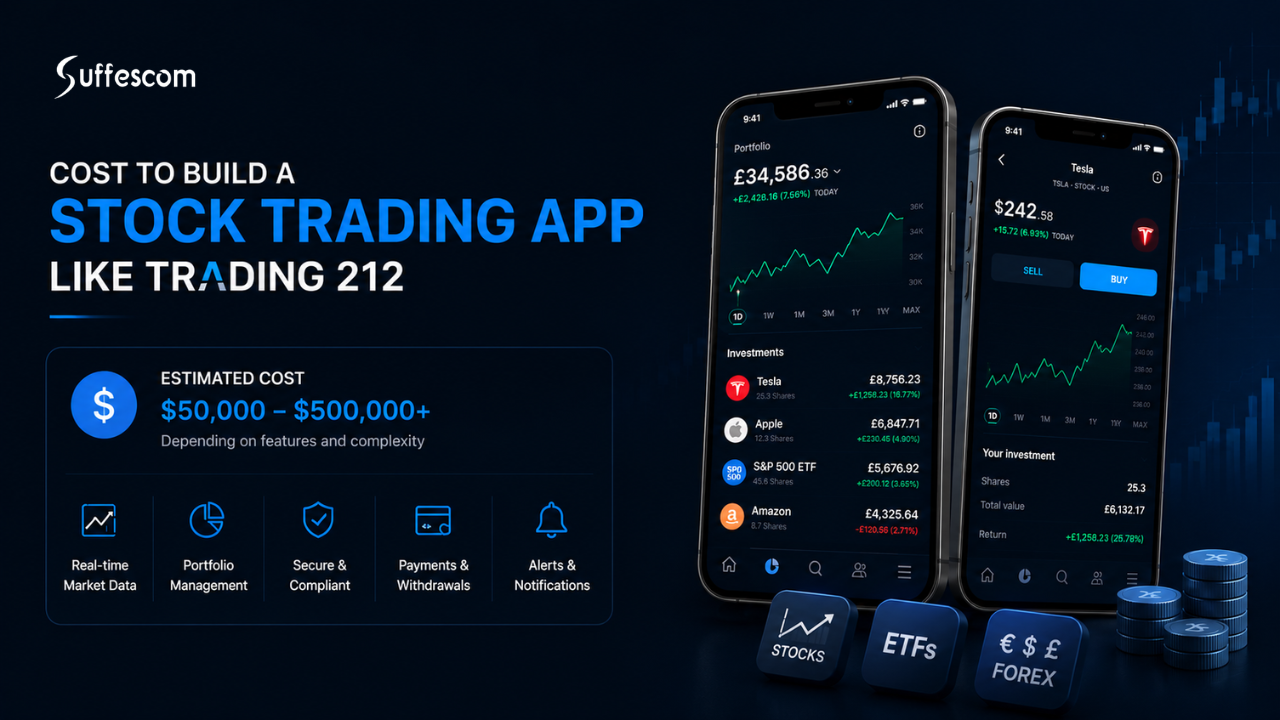
The average cost of developing a stock trading app such as Trading 212 in the UK will vary depending on the complexity of the application and the app’s investment features, third party API integrations, investment security systems and platform scalability factors as well as many other factors. The estimated average cost of developing a Minimum Viable Product (MVP) trading app will be around £40,000 while developing an investment platform with many investment features will cost you over £300,000.
In this guide, we will break down stock trading app development costs, essential fintech app features, monetisation models, compliance requirements, development timelines, and hidden expenses businesses should consider before launching a UK trading platform.
Understanding the UK Stock Trading App Market
The stock trading app industry in the UK has experienced significant growth in the past few years because many people prefer to invest using mobile applications as opposed to traditional brokerage houses. Today’s users want fast set-up and commission-free investing; they want to see real-time market data; and they wish to manage their entire portfolio right from their phone. This has resulted in a huge demand for UK-based fintech app development and complete online trading app solutions in the UK.
In addition, stock investing applications are no longer being utilized by just experienced traders; they are now being used by many students, young professionals, and new investors to purchase shares of stock, exchange-traded funds (ETFs), and cryptocurrencies with just a few taps.
Why Trading Apps Are Growing Rapidly in the UK
Multiple factors have contributed to the increased popularity of stock trading applications throughout the UK fintech landscape.
Mobile-First Investing Behaviour
The traditional method of managing investments is giving way to the newer, mobile-first method, where individuals use their smartphones or tablets to do their trading.
Example:
A novice investor could use a mobile app to open an account, perform KYC verification, and purchase FTSE 100 equities in a matter of minutes.
Rise of Commission-Free Trading
Popular investing platforms such as Trading 212 and Robinhood have made investing easier than ever by eliminating high-cost broker commissions.
Increased Financial Awareness
Increased exposure to financial topics on social media, as well as content related to investments from financial influencers and the growth of user-generated investing communities, are encouraging younger generations in the UK to use stock trading apps and personal finance products to educate themselves about investing.
How Apps Like Trading 212 Make Money
Although most trading sites still use commission-free investing to get customers in the door, they still make money by using different ways to make money off their customers.
Spread Fees
The difference between the buy price and the sell price of a stock (or CFD) is the amount a trading platform will make from the transaction.
Example:
If a stock is bought for £100.00 and sold for £100.30, the Trading platform would be able to keep some of the £0.30 profit from the sale.
Premium Subscriptions
Some platforms offer premium services. Premium services may include advanced charting tools, faster customer service, and analytics from an analyst.
CFD Commissions
Platforms can make money by providing leverage to customers through CFD trading.
Currency Conversion Charges
When buying US stocks with GBP accounts, the Trading platform may charge a small currency conversion fee.
Securities Lending
Some platforms make money from lending out users’ shares to institutional investors to earn interest.
Key Market Trends in UK Fintech Trading Apps
The UK fintech market is continuously developing with new technology applications alongside changes to customer expectations for investing through apps.
Fractional Investing
Users are now able to purchase portions of a company’s stock vs. only being able to purchase the entire stock.
Example:
An investor can purchase £20 dollars worth of TSLA instead of one entire share of TSLA.
AI-Powered Investing
AI Investing has made it easier to review risk and make informed market decisions via AI-powered risk analysis, track market trends, and receive recommendations about what would be an appropriate investment.
Robo-Advisory Platforms
Robo-Advisory Platforms allow users of fintech apps to build portfolios based on their risk profile and investment goals.
Copy Trading Features
Copy Trading features allow the user to automatically copy the trades of successful investors.
Example:
eToro became exceptionally popular based on the social investing and copy trading features of their platform.
Crypto Integration
Increased Integration of Cryptocurrency in Trading Apps: As time passes, more trading applications will allow for cryptocurrency trading alongside other asset classes.
Real-Time Analytics
Real-time analytics are no longer optional. Investors are expecting immediate access to updated pricing on securities, instant notification of the completion of transactions, and detailed performance measures for their individual’s investments will continue to be modified for the better.
What Is a Stock Trading App Like Trading 212?
Trading apps, such as Trading212, are online (or mobile) investment platforms that allow investors to buy, sell & track their investments all in real time. Some examples of financial securities available for purchase through online trading apps include stocks, ETFs, CFDs and commodities with many trading apps also offering the option of buying & selling cryptocurrency or digital currencies.
Trading platforms are designed for use by both new & experienced investors as they provide live market data, portfolio tracking, fast execution of trades & secure payment systems allowing users in the UK to have easy access to the stocks & shares they want to invest in.
For example; you no longer need to contact a broker to trade stocks, simply use your trading app to look for the stock you want to invest in ie: Apple or Tesco and you can start trading right from your smartphone within seconds.
Core Features of Trading 212-Type Applications
| Feature | Purpose | Complexity |
| User Registration & KYC | Identity verification | Medium |
| Portfolio Dashboard | Asset tracking | Medium |
| Real-Time Stock Market Data | Live trading insights | High |
| Trading Engine | Buy/sell execution | Very High |
| Watchlists | Asset monitoring | Low |
| Payment Gateway Integration | Deposits & withdrawals | Medium |
| Push Notifications | Alerts & updates | Medium |
| AI-Based Analytics | Investment suggestions | High |
User Registration & KYC
To meet FCA and AML requirements, all trading platforms must have KYC systems in place that allow them to verify the identities of their customers before allowing them to trade.
Example:
For example, they’re going to ask customers to upload either a passport or a driver’s license and one form of proof of their current address before the customer can start trading via the platform.
Portfolio Dashboard
The portfolio dashboard enables an investor to view the performance of their investments, including their holdings, profit or loss and the performance of their overall portfolio, in real time.
Example:
For example, the investor would be able to see how much money they made on their investment in the FTSE 100 throughout the day.
Real-Time Stock Market Data
Real-time market data such as live stock prices, live stock charts, and market volatility, also assist users in making more informed investment decisions.
Trading Engine
The trading engine is the main component of a trading platform that allows users to buy and sell securities in an instantaneous and secure manner.
Example:
For example, when a customer purchases shares of BP or Amazon, the transaction is executed in real time by the trading engine.
Watch-lists
The watch-list feature allows users to select the stocks or other assets they want to follow and track before making any investments.
Payment Gateway Integration
The payment gateway integration feature allows for secure banking transaction via the app and also enables users to use debit and credit cards for deposits and withdrawals via the app.
Push Notifications
The notifications enable users to receive notifications on price changes, trade confirmations, and breaking news from the market.
AI-Based Analytics
Analytics powered by artificial intelligence will be used to thoroughly examine the markets and generate customized investment recommendations based on the user’s account history and current risk level.
Cost to Build a Stock Trading App Like Trading 212 in the UK
When determining how much it’ll cost to create a stock trading app like Trading212 in the UK, you must take into account several things including complexity, security, what trading functions you want to include, any compliance systems you require, and what third-party integrations you will need.
If you want a basic MVP investment platform, it will be much less than a robust enterprise-level trading ecosystem with AI analytics and real-time trading infrastructure.
Most stock trading app development costs in the UK will typically fall within the range of £30,000 – £300,000+, depending on the scope of the project and scalability needs.
Average Trading App Development Cost in the UK
| App Type | Estimated Cost (GBP) |
| MVP Trading App | £30,000 – £60,000 |
| Mid-Level Trading Platform | £60,000 – £120,000 |
| Enterprise Trading Ecosystem | £120,000 – £300,000+ |
MVP Trading App
An MVP (Minimum Viable Product) is just that; it is only the minimum viable features necessary to launch the platform quickly and test the market for demand from users.
Typical Features Included
– User Registration & KYC Verification
– Basic Stock Trading (buy/sell) Functionality
– Portfolio Dashboard
– Payment Gateway Integration
– Watch Lists & Notifications
Example:
A fintech startup launching an investment app in the UK targeted at beginning traders could first create an MVP to validate user interest and then develop more sophisticated features.
It will be the most economical phase of the app developer’s cost for startups with limited financial resources
Mid-Level Trading Platform
A mid level trading platform has many more features/poperties and has more ability to grow/upscale.
Additional Features
– Live real-time market quotes/data
– Advanced charting features
– Multiple payment methods
– Push notifications to inform users of market changes or events
– A better user interface and user experience
– Improved systems for security of client and market transaction
Example:
As an example, A growing app/website that trades would want to add live market analytics/quote data and improved trade execution times as a means of increasing user experience and keeping investors/clients.
Enterprise Trading Ecosystem
Enterprise level trading apps are secure, can scale up, and have many features and can support large quantities of users and complex types of financial transactions.
Advanced Features Included
– AI driven investment analytics
– Robo advisor features
– Automated trading systems
– Integration of crypto/cryptocurrency markets
– Multi-region hosting infrastructure
– Cyber security protection devices for enterprise level
Example:
As an example, A large fintech company creating an entire investment ecosystem similar to Trading 212 or eToro will require advanced back-end hardware/software architecture and FCA-compliant trading infrastructure.
The overall cost to develop an investment app, or enhancement to an existing investment app, will also depend upon the geographical location of the development/consulting team, cloud hosting costs, API licensing fees, as well as continued maintenance or operational costs after the investment app has been produced.
Cost Breakdown by Development Stage
A stock trading platform has several stages of development which contribute significantly to the overall cost to develop a stock trading app in the UK. The final budget will depend on how complex the application is, compliance with regulations, and trading infrastructure.
| Development Stage | Estimated Cost |
| Market Research | £2,000 – £5,000 |
| UI/UX Design | £5,000 – £15,000 |
| Frontend Development | £10,000 – £30,000 |
| Backend Infrastructure | £15,000 – £50,000 |
| Trading APIs Integration | £8,000 – £25,000 |
| Security & Compliance | £10,000 – £40,000 |
| Testing & QA | £5,000 – £15,000 |
| Maintenance | 15–20% yearly |
Market Research
Prior to beginning development, businesses should conduct market research by studying the competition in the market, how users behave, and what fintech regulations are in place in the UK.
Example:
For example, a startup may want to look at trading platforms such as Trading 212 and eToro in order to understand what investors expect from the trading app and identify features that are popular among investors. By conducting market research, businesses will have reduced risk and will also be able to determine which markets they can target.
UI/UX Design
Designers focus on creating the layout, navigation, report, and trading screens of the app in such a way that the user’s experience is as seamless as possible.
Example:
For example, creating simple investment charts, easy to use buy/sell buttons and/navigation will all help to improve user engagement with the app. Having a well designed application is critical for retaining users of fintech applications.
Frontend Development
The focus of frontend development is on creating the visible portion of the trading platform for iOS, Android, and Web users. Frontend development includes:
This includes:
– Portfolio Dashboards
– Portfolio Watchlists
– Live Charts
– Trading Screens
– Notifications
Backend Infrastructure
The backend functionality of the trading platform will support the amount of computing power/resources required by the trading platform. The backend will allow for databases to operate, manage user accounts, manage the trading system and host the cloud.
Example:
For example, if a large number of users place trades simultaneously, the backend will be able to facilitate a fast and secure processing of each trade.
Trading APIs Integration
Third-party APIs are used by trading apps to get real-time stock prices, market data, and execute trades.
Example:
For example, an API provider may provide real-time market updates for NASDAQ or FTSE directly inside the app through an API.
Security & Compliance
Security is one of the major costs of building a fintech app due to the stringent security requirements of the FCA and GDPR. The following items fall under this category:
This stage includes:
- Data encryption
- Multi-factor authentication
- AML checks
- Fraud detection systems
Testing & QA
The quality assurance team will test the application to ensure that there are no bugs, performance issues, or security weaknesses before it is released.
Maintenance
Ongoing maintenance, including updating security systems, monitoring servers, fixing bugs, and adding new features, is required after the app has been launched. Ongoing annual maintenance budgets for a typical fintech company account for around 15-20% of the original development costs.
Major Factors Affecting Trading App Development Cost
The overall cost to develop a trading platform will depend on a variety of variables, including financial, legal, technical, and security-related factors. Regulatory compliance, for example, is the largest cost driver of the UK fintech industry. Companies that plan on launching a trading platform that is FCA compliant, as well as providing investor protection and fraud prevention, must abide by numerous regulations.
This means that developing a trading platform that is compliant with current UK regulations requires additional expenses for regulatory compliance systems, cyber-security, and data protection infrastructure.
FCA Compliance Requirements
The Financial Conduct Authority (FCA) is the UK regulator for all financial services and investment platforms. Although many trading apps provide investment services to their users, they must comply with FCA regulations/responsibilities before they can be considered compliant. If they don’t comply with the regulations, they could be fined, sued, or stopped from using the platform.
KYC & AML Compliance
KYC (Know Your Customer) and AML (Anti Money Laundering) procedures help the business to authenticate the identity of the customer as well as to mitigate any financial crime that may potentially be committed by the customer. When a new user registers with a trading platform, they are typically required to upload ID validation documents such as a passport or driving license or proof of address or with a KYC-compliant bank account statement or source of funds documentation.
Automated identity verification systems will increase development costs but will improve chances of getting regulatory approval.
GDPR Compliance
Any trading app providing services to customers in the UK must comply with GDPR data protection procedures for storing users’ data securely and processing it legally. Trading apps have an obligation to meet the requirements for secure storage of user data, management of consent from users, data encryption, and privacy controls and secure cloud infrastructure.
Example:
For example, users can be informed how their personal and financial data will be used in the app.
PCI-DSS Compliance
If the trading app provides debit or credit card payments and/ or bank direct transfers or online card-enabled payments, it is subject to the PCI-DSS Security Standard. The purpose of the PCI DSS Security Standard is to prevent fraud and abuse relating to payment card transactions.
Secure Transaction Logging
Collecting Transaction Information Securely: All transactions, logins, trades etc., must all be collected safely therefore allowing for auditing and viewing of fraudulent activity at a later date.
Example:
For example, if suspicious trading activity takes place then the platform should be able to look back at the account history and obtain this information immediately.
Due to these very strict regulations many times compliance and security development will represent one the largest costs incurred when developing an FCA compliant UK trading application.
Real-Time Market Data APIs
Real time market data APIs are one of the key elements to any stock trading application. Real time market data APIs offer live prices, market data, volume traded, historical data, as well as company finance information within your application. If a trading application does not have on-going access to up to date market data; the application will not be able to provide accurate investment information or to conduct near real time trading.
Businesses developing FCA compliant trading applications within the UK need to ensure they select the correct API provider to guarantee software performance, scalability, and user satisfaction.
Alpha Vantage API
Provides Low Cost Stock Price Data, Forex Data, Cryptocurrency Data, and Technical Indicators
The Alpha Vantage API is a ‘low cost’ API for stock price, forex, cryptocurrency and technical indicator data. The API is frequently used for MVP trading applications as it is developer friendly and has a much lower cost associated with its implementation.
Example:
A new business developing an easy-to-use stock investment application for novices may use the Alpha Vantage API to show real-time FTSE 100 price and simple charts for tracking their investments.
Yahoo Finance API
Yahoo holds an incredibly well-known reputation by supplying its users with up-to-date financial news, as well as historical prices for stocks market indices, overall markets, and investment opportunities.
Yahoo Finance APIs are commonly used by software developers for:
- Stock price updates
- Historical market trends
- Company financial information
- Investment analysis dashboards
Example:
Users can determine the long-term performance of Tesla versus Barclays before making any investment decisions.
Bloomberg API
Bloomberg also provides its clients with the world’s best financial data service to support their daily trading decisions with banks, hedge funds, and institutional-level trading other than through their own in-house systems.
The APIs offered via Bloomberg provide timely and accurate data for all financial instruments, yet both the cost of integration and the cost of licensing are prohibitively high.
The APIs provided by Bloomberg are for companies engaged in high-volume trading with significant analytical requirements and for investors who need reliable data for all assets on an institutional-level basis.
Interactive Brokers API
The Interactive Brokers Trading API offers robust functionality to support the execution of live trades, the management of individual accounts, foreign exchange trading, and access to the global marketplace.
Example:
A UK-based, online trading company can use an Interactive Brokers API to enable their customers to make purchases and sales of international stocks via their mobile application.
Real-time APIs continuously consume vast amounts of information, which will greatly influence the cost associated with developing a Fintech application.
App Security Requirements
Security is an extremely important part of creating a stock market application. Because customers store their names, addresses, phone numbers, and financial funds within your stock market app. You also need to have additional levels of protection as a means of providing fraud prevention and protection against unauthorised access.
You must have complete confidence that your application is protected according to the Financial Conduct Authority’s (FCA) regulations and trustworthiness of your customers. You must adhere to FCA regulations for all your users/customers.
Biometric Authentication
Biometric credentials are an alternative to traditional passwords. A user can log into your stock market application using their fingerprints, facial recognition, or other biometric functions.
It improves user experience by eliminating the need to remember complex passwords and providing a more secure way for users to access their portfolio.
Example:
By using biometrics, the likelihood of a password being compromised for an investor is limited to anything other than themselves. Therefore, the chance of unauthorised access to an investment portfolio is extremely small when using biometrics.
End-to-End Encryption
End to End Encryption is the transfer of encrypted data from the device where the data originates to the application server and finally to the payment processing company.
This will help to ensure that an payment request will not be intercepted by any hacker and cannot be used for any malicious activities related to the following:
- Banking information
- Login credentials
- Trading activity
- Personal identity documents
Example:
If a user is purchasing shares or depositing money, the data associated with this transaction will always remain encrypted from the moment the user submits the transaction until it reaches the payment processing company.
In addition, encryption is vital for all regulated trading platform companies operating in the UK.
Device Verification
Device verification refers to systems used by individuals to secure their private information and authorize access to a user’s account through trusted devices that will connect to their account.
Example:
An example of device verification being used is if a user typically logs onto their trading platform from London but tries to log on from another country without previous authorization from that device or physical location. The app could ask for additional authentication before giving access.
Device verification has significantly helped reduce the amount of attempted account takeovers and invalid access attempts.
Fraud Detection Systems
Modern trading apps utilize various artificial intelligence (AI)-based fraud detection instruments to monitor user accounts for suspicious transactions and abnormal activity on a daily basis.
These systems can identify:
- Rapid failed login attempts
- Suspicious withdrawals
- Unusual trading behaviour
- Fake account activity
- Money laundering risks
Example:
As a result, an AI fraud detection system may temporarily freeze a trade made by a user if the user places a trade larger than what they normally do and this causes a temporary hold on the trade until it can be cleared.
Although the implementation of advanced technological security systems has increased the overall cost associated with developing a fintech-driven trading app or platform. They are critically necessary to develop investor protection solutions, maintain compliance with regulators and provide a reliable platform for the long run.
Complexity of Trading Engine Development
The complexity of creating a trading engine is immense. This component serves as the ‘brain’ of the stock trading application. All real-time buying and selling activities are conducted from the trading engine, creating considerable difficulty in developing a secure and quick trading engine for stock trading applications.
When users place trades, they do so with the understanding that they will be processed in real-time (no delays or errors). As a result, any minor technical issue can lead to a financial loss for both the user and the platform.
Order Matching
Order matching refers to the connection of buyers and sellers to each other in the marketplace. For instance, if one user (the buyer) wants to purchase shares in a specific company, and another (the seller) has a matching sell order at an identical price, the trading engine will automatically match the orders.
Order matching takes less than one second to execute when utilizing the newest trade application technology.
Trade Execution
When a buy or sell request is placed, after matching orders, the order must be executed.
Example:
If a user enters an order for 100 shares of Tesla at 1 pound per share, immediately after execution, the account balance and the portfolio dashboard must also be updated.
Quick trade execution is so critical because of the minute-by-minute fluctuation of stock prices.
Risk Management Systems
Stock trading applications must have systems in place to minimize the risk inherent in stock trading.
These systems help:
- Detect unusual transactions
- Prevent fraud
- Limit high-risk trading
- Monitor market volatility
Example:
For instance, let’s say that somebody who has made a small number of trades suddenly decides to use their online account and make an extremely large number of trades, causing large spikes in price, and as a result, those stocks may temporarily halt much of the system until those trades are verified by other exchanges or the brokerage firm itself to ensure that no one is taking advantage of a fast changing system or the fact that they’ve just come on board.
Liquidity Management
Liquidity is the ability to have enough buyers and sellers in a market. When using a trading application, it is important for users to be able to purchase and sell assets quickly and efficiently within the same amount of time without having to wait long.
Example:
For example, if a number of investors decide to sell their shares all at once, the system must process those multiple transactions timely and efficiently.
Because a trading engine processes real-time transactions, stock data in real-time, and financial security to individuals, a trading engine requires skilled developers, high-performance cloud infrastructure and the development of a highly advanced backend infrastructure. Therefore, the development of a trading engine is the most expensive element in the development of a share-trading application.
Essential Features Needed in a UK Trading App
Trading 212 and eToro have both become successful and popular trading applications because they have introduced a simple, efficient, unified trading platform that provides the following in one place: investing tools, banking features, and live trading experience.
User Features
| Feature Category | Features |
| Account Features | Signup, KYC, Profile |
| Trading Features | Buy/sell, watchlist, portfolio |
| Banking Features | Wallet, bank transfer, withdrawals |
| Notifications | Price alerts, market updates |
| Support Features | Chat support, FAQs |
Account Features
Account options are designed to help a user create, validate their identity, and securely manage their profile.
Account options vary by provider; however, all providers have options that typically include:
- Email or mobile signup
- KYC verification
- Password setup
- Profile management
- Two-factor authentication
Example:
A user can upload their driving licence and proof of residence prior to trading stocks.
Two Factor Authentication is required to comply with FCA (Financial Conduct Authority) regulation and for user protection.
Trading Features
Trading options are foundational to the trading application as users use these options to buy, sell and track their investments in real time.
There are many trading options but typical options include:
- Stock buying and selling
- Portfolio dashboards
- Watchlists
- Real-time market prices
- Investment history
Example:
A user can monitor the stock price of both Tesla and FTSE 100 shares on their watchlist before deciding to invest.
Banking Features
Trading applications must also facilitate secure payments and money transfers. Typical banking options include:
This includes:
- Wallet functionality
- Debit or credit card payments
- Bank transfers
- Withdrawals
- Deposit tracking
Example:
Users in the UK can use online banking to immediately deposit into their trading wallet.
Notifications
With a push notification system, users can be kept aware at all times in regard to significant market activity.
Some of the important notifications include:
- Stock price changes
- Trade confirmations
- Market news
- Portfolio performance updates
Support Features
Through customer support features, you can quickly help users solve their issues and build user trust in the platform. Most trading apps will provide support to their customers through many channels:
Most trading apps provide:
- Live chat support
- Help centres
- FAQs
- Email support
- Ticket systems
This support is essential for new investors who will use a trading platform for the first time.
Admin Panel Features
- User management
- Fraud monitoring
- Compliance management
- Trading oversight
- Analytics dashboard
Advanced Features for Competitive Advantage
Modern traders expect more than just using a basic trading app (buy & sell) to assist them in trading. In order for businesses to gain and retain a competitive advantage over apps such as Trading 212 and eToro, businesses are investing in modern technologies that deliver advanced features to increase user engagement and thus the overall investment experience for the user.
These advanced features increase development costs; however, by incorporating such advanced features, businesses are able to not only differentiate themselves but also improve new customer acquisition through an increased number of new users. Therefore, A.I.-based trading app development and copy trading platforms have emerged as major elements of modern investment application technology.
AI Investment Advisor
A lot of investment-related websites have developed “Intelligent” (AI) analysis and trading apps that analyze Trader’s past results and use that information to provide a customized recommendation for future trades.
A lot of newer investors are not comfortable making smart investment decisions by themselves because they do not have enough financial knowledge to do so.
Example:
If an investor has a low-risk tolerance, the app would recommend purchasing low-risk exchange-traded funds (ETFs), which are similar to mutual funds with lower costs.
AI tools can also provide:
- Portfolio recommendations
- Risk analysis
- Market trend predictions
- Automated investment insights
Social Trading
Investors have the ability to interact with other individuals within the same trading platform and share ideas and knowledge through the use of social trading.
Users can:
- Share trading strategies
- Discuss market trends
- Follow experienced traders
- View public investment portfolios
Example:
the beginning investor has access to an experienced trader’s portfolio, can discuss their trade strategies with other investors, and can see what types of trades other investors have executed successfully.
This creates increased interaction and a more engaged group within the trading platform, keeping the user base active and connected to each other through a common interest in trading.
Copy Trading
Copy trading is where a trader will sign up to copy all of the trades executed by the trader they are following, (in this case, a trader who is considered to be a high performer).
This has become an extremely popular form of copy trading in the last five years.
Example:
if the person being copied makes a trade in a tech company, that trade is automatically copied to the trader who is following them.
This has become a very popular method for new investors who do not yet have the knowledge to execute their own trades.
Robo-Advisory
Robo advisory systems can create investment portfolios and manage investments using only algorithms and AI-based technology.
The system will analyze several factors to come up with an appropriate investment strategy. Examples of the factors that will be analyzed include:
- Financial goals
- Risk tolerance
- Investment preferences
- Market conditions
Once all of these factors have been analyzed, the system will suggest one or more suitable investment strategies.
Voice-Enabled Trading
Voice-enabled trading gives users the option to execute trades using their voice.
Example:
For example, a user could make a request by saying “buy £100 worth of Apple shares” and the app would process their request securely.
Voice-enabled trading improves accessibility and provides users with a more modern user experience within the development of AI-based trading apps.
How Long Does It Take to Create a Trading App Like Trading 212?
The development of a stock trading platform similar to trading212 is a complex process involving several different phases which include planning, designing, developing, compliance, and conducting testing for security purposes. The overall time line of development will depend on many factors including:
- The number and types of features that the app will include
- The complexity of the application (how sophisticated will the app be? – What types of computations/calculations will need to be done)
- The number of third party integrations that are needed
- The level of compliance required with FCA regulations
The basic MVP trading application will take 4 – 6 months to create while a fully featured enterprise investment platform will typically take 12 months or longer.
Estimated Trading App Development Timeline
| Development Phase | Timeline |
| Discovery & Planning | 2–4 Weeks |
| UI/UX Design | 3–6 Weeks |
| MVP Development | 3–5 Months |
| Compliance Integration | 1–2 Months |
| QA & Security Testing | 1 Month |
| Full Launch | 6–12 Months |
Discovery & Planning
The discovery and planning phase is the first phase of an app project. In this phase, developing businesses will establish the goals for their proposed app as well as identify their target audience, features and functionalities required of the app.
Example:
A fintech startup may want to do research on platforms such as eToro, so they can learn about common features found in trading as well as what users expect from the system.
Good planning can help minimize problems with future development and reduce costs that may result from change requests.
UI/UX Design
Designers will put together a design for an application’s layout, trading dashboards, navigation menus and mobile screens.
The purpose of the design is to provide investors with a platform that is simple to use.
Example:
By designing clear and simple buy/sell buttons and beginner-friendly portfolio dashboards, user experience will be improved.
MVP Development
At this point, the core functionality of the application is built.
Some of those typical features are:
- User registration
- KYC verification
- Portfolio dashboard
- Real-time trading
- Watchlists
- Payment systems
This phase is usually the longest segment of a project.
Compliance Integration
In the UK, trading applications must use systems that are compliant with FCA regulation. This includes systems that facilitate:
- AML verification
- GDPR compliance
- Transaction monitoring
- Identity verification
There will also be additional testing and security implementations associated with these integrations.
QA & Security Testing
Prior to launching an application, developers will test it to find potential bugs, security flaws and performance issues. This is the phase that will confirm that your platform is capable of conducting live trading in a safe and efficient manner.
Full Launch
Once the application has gone through all testing phases and received approval, the application can be deployed in app stores and/or cloud servers for public use.
Larger trading applications may continue making enhancements to features and to infrastructure even after the full launch.
UK Regulatory Requirements for Stock Trading Apps
Building a stock trading app is more than just technology development. It requires compliance with both the financial regulations and data protection regulations in place to protect investors, reduce fraud and protect the integrity of the financial transaction process.
Any business wishing to launch a regulated trading platform for its users in the UK will want to ensure it complies with all applicable laws, such as FCA regulations, GDPR regulations, and anti-money laundering statutes.
FCA Licensing Requirements
The financial services regulatory authority in the UK is the Financial Conduct Authority (FCA). The FCA governs banks, investment firms, trading platforms and all companies who provide any form of financial services to ensure they operate legally and ethically.
Financial Conduct Authority Overview
The FCA works to protect the public and is responsible for ensuring all companies involved with or providing any financial service comply with rules and regulations regarding consumer protection and security.
Licensed trading apps that provide investment related services are not permitted to operate within the UK without obtaining regulatory approval from FCA.
Licensing Process
The process for obtaining a FCA license can take several months to complete due to the complexity of the business model. Some of the information that companies will be required to produce is:
Companies must provide:
- Business plans
- Security policies
- Risk management procedures
- Financial records
- Compliance documentation
Example:
As part of obtaining their FCA license, a start-up launching its stock trading app must document the steps required for securely managing customer funds and executing financial transactions on behalf of customers.
Legal Implications
Operating without an appropriate FCA license could expose a business to severe punishment:
- Heavy financial penalties
- Legal action
- Business restrictions
- Loss of customer trust
For these reasons, compliance with the FCA is among the top priorities of fintech application developers in the UK.
GDPR Compliance for Investment Apps
Investment applications in the UK must comply with the (General Data Protection Regulations) in order to protect customers’ data and privacy.
Data Protection
Trading applications will gather sensitive information about users:
- Identity documents
- Banking details
- Trading activity
- Contact information
Necessary to store securely, to prevent leaks of data or attacks on the data.
User Privacy
Users need to have a good understanding of how their data is collected and used; All applications should give notice of;
Apps should provide:
- Privacy policies
- Consent options
- Account data controls
Secure Data Storage
Financial data should be stored safely through secured cloud storage, encryption systems and access controls.
Example:
If hackers try to get access to a user’s records, they’re less likely to expose sensitive information through using encrypted databases.
AML & KYC Verification Requirements
Anti Money Laundering and Know Your Customer checks reduce the risk of fraud, illegal and financial crimes or any other illegal activity.
Identity Verification
The user must prove who he/she is before they can begin trading. This usually entails:
This often includes:
- Passport or driving licence upload
- Proof of address
- Selfie verification
Anti-Money Laundering Checks
Trading platforms should be able to monitor suspicious activities such as:
- Unusual transactions
- Large deposits
- Fraud risks
- Illegal fund transfers
These compliance systems help create a safer and more trusted investment environment for UK users.
Hidden Costs of Trading App Development
There are many things companies need to consider when developing an app for trading stocks, including hidden and up-front costs as well as ongoing expenses, which can increase the total cost of developing a FinTech Application over the long term.
Start-ups that want to develop a regulated trading platform for users in the UK must consider these hidden expenses in order to develop an accurate financial plan.
Third-Party API Costs
APIs may have varying levels of access and pricing (some are based on usage) and companies will incur monthly subscriptions.
- Live stock market data
- Payment processing
- Identity verification
- Trade execution
- Push notifications
Most API providers charge monthly subscription or usage-based fees.
Example:
if thousands of people access the platform for real-time market update information it could end up costing companies a fortune on usage.
APIs with advanced financial functionality (including but not limited to those provided by companies like Bloomberg) may have particularly high prices due to access to premium market data.
Compliance & Legal Costs
Legal and regulatory requirements imposed by the FCA, GDPR, AML, KYC on financial applications within the UK are stringent.
To comply with these regulations, companies in this market commonly hire the following types of experts to help meet their compliance requirements prior to and following the launch of their app:
- Legal consultants
- Compliance specialists
- Financial advisors
- Data protection experts
Providing these services increases the overall cost of operation for a company prior to and after their app launch.
Example:
Legal advice/support may be necessary to prepare all of the necessary FCA licensing documents and provide compliance reviews prior to launching the application.
Server Infrastructure Expenses
Financial Applications deliver very large volumes of real-time financial data every millisecond of every second. Superior cloud servers must be utilised to provide a scalable infrastructure to adequately support Financial Applications.
There are several supporting costs associated with the use of a cloud server for Financial Applications, including:
- Cloud hosting
- Backup systems
- Load balancing
- Data storage
- Performance monitoring
Example:
Example: During times of extreme market activity, additional cloud resources may be required to prevent the app from crashing or delaying.
Large scale financial applications typically utilise large service providers such as Amazon Web Services (AWS) or Microsoft Azure as a foundation for their cloud infrastructure.
Security Audit Costs
Most companies will conduct the following testing prior to launching their application in order to identify any weaknesses prior to them becoming exploited by hackers:
- Penetration testing
- Vulnerability scanning
- Security audits
- Fraud prevention analysis
These audits help identify weaknesses before hackers can exploit them.
Example:
A company’s security team would conduct penetration testing to determine whether an attacker can bypass a company’s login systems or gain access to sensitive financial records.
App Maintenance & Updates
Operating a trading app requires continued maintenance after its launch.
To maintain an app, developers will be required to produce:
- Bug fixes
- Performance improvements
- Feature upgrades
- Security patches
- OS compatibility updates
In general, many Fintech companies spend at least 15%-20% of what they spent developing an app in a year on it after launch.
Market Data Licensing Fees
Financial markets may not always provide their market data for free. The exchanges may also charge you a fee for the right to provide live data from the market.
Factors affecting the price of licenses include:
- Number of users
- Data type
- Global market access
- Exchange requirements
Example:
If you wanted to provide the NASDAQ or London Stock Exchange with real-time pricing for their stocks and markets, you would probably need to enter into a contract with the exchange to provide them with the ability to charge you a monthly or annual subscription for the service you provided them.
As users buy and sell on your trading app will increase your costs and therefore, the long-term operational costs associated with providing your customers with replacement licenses.
Monetisation Strategies for Stock Trading Apps
Trading apps can generate revenues using multiple models; they can create an ongoing stream of revenues and make sure their customers can afford to invest.
For instance, Trading 212 and eToro have mixed/recurrent subscriptions, spread of trades, and merchant services.
| Monetisation Model | Description |
| Commission Fees | Charges per trade |
| Premium Plans | Advanced features |
| Spread Revenue | Buy/sell spread |
| Margin Lending | Interest income |
| Advertisements | Sponsored placements |
Commission Fees
Many online trading platforms charge commission fees for completing trades of stocks, ETFs, and cryptocurrencies on their platform. Commission fees may include:
- A fixed amount per trade
- A percentage of the transaction value
- A charge for advanced trading tools
Example:
Many online trading apps have eliminated commission fees for all trades, although other platforms will still charge for certain types of assets or trades made outside of the country.
Premium Plans
Paid memberships on online trading platforms generally provide users with access to more advanced investing tools and features that are not available to members who do not pay the membership fee. Examples of features available only to paid members include:
- Advanced stock analytics
- Professional charts
- AI investment insights
- Faster withdrawals
- Priority customer support
Example:
For example, a new investor may use the no-cost membership (non-paid) provided by a trading platform; however, a more experienced trader may pay for a paid membership on that same trading platform in order to gain access to advanced stock trading analysis features.
Paid memberships create predictable income for a trading platform because they generate recurring monthly revenue.
Spread Revenue
The spread is the small difference between the price you would pay to purchase an asset, vs. the price you would receive when selling that same asset at a later date.
Example:
If you paid £100 to buy AAPL and sold it for £100.30, the platform may receive the entire £0.30 -or part of it- as spread revenue). The spread revenue model is one of the most common ways in which commission-free trading apps earn money.
Margin Lending
When using margin loans, you have the ability to borrow funds from the trading platform to invest in additional assets.
Example:
A trader may borrow funds to invest more heavily in certain stocks during market opportunities.
This feature is commonly used by advanced traders but requires strong risk management systems.
Advertisements
Some platforms generate revenue through sponsored content and financial advertisements.
These may include:
- Sponsored stock promotions
- Investment product advertising
- Partner financial services
- Featured educational content
However, trading apps must ensure advertisements comply with FCA regulations and do not mislead investors.
H2: Trading 212 vs eToro vs Robinhood – Feature Comparison
| Platform | Founded In | Core Strength | Main Features | Revenue Model | Supported Assets | Best For | Availability |
|---|---|---|---|---|---|---|---|
| Trading 212 | 2004 | Commission-free investing | Fractional shares, ISA accounts, real-time trading, portfolio tracking, CFDs | Spread fees, currency conversion, CFD trading | Stocks, ETFs, CFDs, Forex | UK investors and beginners | UK & Europe |
| eToro | 2007 | Social and copy trading | Copy trading, social feeds, crypto trading, smart portfolios | CFD spreads, withdrawal fees, premium services | Stocks, Crypto, ETFs, CFDs, Commodities | Social investors and copy traders | Global markets |
| Robinhood | 2013 | Beginner-friendly investing | Commission-free trades, fractional shares, crypto trading, options, instant deposits | Payment for order flow, margin interest, premium subscription (Gold) | Stocks, ETFs, Options, Crypto | US retail investors and beginners | US (primary), limited UK crypto access |
MVP vs Full-Scale Trading App Development
The majority of businesses entering the Fintech industry in the UK tend to start developing an MVP (Minimal Viable Product) before creating Continuing enterprise-level trading platforms that typically consist of several different applications working as a single system to meet user needs. The advantage of using an MVP is that it allows new firms to build their platform for less, thus enabling them to quickly bring their product to market and have it tested by real users for suitability before spending too much on creating their trading platform.
A full-scale trading App will ultimately serve larger numbers of users, provide advanced investing tools as well as offer the ability for firms to support users over the longer term.
MVP Features Recommended for Startups
An MVP trading App must provide the Minimum Features Needed to Support Users’ Ability to Invest Securely and Use the Trading App with Ease.
KYC Verification
For an application to be compliant with FCA Regulation and secure, it is critical that users are able to verify their identity.
Example:
Users will need to Provide Identity and Address Verification Documents Before Being Able to Place an Order.
Basic Trading
A Trading App must provide users with a Simple User Interface to Place a Buy and Sell Order for Securities.
Portfolio Management
A Trading App Must Enable Users to Track the Following Types of Information:
- Investments
- Profits and losses
- Transaction history
- Portfolio performance
Payment Gateway
A Trading System Must Have Mechanisms to Facilitate Secure Method of Making Deposits/Withdrawals to/from a Trading Account.
Notifications
Users Will Benefit From Receiving Notification Alerts Including the Following Types of Information:
- Price alerts
- Trade confirmations
- Market news
- Portfolio updates
With an MVP, Start-up companies have the ability to validate their business concept while maintaining the integrity and Quality of the Trade Application System.
When to Build Enterprise-Level Features
With more customers and money coming into your platform, you are able to create value-added enhancements to your application to compete with more established companies like Trading 212 and eToro.
AI Investing
AI-enhanced investment systems will provide a customer with tailored recommendations and forward-looking predictions regarding the marketplace.
Advanced Analytics
Professional investors will often require:
- Detailed charts
- Technical indicators
- Risk analysis tools
- Market forecasting dashboards
Multi-Asset Support
Enterprise applications may provide support for:
- Stocks
- ETFs
- Forex
- Commodities
- Cryptocurrencies
Crypto Trading
Adding cryptocurrency trading will help you to appeal to a younger, technology-savvy demographic, but integrating cryptocurrencies will increase the risk related to compliance, security, and infrastructure.
Best Practices for Building a Successful Trading App
To ensure that you develop a profitable trading platform you’ll need to focus on many factors such as: security, performance, scalability, and developing an environment of trust with your investors.
Prioritize Security & Compliance
Since the information handled by trading applications consists of sensitive, financial information, this necessitates that cybersecurity be a high priority.
- Two-factor authentication
- Data encryption
- Fraud monitoring
- AML & KYC verification
Developing strong processes to be compliant with regulations such as FCA and GDPR will also help your business to be successful.
Focus on User Experience
By developing a user-friendly and intuitive interface for your trading platform, you should be able to create a stronger sense of confidence and engagement with your customers.
Example:
Clear buy/sell buttons, intuitive navigation, and user-friendly dashboards enable novice investors to feel comfortable when utilizing the application.
Use Scalable Cloud Infrastructure
In order to support the influx of new users and the increasing amount of real-time market activity being processed by trading apps, it is critical for these applications to have cloud-based infrastructure that can scale as traffic increases. The ability to scale infrastructure on-demand through services like Amazon Web Services (AWS) and Google Cloud enables companies to effectively support their growing platforms.
Ensure Fast Trade Execution
Traders expect their trades to be executed in an instant and do not have patience for any delays. If a trader’s trades are not executed quickly enough, the repercussions could include:
- Poor user experience
- Financial losses
- Reduced investor trust
In order to create optimised backend processes and reliable APIs that enable rapid execution of trades, it is critical to implement the correct technology stack to provide the best performance at all times.
Build Investor Trust Through Transparency
Investors are going to have more confidence in trading platforms that offer clear pricing, policies and communicate honestly. Developers should ensure that their users have a thorough understanding of:
Trading apps should clearly explain:
- Fees and charges
- Investment risks
- Privacy policies
- Security practices
Providing users with transparency is a proven way to build long-term loyalty among customers, as well as increase the credibility of the platform.
Why Choose a Fintech App Development Company for Trading App Development
Building a mobile application for stock trading is significantly more complicated than building a standard mobile application. There are a number of aspects that must be considered including the need for real-time transaction processing, the security of sensitive investor data, and the requirements set forth by the Financial Conduct Authority (FCA) within the UK for financial services businesses such as stock trading. As a result, businesses typically select an established fintech app development company that has experience developing enterprise-class trading applications to complete their trading app development project.
A fintech-app development agency company understands how to develop secure, scalable, and FCA-compliant investment platforms. Trusted app development company like Suffescom Solutions help businesses build trading apps with strong security, reliable performance, and modern user experiences.
Importance of Financial Software Expertise
Fintech applications are unique because of the requirements regarding technical knowledge; a developer needs to know how to develop systems with trading, payment gateways, market data APIs and portfolio management tools.
Take trading apps as an example-the app must be able to execute a trade in real time and give accurate updated stock prices in real time without delay. Financial expertise helps to mitigate technical risks and increase the reliability of the platform.
Security & Regulatory Experience
Trading apps manage sensitive banking information, personal identification information, and make financial transactions every day, therefore it is essential to have a high level of security and comply with all regulatory standards.
An experienced fintech development company can implement:
- KYC & AML verification
- End-to-end encryption
- Two-factor authentication
- GDPR compliance
- Fraud detection systems
This enables firms to be able to create a secure and compliant platform to service UK investors.
Faster MVP Launch
Creating an MVP allows a company to test the idea of their trading app with minimal investment and if it works. A fintech-specific team can quickly develop the necessary features for any trading app, such as dashboards, payments, notifications and helping users to set up their account .
Doing things this way allows businesses to enter the marketplace faster while finding out whether or not their customers will use their trading app.
Long-Term Product Scalability
Over time, as the app develops and evolves, businesses may want to add features like AI investing, crypto trading, the ability to copy traders and advanced analytics capabilities. Using cloud infrastructure that can scale will allow the application to support many more users and much greater market activity as the business continues to grow.
Conclusion
The expanding trend of mobile investing and the growing desire for commission free trading apps gives high growth opportunity for Fintech businesses to create and build a stock trading App similar to Trading 212 . Building a Stock Trading App is a complicated but very profitable process that requires a variety of advanced components including real-time trading, portfolio management, AI-driven data analytics, secure payment systems, seamless user experiences and most importantly strict adherence to FCA, GDPR, KYC and AML regulations. The integration of Trading Engines and Real-Time Market Data API’s additionally increase development costs and technical complexities.
Development costs for a Stock Trading App generally range from £30,000 for a Minimum Viable Product (MVP), to over £300,000 for a Large-Scale (Enterprise) Trading Platform depending upon the features, level of scalability and infrastructure requirements you would like your Stock Trading App to achieve. The key cost centres of developing a Stock Trading App include Backend Development/Architecture, Security Systems, Third-Party Integration, and Ongoing Maintenance. Although there is a high level of Investment required to develop a Stock Trading App, there is also a high level of Monetisation potential either through Spread Fees, Premium Subscriptions, Margin Lending and/or Electronic Trading Fees via the Stock Trading App. The success of a trading platform largely depends on choosing the right app development company capable of building a secure and user-friendly fintech application that can compete in the growing UK trading market.
Frequently Asked Questions (FAQs)
How much does it cost to build a stock trading app like Trading 212 in the UK?
Cost can vary widely based on how extensive the app is; however, it is common to see basic MVP trading applications ranging in price from £30,000 (for basic features) to well above £300,000 (for a fully developed platform that encompasses numerous advanced features and functionalities, along with robust compliance and security protocols in place).
What are the key features required in a trading app?
While every trader has their unique requirements, the following list should provide a general understanding of features you want/need to incorporate into your trading app:
- User Registration/Authentication
- KYC Verification
- Portfolio Management Functionality
- Real-Time Stock/Share Market Data
- Buy/Sell Functionalities
- Integration of Payment Methods/Systems
- Notifications
- Integration of High-Security Functionality (including encryption)
How long does trading app development take?
While time varies depending upon the overall architecture of the app, as a rule of thumb, MVP styled trading apps require approximately four to six months to develop, whereas larger enterprise-sized trading platforms typically take nine to twelve months or longer, depending on their complexity.
Is FCA approval required for stock trading apps in the UK?
The FCA must approve any UK trading platform that provides financial services, which is necessary for these companies to be able to operate and comply with regulations.
What technology stack is best for fintech app development?
The most common front-end technologies are typically either Flutter or React Native while on the back-end node.js, Python, or Java are usually utilised. Many fintech companies also utilise AWS or similar cloud platforms.
Can startups build an MVP trading platform first?
Startups can build their trading platforms using an MVP strategy, which will allow them to save significant amounts of money while testing the demand in the marketplace for their software before investing in additional functionality such as AI-based trading or cryptocurrency trading.
How do trading apps make money?
Trading applications generate revenues through; spread fees, premium membership subscriptions, margin loans, foreign exchange conversion fees, advertising, and user transaction commission fees.
What security measures are required for trading applications?
At a minimum, trading applications should include encryption, biometric authentication, 2FA (two-factor authentication), fraud detection mechanisms, device verifications, and a secure cloud infrastructure.
How much does KYC integration cost in a trading app?
KYC integration costs depend on the provider used to conduct the KYC process and the verification complexity but can range in price; businesses should budget several thousand GBP for initial set up plus ongoing KYC services.
What APIs are used in stock trading apps?
Trading applications typically utilize different types of programs such as Application Program Interface (API) for various purposes. Common applications of APIs include usage for financial transactions which include securities transactions, to market data, and to send and receive notifications to traders and investors. Some popular providers of trading app APIs are Alpha Vantage and Interactive Brokers.
Can AI be integrated into trading applications?
Yes! AI integration can assist with providing users with investment recommendations, conducting risk analysis or predicting future market conditions using predictive analytics or robo-advisory services, or detecting fraud within trading applications.
What is the cost difference between MVP and enterprise trading apps?
The vast majority of MVP trading apps have only been minimally developed to provide users with basic functions, as well as to reduce the development costs of the MVP app. Enterprise level trading applications, however, will have advanced/complex functions such as providing users with access to robust data analysis tools, AI tools, copy trading capabilities and will require considerable infrastructure (i.e., servers) to support large numbers of users, thus resulting in enterprise level development costs being significantly higher.
How do apps like Trading 212 handle real-time stock data?
Apps like Trading 212 utilise financial market API’s along with a cloud based backend to process market activity and to display real time updates/progress of stock trades and new stock prices instantaneously.
What compliance regulations apply to UK fintech apps?
Generally speaking, UK based FinTech Apps must comply with these regulations: FCA Instructions, General Data Protection Regulation (GDPR), anti-money laundering (AML) rules, Know Your Customer (KYC) regulations, and Payment Security standards.
Is crypto trading integration expensive?
Yes! Crypto trading integration is considered expensive because it requires a variety of additional components that are cost prohibitive due to the costs of developing additional security systems, creating a blockchain-based API integration, complying with regulations and developing an electronic wallet management infrastructure.
How much does trading app maintenance cost annually?
Typically, fintech firms spend approximately 15%-20% of the initial development budget each year on app maintenance/updates, security improvements, and infrastructure management.
Which is better: native or cross-platform app development?
In general, native applications provide more efficient use of hardware resources and work better with the device. Conversely, cross-platform development can be done for both iOS and Android at lower cost and faster speed.
How can businesses reduce trading app development costs?
Some actions include: creating an MVP, putting emphasis on important features, using scalable cloud services, using cross-platform development, and not implementing complicated features after the app is first launched.

Senior Content Strategist
Jonathan Raabe is the Content Strategist at Suffescom Solutions and has more than 7 years of experience in developing data-driven content strategies for technology-centric organizations. He is proficient in the areas of mobile app development, software development, AI, cloud computing, fintech, healthcare, and digital transformation. Jonathan collaborates with industry leaders, developers, and business heads in creating high-value, SEO-optimized content that helps companies in increasing their visibility on the search engines, establishing trust, and driving business inquiries.
Need Help With
Development?