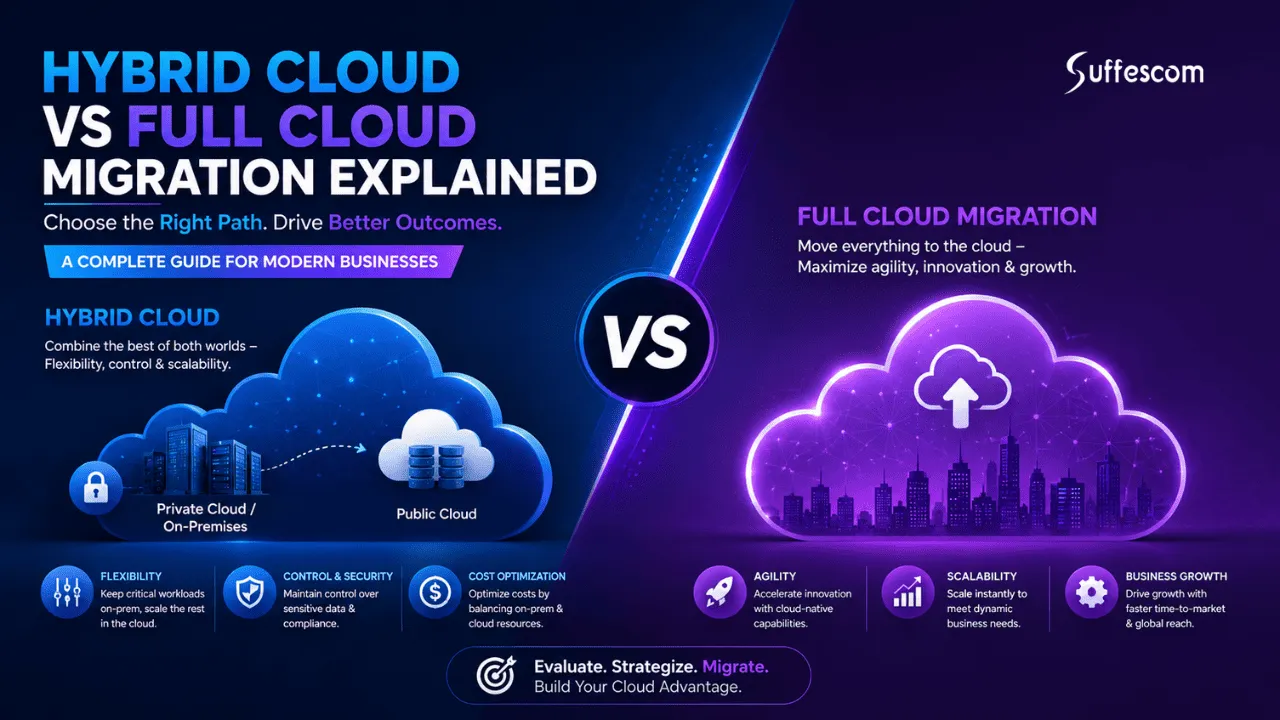
Moving to the cloud isn’t just a matter of infrastructure for UK-based businesses anymore. The decision has now evolved into one that impacts scalability, security, operational costs, compliance, and innovation itself. In fact, Gartner predicts that more than 90% of organizations will adopt a hybrid cloud approach through 2027.
Many industries are facing increasing pressure to modernize legacy systems within regulatory frameworks and cost constraints while meeting rising expectations regarding digital transformation and delivery of new services. It is true that most businesses based in the UK end up facing the same dilemma: whether they should choose hybrid cloud migration or full cloud migration.
In this guide, we outline how hybrid cloud migration and full cloud migration differ in terms of architecture, operational costs, scalability, compliance, performance, migration complexity, and industry adoption rates to help UK-based enterprises make the best choice.
Key Takeaways
- A hybrid cloud combines private infrastructure and cloud service, while full cloud migration means migration of workloads to only cloud environments.
- Hybrid cloud is normally seen as the best option when it comes to the use of existing legacy systems or for any other reasons.
- Full cloud migration results in greater scalability, ease of infrastructure management, and higher chances of future modernisation.
- The ultimate choice comes down to how the architecture is designed and the company’s business needs.
What is Hybrid Cloud Architecture?
Hybrid cloud architecture involves the integration of on-premise infrastructure along with the services provided by cloud platforms for the execution of applications, storage of data, and handling of workloads in different environments.
Rather than migrating all the processes to the cloud simultaneously, companies utilise the model of hybrid cloud computing, whereby selected systems can continue to operate within their own infrastructures, whereas some selected workloads are managed in the cloud environment through providers like AWS and Microsoft Azure.
Key Components of Hybrid Cloud
The components of a hybrid cloud solution typically comprise several layers of infrastructure that work together.
On-premises infrastructure
These are physical servers, storage systems, networking hardware, and privately owned data centers under the direct control of the company itself. Most companies maintain their on-premises infrastructure due to reasons such as legacy software, regulatory compliance, and other dependencies.
Public cloud infrastructure
Public cloud vendors provide compute resources, storage, databases, analytics tools, and managed services that are available for use by an enterprise. Services like AWS and Azure enable businesses to increase capacity without building new infrastructure.
Secure network connectivity
For a hybrid cloud solution to be effective, there needs to be secure network access to both cloud and on-premises environments. Organisations use dedicated links, virtual private networks, and specialised networking services to connect their environments.
Some examples include:
- AWS Direct Connect
- Azure ExpressRoute
- Site-to-site virtual private networking
Why Enterprises Use Hybrid Cloud
One common reason many companies choose a hybrid cloud is that it enables them to transform their IT infrastructure without replacing all their existing systems.
Integration of legacy systems
Most big companies usually run business-critical applications that have been in use for several years. The application is difficult to move to a new infrastructure, but the hybrid cloud enables them to integrate legacy systems with cloud solutions.
Regulatory and compliance considerations
Some industries process confidential data that needs extra security measures during migration. This way, hybrid cloud helps organisations strike a balance between migrating to the cloud and following regulatory guidelines.
Cloud migration in steps
Migrating all workloads to the cloud instantly will create operational risks, increased costs, and problems during migration. However, a hybrid approach helps the organisation move the workload step by step without disrupting its operations.
Planning cloud migration but not sure where to begin? Explore the right strategy for your infrastructure.
What is Full Cloud Migration?
The term full cloud migration is used to describe the transition of applications, workloads, databases, infrastructure, and other business systems to cloud environments, rather than maintaining them locally.
Full cloud migration is different from the hybrid model because it involves removing any dependency on physical infrastructure and running most workloads within the cloud.
Businesses that choose to implement a full cloud strategy often transfer their computing power, data storage capacity, network connectivity, and applications to the cloud.
Key Characteristics of Full Cloud Migration
Full cloud ecosystems have some common features which differentiate them from hybrid clouds.
Cloud native architecture
Application development usually focuses on building cloud-optimised applications. This helps organisations leverage the benefits of managed services, containerization, automation, and scalable infrastructure.
No or minimal dependence on local infrastructure
The full cloud does not require any kind of physical server or local data centre infrastructure, unlike a hybrid environment. Cloud providers take care of managing infrastructure.
Scalability and automation
Organisations can easily scale their infrastructure and automate many tasks, including application and infrastructure management.
Benefits of Full Cloud Model
Full cloud adoption may be selected by many firms due to its potential ability to simplify infrastructure management and enable accelerated digital transformations.
Reduced operational expenses over time
Companies can gradually start cutting down the costs related to the physical infrastructure. They will no longer be required to maintain the data centres or hardware components.
Faster innovation cycles
With a cloud environment, it is easy to facilitate the quick deployment of apps. It is also easier to test the functionalities and integration of innovative technology solutions.
Elastic scalability
Depending on the demand, the cloud computing capabilities can be easily scaled up. This would provide companies with the agility in response to their changing needs.
Hybrid Cloud vs Full Cloud Migration
Both Hybrid Cloud and Full Cloud Migration strategies have been devised to offer better scalability, efficiency, and agility for businesses; however, the two approaches differ in how they go about accomplishing these benefits.
Whereas a hybrid cloud environment is one that integrates existing physical infrastructure with cloud solutions, a full cloud migration involves moving all infrastructure, applications, and workload into cloud environments for better scalability.
The following table shows the key differences between these two strategies.
| Factor | Hybrid Cloud | Full Cloud Migration |
| Infrastructure | On-premise + cloud environments | Cloud-only infrastructure |
| Scalability | Medium to high | Very high |
| Compliance Control | Very high | High (depends on architecture) |
| Cost Structure | Mixed CapEx + OpEx | Primarily OpEx |
| Complexity | High | Medium to high |
| Migration Speed | Gradual | Fast to moderate |
Infrastructure Differences
In hybrid cloud architectures, companies utilise their private infrastructure along with public cloud offerings. Companies continue to operate on physical servers, private clouds, or legacy systems, but they migrate some applications to cloud environments.
Cloud-only migration ensures that there is very little need for any dependency on the part of the infrastructure, as all systems would have been migrated to cloud environments.
Scalability Comparison
Hybrid cloud systems can offer effective scalability; however, scalability could also be dependent on the existing infrastructure.
A cloud-only environment offers better scalability since provisioning of resources does not depend upon the physical limitations of infrastructure.
Control and Compliance
The hybrid cloud is considered to have higher control levels as companies are able to choose the exact location for their sensitive workloads and data.
Full cloud solutions are still capable of fulfilling all the necessary compliance requirements; however, this largely depends on architecture, governance, security, and cloud configuration.
Differences in Cost Structure
A hybrid cloud solution requires the involvement of capital expenses, alongside operational expenses, since the company owns its own infrastructure and utilises cloud computing simultaneously.
For full cloud, cost allocation moves towards purely operational expenses as payment is done on a consumption basis.
Complexity and Speed of Migration
Hybrid cloud migration is seen as highly complex since organisations will have to manage different systems at once.
Full cloud migration becomes easier as it entails moving towards one model, although this might not be the case with large-scale migrations.
Which Model is Simpler?
It is difficult to say whether there is one best choice. A hybrid cloud usually gives more flexibility and reduced risks for businesses that have legacy systems.
Fully migrating to the cloud allows a business to gain more efficiency when modernising its infrastructure.
Every enterprise has different cloud requirements. Find the migration approach that matches yours.
Cost Comparison: Hybrid Cloud vs Full Cloud
Hybrid Cloud Cost Structure
A hybrid cloud migration cost is high due to the fact that both physical and virtual infrastructure are used at the same time by organisations.
Dual infrastructure
A major source of cost in hybrid infrastructure is the fact that two different types of infrastructures have to be maintained at the same time. Therefore, organisations incur server, storage, network, software licenses, and infrastructure costs for both.
Network and synchronisation costs
When applications and workloads run on both infrastructures, then there will be frequent synchronisation of data between the local environment and the cloud environment. As a result, costs for the network and synchronisation will go up.
Infrastructure maintenance and cloud costs
Organisations continue to bear the costs of maintaining their physical infrastructure along with the costs of using cloud resources.
Full Cloud Cost Structure
Companies continue to incur expenses for the maintenance of physical infrastructure alongside expenses for accessing cloud resources.
Full Cloud Cost Model
Migration to the full cloud model involves shifting expenses related to infrastructure operations from physical hardware to cloud computing.
On-demand pricing model
Most clouds use a pay-for-what-you-use pricing system. While flexible, this type of pricing makes it necessary to constantly monitor expenses to avoid paying unnecessarily.
Less expensive due to less hardware
Organisations that manage their infrastructure in the cloud will be able to cut down expenses associated with hardware management, including servers, data centres, infrastructure purchases, and hardware updates.
Cloud cost optimisation by FinOps
FinOps techniques are utilised by many organisations to optimise their cloud costs. Optimisation of resource usage, scalability options, workload monitoring, and prediction of usage allows one to save expenses.
Cost Comparison Table
The overall amount of savings largely depends on the specifics of workloads, the migration process, regulatory requirements, and initial infrastructure investment.
| Cost Factor | Hybrid Cloud | Full Cloud |
| Infrastructure Cost | High due to split environments | Lower long-term infrastructure overhead |
| Maintenance Cost | High | Lower |
| Data Transfer Cost | Medium to High | Low to Medium |
| Optimization Potential | Medium | High |
Cloud costs depend on architecture choices. Understand what migration could mean for your business.
Security & Compliance
Compliance and security concerns frequently drive many organisations to choose between hybrid cloud and full cloud adoption. Although both types of clouds can offer enterprise-level security, the approach to governance, infrastructure control, and regulatory compliance varies greatly.
Hybrid Cloud Security Approach
Companies can achieve better control over where their workloads and data are stored, as well as over the apps used in hybrid deployments.
Better control over sensitive data
Organizations retain sensitive or business-critical data and systems in-house, whereas non-sensitive applications can be migrated to cloud infrastructures. In this way, organisations can better control their assets.
Localised data storage for compliance reasons
Hybrid infrastructures give organisations more opportunities to identify where their sensitive data will reside, and processes will take place. Such flexibility is especially helpful when there are stricter requirements for data processing.
Since organisations have to monitor access, policies, and control activities in two environments, securing hybrid infrastructures may prove to be quite complicated.
Full Cloud Security Model
The adoption of a full cloud ecosystem leads to infrastructure management shifting from traditional methods to cloud infrastructure management, with organisations taking care of securing applications, configurations, users, and workloads.
Shared responsibility model
Cloud computing security typically follows a shared responsibility model. Cloud vendors take charge of securing the infrastructure, whereas organisations become responsible for securing the apps, identities, data, access management, and configurations.
Organisations may still pose security threats due to misconfigurations, weak access management practices, and ineffective governance, even with extremely safe cloud environments.
Cloud-native advanced security features
There are many security features that come with cloud-based services. Organisations gain access to security management services such as monitoring, encryption, threat identification, logging, and configuration management.
UK Compliance Considerations
Compliance considerations can sometimes drive decisions about the cloud infrastructure architecture just as much as technical considerations.
UK GDPR and data residency requirements
When organisations handle personal information, they need to ensure that their data management processes comply with regulations, governance frameworks, and security controls. The choice of a cloud deployment strategy may well affect the way that they manage their data.
Financial sector compliance requirements
Where organisations operate in financial sectors subject to regulation, additional compliance requirements relate to operational resilience, governance, risk management, and oversight of third-party service providers.
Healthcare and public sector governance requirements
Healthcare and public sector organisations typically deal with very sensitive data and therefore have strong governance requirements for access management, audits, and security management.
The most secure option is not necessarily hybrid or full cloud. Security outcomes generally depend more on architectural design, governance, operational maturity, and risk management than on cloud deployment.
Performance & Scalability Comparison
Performance and scalability needs might also dictate whether an organisation opts to go with hybrid cloud migration or migrate their processes to the cloud fully.
Both these methods have the potential to give good performance, although there is much that affects this outcome.
Hybrid Cloud Performance
The performance of a hybrid cloud will rely heavily on how the workloads are managed within the on-premises and cloud infrastructure.
Performance depends on existing infrastructure.
Since hybrid clouds keep using the physical infrastructure, along with the cloud services, performance might differ based on the server capacity, the network design, the type of storage, and infrastructure maturity.
Older infrastructure or infrastructure that is highly interconnected may cause performance issues.
Latency between environments can create challenges
Applications running in both infrastructures have to communicate across the clouds and the physical servers continually.
This can lead to latency since the applications have to keep transferring data between the different environments.
Full Cloud Performance
The full cloud environment is usually built with scalability and minimum infrastructure constraints in mind.
Scalability on a global level
Cloud services enable an enterprise to adjust computing power either up or down according to the actual workload required. This allows companies to cope better with increased traffic or seasonal demand variations.
High availability through multiple regions
There are numerous geographic regions and availability zones offered by cloud providers for workload distribution and reliability purposes.
A business can implement architecture designs that will ensure high availability while not having to create its own physical infrastructures.
Performance Comparison Table
| Factor | Hybrid Cloud | Full Cloud |
| Latency | Medium (depends on architecture) | Lower in cloud-native environments |
| Global Scaling | Limited by infrastructure dependencies | High |
| Reliability | High with controlled environments | Very high with a distributed architecture |
| Elasticity | Medium | Very high |
Which Model Will Perform Better?
It varies due to different performance requirements. For example, a hybrid cloud may perform better if there are low-latency requirements from organisations to access their local systems and infrastructures. Generally, full cloud models will offer more scalable and elastic capabilities, as well as the ability to easily expand globally. This, however, depends not only on the chosen deployment model but on other factors.
Compliance requirements can significantly influence cloud architecture decisions. Get guidance tailored to your environment.
Migration Complexity: Hybrid vs Full Cloud
The complexity of migration is one of the major factors affecting cloud-based migration decision-making.
Dependencies on infrastructure, application design, regulations, procedures, and legacy systems can all make migration more complex. Even though both hybrid cloud migration and total cloud migration can be difficult, their complexity arises from different sources.
Hybrid Cloud Migration Complexity
The situations under which cloud migrations tend to happen are when there are various cloud infrastructures operating while the business operations continue.
Integration with existing systems
Businesses may consider opting for hybrid clouds due to applications that cannot be migrated into the cloud computing environment. Using cloud technologies along with legacy systems may complicate matters.
Networking Configuration Issues
In order to ensure that communication happens within the hybrid cloud computing environment, aspects such as networking, identity management, authentication, security, and monitoring need to be taken care of. Thus, it complicates the process further.
Longer implementation phase
Due to the fact that implementation happens in phases, it tends to take a much longer time than cloud implementations done entirely. Both the new and existing systems will have to be supported for some time.
Full Cloud Migration Complexity
Complete cloud migration can simplify operations, but can at the same time necessitate bigger changes as part of the migration process itself.
Requirements for application redesign or modernisation
Certain applications might simply be migrated into cloud environments, but others would need to undergo some level of redesign, refactoring or rebuilding prior to being able to do the same.
Planning will become vital in relation to data migration
Migrating databases, applications and other business-critical workloads will involve a lot of pre-planning to limit disruption, downtime and operational impact.
Challenges in data migration can grow when migrating many interconnected workloads.
Complexity Comparison Table
| Factor | Hybrid Cloud | Full Cloud |
| Setup Complexity | High | Medium to High |
| Skill Requirement | High | High |
| Migration Time | Long | Medium |
| Risk Level | Medium | Medium to High |
Which Migration Model Is More Complex?
Operational complexity is normally higher in hybrid cloud implementations since companies operate within multiple environments at once.
Cloud migration will simplify operations in the long run but poses additional difficulties in the short term, especially in relation to transforming legacy software.
The best migration approach generally depends on workload complexity, current infrastructure, organisational priorities, and the company’s risk appetite, rather than the simpler one being chosen.
Industry Use Cases
The adoption of cloud computing varies widely among different sectors because infrastructure selection is largely influenced by regulations, business needs, and technical considerations.
Although not all organisations can apply the same model of cloud computing, there are particular models that fit well into certain business sectors.
Banking & Financial Services
Financial service providers have to deal with very regulated environments that require extensive infrastructure.
Banks, insurance firms, payment companies, and many other financial organisations adopt hybrid clouds because they need to be able to modernise without necessarily meeting all their obligations regarding regulation, business continuity, etc.
In such an environment, businesses are given the opportunity to modernise themselves in steps, having full control of their critical systems.
At the same time, many businesses prefer to use cloud computing for their client-facing applications, analytics applications, and other modern systems while maintaining some others in controlled environments.
Government & Public Sector
Public sector entities usually deal with extensive infrastructure, sensitive data, and critical services.
Hybrid cloud systems are prevalent since organisations usually require more control over data management, resilience, procurement, and resource location.
Modernisation efforts in the public sector typically involve cloud services, although migration approaches generally emphasise evolution over revolution.
Healthcare and NHS Environments
Healthcare organisations are subject to stringent rules when it comes to governance, as these organisations handle highly sensitive data and essential services.
Hybrid models are common among many healthcare organisations because some workloads will be governed more strictly, whereas others will take advantage of cloud computing flexibility.
Clinical applications, patient information, business applications, and legacy infrastructure tend to create situations in which migration should take place gradually.
Retail & E-commerce
In retail, it is common practice to emphasise scalability, customer experience, flexibility, and speedy rollouts. The selection of a platform would not be based on AWS versus Azure alone but would primarily consider factors like workloads, technological investment, migration policies, operations expertise, and long-term business goals.
It is also common to see organisations implementing hybrid cloud strategies using both these platforms, depending on their workloads.
Complete cloud infrastructures may be considered ideal since they provide the ability for retailers to scale during peaks of demand, operate on digital platforms, increase their global reach, and roll out functionalities faster.
Cloud architectures can also provide convenience during peak times, like holiday seasons and promotions.
What Do These Patterns Mean?
Industry adoption trends should not be viewed as concrete rules.
The majority of enterprise cloud choices are made based on workload needs, compliance mandates, operational readiness, legacy infrastructure commitments, and strategic objectives rather than purely industry classification.
AWS vs Azure Role in Hybrid and Full Cloud Models
The cloud migration process is not only driven by the architectural considerations but also by the ability of the platform itself.
While both AWS and Azure have options for hybrid cloud and complete cloud migrations, there are various other factors that make the platform decision difficult for enterprises.
AWS in Hybrid and Full Cloud Environments
AWS is widely used for large-scale cloud infrastructure, modernisation initiatives, and cloud-native environments.
Common strengths include:
- Strong support for complete cloud solutions: AWS offers an extensive range of computing, storage, network, database, analytics, and other services that help companies migrate their operations to the cloud and build native cloud applications.
- Hybrid cloud support via dedicated infrastructure services: AWS also offers hybrid cloud support by enabling companies to leverage the cloud within their own infrastructure environments.
Examples include:
- AWS Outposts for extending AWS infrastructure into on-premise environments
- Direct connectivity solutions for secure communication between environments
- Hybrid storage, backup, and disaster recovery capabilities
Common use cases
Many organisations use AWS when they want:
- Large-scale modernisation initiatives
- Cloud-native application development
- Global scalability and distributed infrastructure
- High levels of automation and managed services
Azure in Hybrid and Full Cloud Environments
Azure is frequently adopted by organisations that operate heavily within Microsoft-based environments.
Common strengths include:
Strong hybrid cloud capabilities: Azure provides multiple services specifically designed to support hybrid infrastructure, workload management, and multi-environment operations.
Examples include:
- Azure Arc for managing distributed infrastructure
- Azure Stack for extending Azure services into on-premise environments
- ExpressRoute for private connectivity between environments
Strong integration with Microsoft ecosystems
Many enterprises already operate Windows infrastructure, Microsoft applications, identity services, and enterprise productivity platforms. Azure often integrates naturally with these environments.
Common use cases
Organisations often prefer Azure when they require:
- Hybrid cloud deployment models
- Existing Microsoft infrastructure integration
- Gradual modernisation strategies
- Centralised infrastructure management across environments
Which Platform Is Better?
The platform choice would not necessarily be influenced by whether AWS or Azure is chosen, but more by considerations such as workloads, technical investments, migration strategies, operational skills, and business objectives.
It is not rare for firms to adopt a hybrid approach where both these platforms can be utilised, depending on the workload requirements.
Not sure which cloud platform fits your environment? Compare your options with expert guidance.
Hybrid Cloud vs Full Cloud: Which Model Should Your Business Choose?
It all comes down to current infrastructure, regulatory obligations, organisational goals, migration deadlines, and operational priorities.
The following decision matrix should enable organisations to determine which cloud option is best aligned with their needs.
When to choose Hybrid
Use Hybrid Cloud if organisations find hybrid cloud a better solution when they need to gain more flexibility without relinquishing control over existing infrastructure. For example, in the following cases, it may be suitable:
- You run legacy systems that cannot easily be transitioned into the cloud
- You are operating in tightly regulated sectors that demand more stringent controls
- You would like to migrate slowly, rather than immediately replace the existing infrastructure
- You need more control over certain applications or systems
- You seek to mitigate risk while still pursuing transformation efforts
- You have an extensive on-premise infrastructure already
When You Should Go For Full Cloud Migration
The following could be some of the scenarios under which cloud migration would be most appropriate:
- Your focus lies on scalability and flexibility
- Creating cloud native applications or transforming old applications completely into new ones
- Minimal management of the physical infrastructure is involved
- Less time required for both development and deployment
- Optimising infrastructure in the long term
- Workloads capable of operating independently of the physical infrastructure
Hybrid vs Full Cloud Decision Matrix
| Business Need | Best Model |
| Compliance-heavy workloads | Hybrid Cloud |
| Fast innovation and modernisation | Full Cloud |
| Legacy system dependency | Hybrid Cloud |
| Long-term cost optimization | Full Cloud |
| Gradual migration approach | Hybrid Cloud |
| Maximum scalability | Full Cloud |
Most companies do not go for either pure hybrid or pure full cloud implementations. Rather, many companies use migration techniques that can be developed over time. Hybrid clouds might also serve as temporary states on the road to major cloud projects, while there will be firms that will run on hybrid clouds indefinitely due to their workload.
The best cloud approach would be the one where technological considerations take second place to business needs.
Cloud Modernisation Connection
Cloud migration and cloud modernisation are often used in conjunction, but this does not mean these processes involve the same actions.
While migration means transitioning workloads, applications, and infrastructures into the cloud, cloud modernisation implies the optimisation of their operations. Hybrid clouds and fully-fledged clouds can be used for cloud modernisation in various ways.
How Hybrid Cloud Supports Modernisation
A hybrid cloud solution can be applied when organisations prefer to gradually modernise their environment and not completely change it all at once.
The benefits of modernisation can be outlined as follows:
- Helps organisations to modernise their workloads incrementally rather than make complete changes
- Minimises risks during migrations and allows for sustaining operations while transforming environments
- Facilitates integration of legacy and new systems into cloud-based environments
- Helps prioritise modernisation initiatives according to workload priority
- Allows testing of cloud services without having to modernise existing infrastructure immediately
In many organisations, a hybrid cloud solution becomes a model of a gradual modernisation process.
How Full Cloud Enables Modernisation
Cloud environments tend to facilitate modernisation since organisations run their processes using cloud-enabled infrastructure designs.
Some advantages of modernisation include:
- Facilitation of cloud native applications’ development and architecture redesign
- Facilitation of the adoption of microservices, automation, and containerised environments
- Speeding up deployment through modern software development
- Facilitating more managed services and automation
- Easy scaling of the infrastructure and management
- Cloud modernisation might need greater effort at the beginning, but it creates better grounds for future modernisations.
Migration Does Not Always Mean Modernisation
Migration to cloud computing does not necessarily lead to the modernisation of the application. Companies migrating without taking any actions to change their IT infrastructure, operations, and business processes will still encounter difficulties related to scalability, legacy systems, and complexity. Modernisation generally occurs over a period of time rather than with a single migration.
Common Challenges in Both Models
Opting for either the hybrid cloud or cloud migration strategy will not make things easy when it comes to operation management. There are specific requirements for both of these options, which require effective management in order to migrate successfully and continue operating effectively thereafter.
Hybrid Cloud Challenges
Although hybrid environments offer flexibility, they can complicate operations for organisations managing multiple environments simultaneously.
Examples of common issues include:
Integration challenges
Many software applications, database management systems, security mechanisms, and operational processes require the ability to operate in different environments, leading to greater operational challenges.
More operational costs
Operating both cloud and on-premises infrastructures is likely to demand extra efforts from organisations.
Greater complexity of security and governance
Different environments can be difficult to monitor and protect due to various reasons, such as identity and access management.
Extended modernisation time frame
Gradual modernisation takes longer than any transformation project.
Full Cloud Challenges
Complete cloud environments help ease infrastructure management in certain ways; however, they raise new concerns.
The most common problems associated with cloud infrastructure include:
Risks related to migration disruptions
In case there are no effective plans regarding the migration process, this operation will impact applications, business processes, and operational procedures.
Skills shortage when working with cloud technology
There are many organisations that cannot acquire the necessary skills associated with cloud architecture, security, automation, costs, and cloud infrastructure.
Problems with cost management
While the pay-per-use model adds some flexibility, cloud infrastructure management is still required to avoid additional costs associated with inefficient resource allocation.
Vendor dependence
Vendor dependence becomes an issue when an organisation becomes reliant on specific cloud providers.
Reduce uncertainty and make better cloud decisions with expert guidance tailored to your business.
Conclusion
Neither hybrid cloud nor full cloud is a single, definite solution for several reasons related to the company’s infrastructure, requirements, regulations, and objectives. If an organisation deals with legacy infrastructure, particular regulations and a slow but constant modernisation strategy, the hybrid cloud solution is likely to suit it best. However, the solution with full cloud might suit companies concerned more about efficiency than anything else.
In any case, apart from the technological benefits of different solutions, there should be other factors taken into account, such as costs, performance, security, and further opportunities for cloud migration. It makes sense to talk to experts on clouds and migrations who could give some tips based on their knowledge of your organisation’s infrastructure and goals.
FAQs
What is a hybrid cloud in simple terms?
Hybrid Cloud Computing refers to a form of cloud computing whereby the on-site system architecture works hand in hand with cloud computing. In hybrid cloud computing, a business may use part of its system architecture in the cloud environment and another part within the on-site infrastructure.
What is full cloud migration?
The term full cloud migration suggests that all software, workloads, databases, and infrastructure have been shifted to a cloud environment. It ensures that the requirement for the use of physical infrastructure remains minimal.
Which is better: Hybrid Cloud or Full Cloud?
No one solution may be inherently better than another. For businesses having legacy systems and regulatory requirements, it is better to adopt the hybrid cloud strategy, whereas migrating everything to the cloud will be better for scalable businesses.
What are the benefits of hybrid cloud?
Greater flexibility, usage of current software, migration facility, improved workload management, and balancing of modernisation and operations can be provided by hybrid clouds.
What are the risks of full cloud migration?
Migration disruption, ineffective cost control, dependency on workload, absence of skills, and problems during the modernisation of the legacy system can be considered common migration project risks.
Is a hybrid cloud more secure than a full cloud?
It is not necessarily so. More important for security are factors such as architecture design, governance, configuration, access control, and operation, rather than whether firms utilise hybrid or pure clouds.
What industries use hybrid cloud in the UK?
Hybrid cloud is widely used by industries like banking, healthcare, governments, financial institutions, and manufacturing, amongst many others, due to the importance of legacy and governance-related reasons.
Is full cloud migration cheaper?
Total migration to the cloud might reduce future infrastructure costs, but migration costs, modernisation efforts, and cloud expenses might make initial costs higher. The cost impact highly depends on the workloads and the approach chosen for migration.
What is the main disadvantage of a hybrid cloud?
The major drawback is that it becomes complicated to manage multiple environments. It can create problems when trying to integrate multiple infrastructures.
Can AWS and Azure be used in a hybrid cloud?
Yes. Both AWS and Azure provide dedicated services for hybrid clouds, thus helping organisations connect their cloud-based services with on-premises infrastructure.
What is the UK GDPR’s impact on cloud deployment?
The UK GDPR affects how organisations handle personal data, governance controls, data processing, and security. The issues relating to cloud computing deployment often impact how businesses handle their data.
How long does hybrid cloud migration take?
Timelines for hybrid cloud migration will differ widely based on complexity, dependency, and strategy. Large enterprises could expect to have their migrations take months or years.
What tools are used for hybrid cloud?
Typically, hybrid cloud technology comes with cloud management software, cloud monitoring software, connectivity software, containerization software, infrastructure automation software, and networking software that can be used to connect the cloud to on-premises resources.
What is multi-cloud vs hybrid cloud?
The hybrid cloud model involves combining on-site infrastructure with cloud infrastructure. When adopting a multi-cloud strategy, an organisation would make use of more than one cloud provider simultaneously.
What is cloud modernisation?
Cloud modernisation is defined as an enhancement of the applications, infrastructure, and processes, thereby increasing scalability, automation, and cloud capabilities without merely moving the application workload.
What is the best cloud strategy for enterprises?
The correct cloud strategy depends on the workload requirements, business objectives, regulatory considerations, capabilities, and current infrastructural investments. There are certain strategies that could be adopted by all organisations.
What is the cost difference between hybrid and full cloud?
A hybrid cloud may have increased overhead costs due to having more than one environment. While full cloud computing environments might present better cost optimisation benefits in the long term, their initial setup and migration costs could be higher.
Which cloud model is best for the UK government?
Most government departments implement hybrid systems because they provide flexibility, but at the same time allow for governance and control as well as modernisation initiatives. However, implementation will ultimately be affected by factors like workload.

Senior Content Strategist
Jonathan Raabe is the Content Strategist at Suffescom Solutions and has more than 7 years of experience in developing data-driven content strategies for technology-centric organizations. He is proficient in the areas of mobile app development, software development, AI, cloud computing, fintech, healthcare, and digital transformation. Jonathan collaborates with industry leaders, developers, and business heads in creating high-value, SEO-optimized content that helps companies in increasing their visibility on the search engines, establishing trust, and driving business inquiries.
Need Help With
Development?